
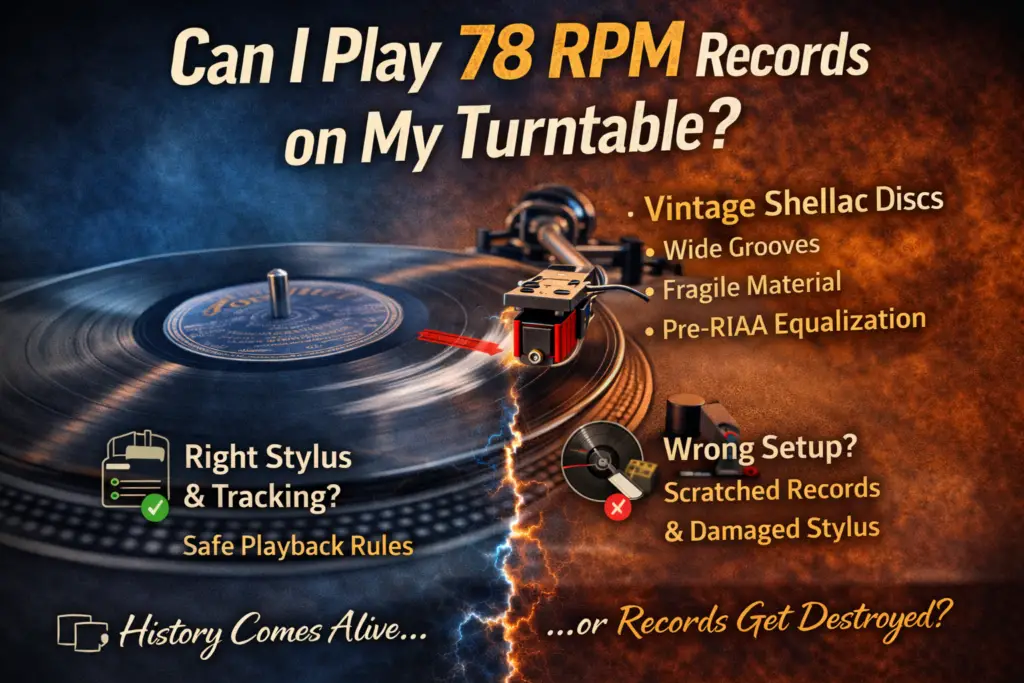
Finding a stack of old 78s can be exciting—big labels, heavy discs, and a sense of musical history you don’t get from modern vinyl. The question comes fast:
Can I play 78 RPM records on my turntable—or will I destroy something?
The answer is: sometimes yes, often no, and it depends on several critical factors.
Let’s break it down before a stylus meets shellac.
What Are 78 RPM Records, Really?
78 RPM records are not vinyl. Most are made of shellac, a much harder and more brittle material than modern LPs.
Key differences:
- Much wider grooves
- Designed for heavy tracking forces
- Intended for steel needles or specialized styli
- Extremely vulnerable to damage from the wrong setup
Treating a 78 like an LP is a fast way to ruin both record and stylus.
First Question: Does Your Turntable Support 78 RPM?
Many modern turntables only support:
- 33⅓ RPM
- 45 RPM
If your turntable does not have a 78 RPM speed setting, do not try to fake it by:
- Playing at 45 RPM
- Digitally correcting speed afterward
That won’t solve the real problem—the stylus and groove geometry are still wrong.
Some turntables offer:
- Dedicated 78 RPM speed
- Electronic speed switching
- Belt or pulley changes
If your deck doesn’t support 78 RPM, stop here.
The Stylus Is the Real Deal-Breaker
Even if your turntable spins at 78 RPM, your standard LP stylus is not safe for 78s.
- LP stylus tip: ~0.7 mil
- 78 RPM stylus tip: ~2.5–3.0 mil
Using an LP stylus on a 78 will:
- Ride too deep in the groove
- Scrape groove walls
- Cause irreversible damage in one play
You must use a dedicated 78 RPM stylus.
Many cartridge manufacturers offer:
- Swap-in 78 styli
- Separate cartridges just for 78 playback
What About the Cartridge and Tonearm?
Most modern tonearms can handle 78s if they allow:
- Higher tracking force (often 3–6 g)
- Cartridge compatibility with 78 styli
However:
- Ultra-light tonearms may struggle
- Fixed or non-adjustable arms are risky
- Ceramic cartridges (on old players) are not interchangeable with modern MM carts
Always check manufacturer specs.
Do I Need a Special Phono Preamp or EQ?
Yes—if you want accurate sound.
78 RPM records were made before standardized RIAA EQ. Different labels used different equalization curves.
What this means:
- Playing 78s through a standard RIAA phono stage will sound thin or strange
- Bass and treble balance may be incorrect
Options:
- Use a phono preamp with 78 EQ curves
- Apply EQ digitally after recording
- Accept approximate sound via RIAA for casual listening
For serious collectors, EQ matters.
What About Record Condition?
78s are:
- Often 70–100 years old
- Prone to cracks and edge chips
- Easily damaged by rough handling
Never:
- Clean with alcohol (damages shellac)
- Use excessive pressure
- Play cracked discs
Handle like antiques—because they are.
Quick Checklist: Can You Play 78s Safely?
You need:
- ✔ Turntable with true 78 RPM speed
- ✔ Dedicated 78 RPM stylus
- ✔ Cartridge that supports higher tracking force
- ✔ Appropriate EQ (or willingness to compromise)
- ✔ Careful handling and cleaning
Miss any of these, and it’s better to admire the records visually.
Final Thoughts
78 RPM records open a window into recorded history—but they demand respect. While many modern turntables can play them, doing so safely requires the right tools and setup.
If you’re serious about 78s:
- Consider a second cartridge or turntable
- Invest in the correct stylus
- Accept that these records play by different rules
Treat them right, and they’ll reward you with performances you simply can’t find anywhere else.
Different era. Different groove. Different rules.