
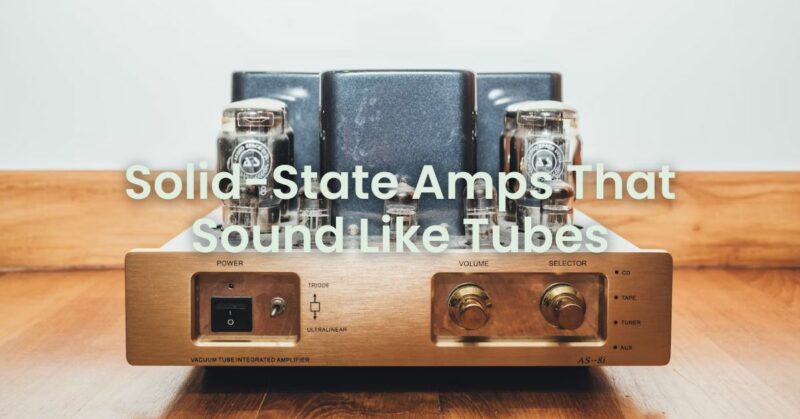
Tube amplifiers are renowned for their warm, rich, and harmonically textured sound. However, they often come with certain drawbacks such as higher costs, tube replacements, and maintenance requirements. For those seeking an alternative, solid-state amplifiers offer a reliable and cost-effective solution. While solid-state amps are traditionally known for their accuracy and transparency, advancements in technology have allowed for the development of solid-state amps that aim to emulate the desirable characteristics of tube amps. In this article, we will explore solid-state amplifiers that strive to replicate the warmth and musicality associated with tube amplifiers, providing an overview of their features and sound qualities.
- Emulation Circuitry and Modeling: Certain solid-state amplifiers employ advanced circuitry and modeling techniques to replicate the sound characteristics of tube amps. These amps use digital signal processing (DSP) algorithms and proprietary technologies to emulate the harmonic distortion, compression, and tonal response associated with tube amplifiers. They often offer multiple amp models, allowing users to switch between different tube amp emulations to achieve their desired sound.
- Tube-Like Preamp Stages: Some solid-state amplifiers incorporate tube-like preamp stages that utilize analog circuitry to introduce subtle harmonic distortion and warmth to the audio signal. These preamp stages may include vacuum tube emulations or utilize specialized op-amps designed to emulate the characteristics of specific tube models. By incorporating these elements, solid-state amps can impart a tube-like sound signature to the audio.
- Output Transformer Simulation: Tube amplifiers are known for their output transformers, which play a significant role in shaping their sound. To mimic this aspect, certain solid-state amplifiers feature output transformer simulation, where the amplifier circuitry replicates the impedance characteristics and saturation behavior of output transformers. This simulation helps to recreate the tube amp’s interaction with speakers, resulting in a more tube-like sound reproduction.
- Tone Shaping Controls: Solid-state amps that aim to emulate tube amps often include tone shaping controls that allow users to fine-tune the sound to their preferences. These controls may include interactive EQs, presence knobs, and tone stacks that provide versatility in sculpting the frequency response and tonal characteristics, mimicking the tonal flexibility associated with tube amplifiers.
- Dynamic Response and Touch Sensitivity: Tube amps are known for their dynamic response and touch sensitivity, which react to subtle changes in playing technique and provide a more expressive playing experience. Some solid-state amps incorporate features to enhance these qualities, such as dynamic amplification circuits and reactive load networks. These technologies aim to replicate the responsiveness and feel of playing through a tube amp, offering a more interactive and expressive performance.
Conclusion: While tube amplifiers have long been favored for their warm and harmonically rich sound, solid-state amplifiers have made significant strides in emulating these desirable characteristics. The development of advanced circuitry, modeling techniques, and tone shaping controls has allowed certain solid-state amps to replicate the warmth and musicality associated with tube amps. These amps offer the advantages of reliability, cost-effectiveness, and maintenance-free operation while delivering a tube-like sound experience. When considering a solid-state amp that emulates tube sound, it’s essential to audition different models, explore their specific features, and evaluate their ability to replicate the sonic qualities you seek. Ultimately, solid-state amps that aim to sound like tubes provide an attractive alternative for those who desire the warmth and musicality associated with tube amplifiers without the associated costs and maintenance.