
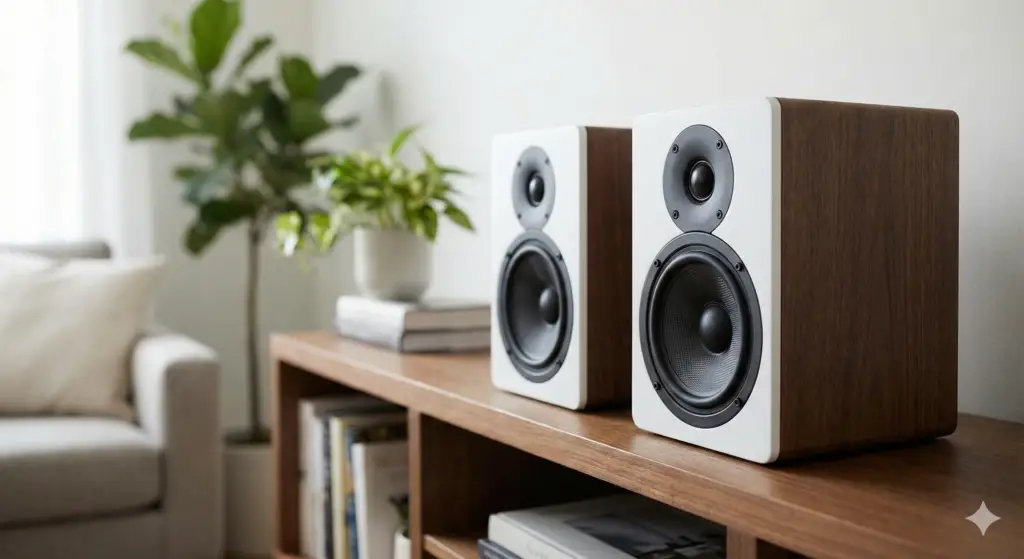
Bookshelf speakers may be compact, but when positioned correctly, they can deliver sound that rivals much larger systems. Whether you’re upgrading your home audio setup or building a new listening space, proper setup is the key to unlocking their full potential.
This guide breaks down everything—from placement and height to toe-in and room acoustics—so your speakers sound as impressive as they look.
1. Place Your Speakers at Ear Height
Bookshelf speakers are designed to perform best when their tweeters are level with your ears during normal listening.
This ensures the most accurate imaging and clarity.
How to achieve ideal height:
- Use speaker stands (recommended)
- Adjust shelf height
- Avoid placing them too low or too high
Ideal tweeter height: ~36–40 inches (90–100 cm)
2. Keep Distance Between Speakers Consistent
A common rule is the equilateral triangle setup:
- The distance between the two speakers
- The distance from each speaker to your listening position
All should be roughly the same.
Suggested starting point:
- 4–6 feet (1.2–1.8 m) apart for small rooms
- 6–8 feet (1.8–2.4 m) apart for medium rooms
Too close = narrow soundstage
Too far = weak center image
3. Pull Speakers Away From the Wall
Bookshelf speakers need breathing room, especially rear-ported designs.
General guidelines:
- Rear-ported speakers: 8–24 inches (20–60 cm) from the wall
- Front-ported or sealed speakers: 4–12 inches (10–30 cm) is acceptable
Giving them space reduces:
- Boominess
- Muddy bass
- Reflections
4. Toe-In for Better Imaging
Toe-in refers to angling speakers slightly toward your listening position.
Benefits:
- Sharper stereo image
- Better center focus
- More precise soundstage
Start with:
- 5–15° of toe-in
Adjust based on preference—more toe-in = more focused sound, less toe-in = wider sound.
5. Use Proper Stands (If Possible)
Putting bookshelf speakers on a bookshelf limits performance.
Stands improve:
- Imaging
- Isolation
- Bass control
- Overall clarity
Look for:
- Mass-loaded stands
- Adjustable height
- Rubber or foam isolation pads
6. Avoid Placing Speakers Inside Cabinets
Enclosed shelves cause:
- Reflections
- Harsh highs
- Bloated bass
- Poor imaging
If you must use a cabinet:
- Add acoustic foam
- Leave space behind and around the speakers
- Pull the speakers to the front edge of the shelf
7. Use Quality Speaker Cables and Proper Connections
You don’t need expensive audiophile cables—but avoid the cheapest thin wires.
Recommended:
- 14–16 AWG copper cable
- Secure polarity (red to red, black to black)
- Avoid running cables next to AC power cords
Correct polarity = correct phase = proper imaging.
8. Optimize Your Room Acoustics
Even the best speakers suffer in untreated rooms.
Simple improvements:
- Add a rug if you have hard floors
- Use curtains to soften reflections
- Add bookshelves, couches, or wall panels for diffusion
- Avoid empty, echo-prone rooms
Small tweaks can dramatically improve clarity.
9. Consider Using a Subwoofer (Optional)
Bookshelf speakers often struggle with deep bass below 50–60 Hz.
A subwoofer can:
- Add weight
- Improve movie and music depth
- Reduce strain on the bookshelves
Set crossover around 70–100 Hz, depending on your speakers.
10. Fine-Tune With Your Ears
No two rooms are the same. After following guidelines:
- Experiment with spacing
- Adjust toe-in
- Move listening position
- Tweak distance from walls
The last 10% of magic comes from listening and adjusting.
Final Thoughts
Setting up bookshelf speakers properly can transform your entire audio experience. With the right height, spacing, angles, and room placement, even budget speakers can sound rich, detailed, and immersive.
Take your time, experiment, and enjoy the upgrade—great sound is all about the details.