
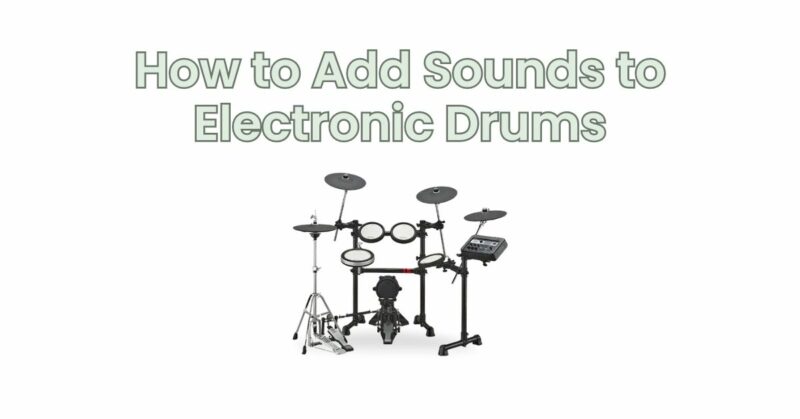
Electronic drums offer drummers an incredible range of possibilities when it comes to sound customization. One of the key advantages of electronic drum kits is the ability to expand your sonic palette by adding new sounds. Whether you want to incorporate unique samples, create hybrid drum sounds, or experiment with unconventional percussion, this article will guide you through the process of adding sounds to your electronic drums.
- Utilize Sound Modules and Sample Packs: One of the simplest ways to add sounds to your electronic drums is by using sound modules or sample packs. Many electronic drum kits come with built-in sound modules that offer a wide range of drum and percussion sounds. Explore the available libraries and experiment with different samples to find the ones that suit your musical style.
- Import Custom Samples: To truly personalize your electronic drum kit, consider importing your own custom samples. These samples can be recordings of real drums, percussion instruments, or any other sound you desire. Most electronic drum modules have the capability to import samples via USB or other connectivity options. Take advantage of this feature to create a unique and customized drum sound.
- Edit and Process Samples: Once you have imported or selected your desired samples, you can further enhance them through editing and processing. Use audio editing software to trim, loop, or adjust the volume and pitch of your samples. Additionally, apply effects such as reverb, compression, and EQ to shape the sound and integrate it seamlessly with your existing drum sounds.
- Layer Sounds for Depth and Texture: To add depth and complexity to your drum sound, experiment with layering different sounds. Combine multiple samples or drum modules to create hybrid drum sounds. For example, layering a traditional acoustic snare sound with an electronic snare sample can result in a unique and dynamic sound that stands out in your drumming.
- Incorporate Trigger Pads and MIDI Controllers: Expand your sonic possibilities by incorporating trigger pads or MIDI controllers into your electronic drum setup. These devices allow you to trigger samples, loops, or even synthesized sounds alongside your drum hits. You can assign specific sounds to different pads or use MIDI controllers to manipulate parameters in real-time, adding a new dimension to your drumming performance.
- Explore Drum Synthesis: Delve into the realm of drum synthesis to create entirely new sounds from scratch. Drum synthesis involves using sound synthesis techniques to generate drum sounds electronically. With the help of drum synthesis software or hardware, you can design and sculpt unique drum sounds that can’t be achieved with traditional sample-based methods.
- Experiment with Effects and Processing: Don’t be afraid to experiment with effects and processing to shape and transform your drum sounds. Apply modulation effects like chorus, flanger, or phaser to add movement and character. Explore time-based effects such as delay and echo to create atmospheric and ambient textures. The possibilities are endless, so let your creativity guide you in creating captivating and expressive drum sounds.
- Integrate External Instruments and Devices: To expand your sonic palette even further, consider integrating external instruments and devices into your electronic drum setup. Connect synthesizers, samplers, or other sound-generating devices to your electronic drum module or audio interface. This allows you to trigger and blend different sounds seamlessly, opening up a world of sonic exploration and fusion.
- Arrange and Save Custom Kits: Once you have added and customized your drum sounds, arrange them into custom kits within your electronic drum module. Organize your sounds in a way that suits your playing style or different musical projects. Save your custom kits for quick access during performances or recording sessions, ensuring that you can easily switch between different sounds and setups.
- Embrace Creativity and Experimentation: The most important aspect of adding sounds to electronic drums is to embrace creativity and experimentation. Don’t be afraid to push boundaries and think outside the box. Explore unconventional percussion samples, experiment with genre-bending combinations, and let your imagination guide you in creating unique and captivating drum sounds.
By incorporating new sounds into your electronic drum kit, you can expand your musical horizons and create a truly personalized and expressive drumming experience. Whether it’s through sample customization, synthesis, layering, or integrating external devices, the process of adding sounds to electronic drums opens up a world of creative possibilities. Embrace the freedom and versatility offered by electronic drums, and let your sonic imagination run wild.