
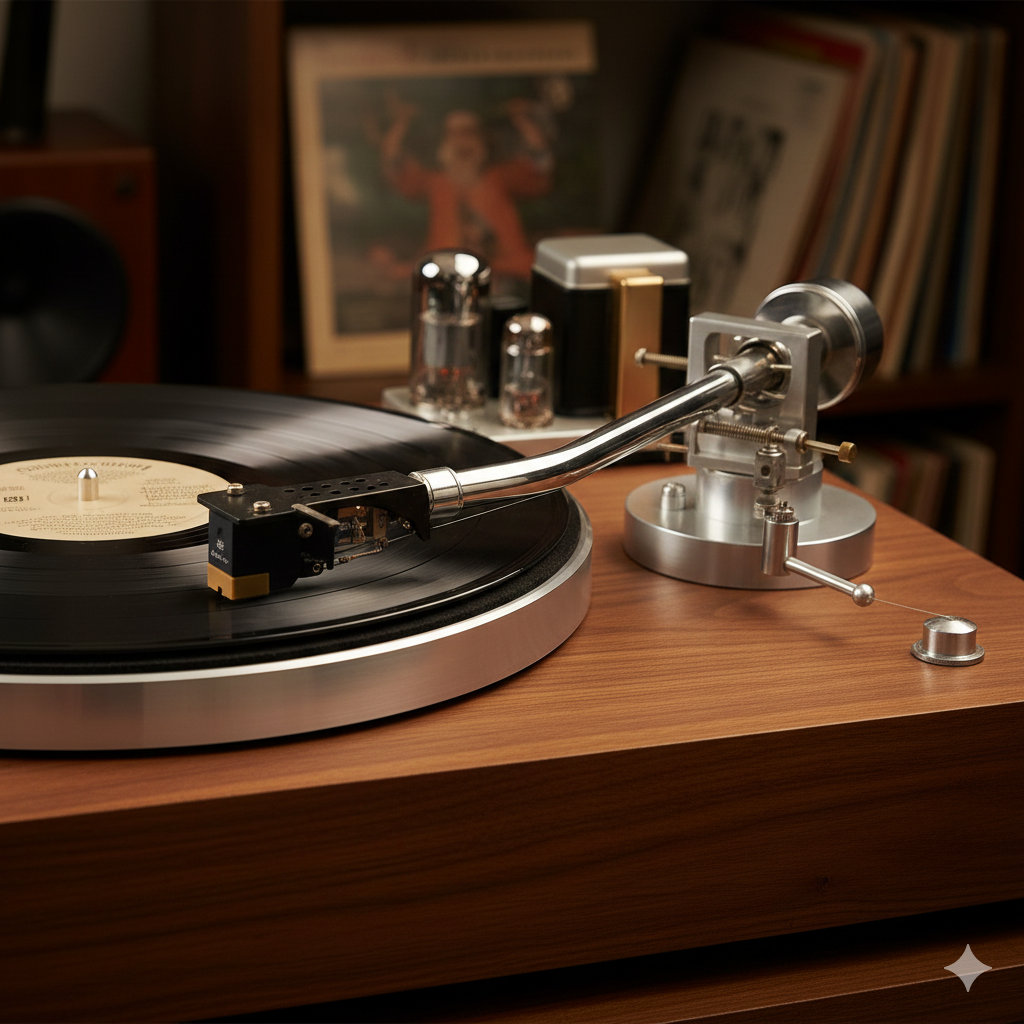
When choosing a turntable, the tonearm design is just as important as the cartridge mounted at its end. Among the most common—and most debated—tonearm designs are gimbal and unipivot tonearms. Each represents a very different engineering philosophy, and each has distinct advantages, compromises, and sonic characteristics.
Understanding how these designs work can help you choose the tonearm that best fits your listening preferences and setup skills.
What Is a Gimbal Tonearm?
A gimbal tonearm uses two sets of bearings, arranged at right angles, to control horizontal and vertical movement independently. This creates a stable, precisely defined pivot point.
Gimbal-bearing tonearms are widely used on both consumer and professional turntables, from entry-level models to high-end audiophile decks.
Pros of Gimbal Tonearms
- Excellent stability and control
- Predictable, repeatable tracking behavior
- Easier to set up and align
- Less sensitive to minor setup errors
Because the arm’s movement is tightly controlled, gimbal designs are often favored for consistency and reliability.
Cons of Gimbal Tonearms
- More mechanical parts and bearings
- Potential for bearing friction if poorly made
- Slightly higher resonance from complex structures
High-quality gimbal arms minimize these issues through precision machining and tight tolerances.
What Is a Unipivot Tonearm?
A unipivot tonearm balances on a single, sharp pivot point, allowing it to move freely in all directions. The arm effectively “floats” on this point, relying on gravity and balance for stability.
Unipivot designs are most commonly found on high-end audiophile turntables.
Pros of Unipivot Tonearms
- Extremely low bearing friction
- Simple mechanical design
- Excellent micro-detail and transparency
- Natural, fluid tracking motion
With fewer contact points, unipivot arms can feel very “free,” which many listeners associate with increased musical openness.
Cons of Unipivot Tonearms
- Less stable than gimbal designs
- More sensitive to setup and balance
- Can wobble during cueing or warped records
- Requires careful handling
Unipivot arms reward patience but can frustrate beginners.
Sound Differences: What Listeners Often Hear
While sound is subjective and system-dependent, common listening impressions include:
Gimbal Tonearm Sound
- Precise imaging
- Solid bass control
- Stable soundstage
- Excellent tracking consistency
Gimbal arms often sound controlled and authoritative, especially in complex or dynamic passages.
Unipivot Tonearm Sound
- Open, airy presentation
- Enhanced low-level detail
- Smooth midrange textures
- More organic flow
Unipivot arms are often described as more “musical” or “natural,” though this can vary widely by design.
Tracking, Warps, and Real-World Use
Gimbal arms generally handle warped records and heavy cueing better due to their inherent stability. This makes them more forgiving in everyday use.
Unipivot arms can track well but may react more visibly to warps or external disturbances. Some designs use stabilizing weights or secondary bearings to improve control.
Which Is Better for Cartridge Matching?
- High-compliance cartridges often pair well with gimbal arms due to stability.
- Low-compliance moving-coil cartridges are frequently matched with unipivot arms, especially high-mass designs.
That said, execution matters more than theory. A well-designed gimbal or unipivot arm can work beautifully with many cartridges.
Which Tonearm Is Right for You?
Choose a gimbal tonearm if you:
- Want ease of setup and daily reliability
- Use a wide range of cartridges
- Prefer a precise, controlled sound
Choose a unipivot tonearm if you:
- Enjoy fine-tuning and careful setup
- Prioritize detail and openness
- Listen in a stable, vibration-controlled environment
Final Thoughts
The debate between gimbal and unipivot tonearms isn’t about which is objectively better—it’s about design philosophy and listener priorities. Gimbal arms offer precision, stability, and user-friendliness, while unipivot arms deliver simplicity, low friction, and a uniquely expressive sound.
Whichever design you choose, proper setup and cartridge matching will matter far more than the pivot style alone. When executed well, both gimbal and unipivot tonearms can deliver exceptional vinyl playback.