
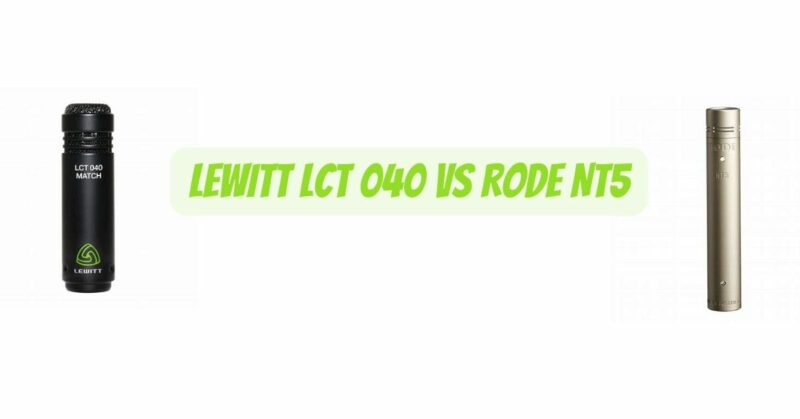
Small-diaphragm condenser microphones are widely used in recording studios and live performances for capturing detailed and accurate audio. In this article, we will compare two popular options in this category: the Lewitt LCT 040 and the Rode NT5. We will evaluate their design, sound quality, versatility, and overall performance to help you choose the right microphone for your recording needs.
Design and Build Quality: Both the Lewitt LCT 040 and Rode NT5 exhibit a sleek and professional design, built to withstand the demands of studio recording and live performances.
The Lewitt LCT 040 features a compact and lightweight design, making it easy to position and transport. It is constructed with high-quality materials, including a metal housing that ensures durability and provides protection for the sensitive internal components. The microphone also comes with a robust carrying case for safe storage and transportation.
The Rode NT5 also has a compact and lightweight design, making it suitable for various recording applications. It has a durable all-metal construction that enhances its longevity and can withstand rigorous use in both studio and live settings. The microphone comes with a zippered pouch for storage and a windshield for outdoor recordings.
Sound Quality: Sound quality is of utmost importance in small-diaphragm condenser microphones, and both the Lewitt LCT 040 and Rode NT5 excel in this aspect.
The Lewitt LCT 040 features a 17mm small-diaphragm capsule that captures sound with exceptional detail and accuracy. It delivers a natural and transparent sound reproduction, making it suitable for various instruments, vocals, and acoustic recordings. The microphone exhibits a balanced frequency response and low self-noise, ensuring pristine audio quality.
The Rode NT5 utilizes a 0.5-inch capsule with a gold-sputtered diaphragm that provides excellent transient response and high-frequency detail. It delivers a smooth and transparent sound reproduction, capturing the nuances of instruments and vocals with clarity and accuracy. The microphone offers a selectable high-pass filter and pad options, allowing for greater versatility in different recording scenarios.
Versatility and Applications: Both the Lewitt LCT 040 and Rode NT5 offer versatility in terms of applications and recording scenarios.
The Lewitt LCT 040 is well-suited for capturing acoustic instruments, such as pianos, guitars, strings, and percussion. Its small-diaphragm design allows for precise sound reproduction and the ability to handle high sound pressure levels. Additionally, the microphone’s compact size makes it ideal for stereo and overhead recording techniques.
The Rode NT5 is also versatile and can be used for various recording applications. It excels in capturing acoustic instruments, drum overheads, cymbals, and other percussion instruments. The microphone’s interchangeable cardioid and omnidirectional capsules expand its versatility, allowing for different recording techniques and stereo configurations.
Accessories and Extras: When considering the Lewitt LCT 040 and Rode NT5, it’s worth noting the additional accessories and extras that come with each microphone.
The Lewitt LCT 040 includes a windscreen and a microphone clip, providing essential accessories for immediate use. It is compatible with Lewitt’s range of microphone mounts and stereo bar accessories, allowing for further customization and flexibility in various recording setups.
The Rode NT5 comes as a matched pair, which is especially useful for stereo recording applications. It includes a stereo mounting bar for easy and precise positioning of the microphones. The microphone also comes with a foam windscreen for outdoor recordings and a durable aluminum storage case for safekeeping and transportation.
Conclusion: When comparing the Lewitt LCT 040 and Rode NT5, both microphones offer excellent sound quality, durability, and versatility in recording applications. The Lewitt LCT 040 stands out with its transparent and accurate sound reproduction, while the Rode NT5 offers a smooth and detailed sound character with additional selectable options.
Ultimately, the choice between the Lewitt LCT 040 and Rode NT5 depends on your specific recording needs, preferences, and budget. Consider factors such as sound quality, versatility, design, and included accessories to make an informed decision. Regardless of your choice, both microphones are reliable options that can elevate your recordings to a professional level.