
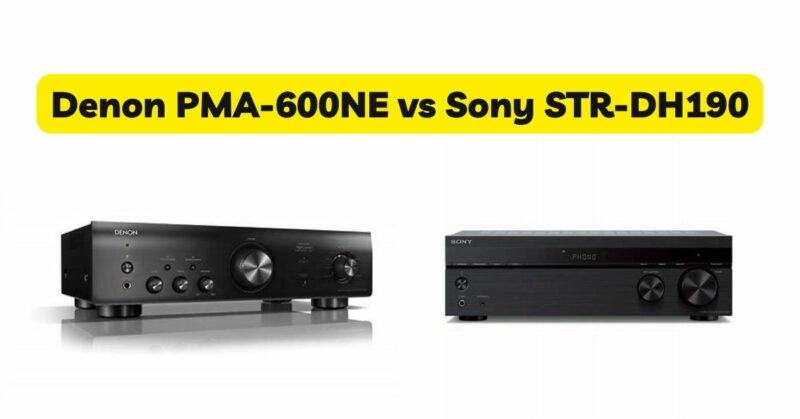
Selecting the right stereo amplifier is crucial for achieving an immersive audio experience in your home. In this detailed article, we will conduct an in-depth comparison between two popular options, the Denon PMA-600NE and the Sony STR-DH190. Both amplifiers offer impressive features and performance within their respective price ranges. By exploring their design, sound quality, connectivity options, and overall value, we aim to assist you in making an informed decision that aligns with your audio preferences and requirements.
Design and Build Quality
The Denon PMA-600NE exhibits a sleek and modern design, complemented by a compact footprint that allows for easy integration into any audio setup. Its front panel features a clean layout, with a centrally positioned volume knob and conveniently placed source selection buttons. The amplifier’s build quality is robust, thanks to its solid metal chassis that minimizes vibrations and ensures long-term durability. On the other hand, the Sony STR-DH190 adopts a more classic design, with a black front panel and intuitive controls. While its appearance may be more understated, it offers a reliable build quality suitable for everyday use.
Sound Quality
Both amplifiers deliver excellent sound quality, albeit with some differences in their sonic characteristics. The Denon PMA-600NE provides a clear and detailed sound reproduction, with a neutral tonal balance. It excels at accurate instrument separation, precise imaging, and a wide soundstage. The amplifier’s high-current amplification ensures dynamic and impactful audio playback across various genres. In contrast, the Sony STR-DH190 offers a warm and musical sound signature that emphasizes smoothness and depth. It aims to provide an enjoyable listening experience, particularly for casual listeners who appreciate a more laid-back sonic presentation.
Power Output and Connectivity
The Denon PMA-600NE offers 45 watts per channel, delivering ample power for small to medium-sized rooms. It features a range of connectivity options, including four analog inputs for connecting various audio sources, a built-in phono stage for turntable enthusiasts, and a digital optical input for compatible devices. This versatility allows for easy integration into diverse audio setups. The Sony STR-DH190 boasts a higher power output of 90 watts per channel, making it well-suited for larger rooms or speakers with higher power demands. It also provides four analog inputs and a dedicated phono input, catering to vinyl enthusiasts.
Additional Features
The Denon PMA-600NE offers some additional features that enhance its functionality and flexibility. It incorporates a built-in DAC (Digital-to-Analog Converter) with high-resolution audio support, enabling you to enjoy your music in its purest form. Additionally, the amplifier includes a dedicated headphone output, allowing for private listening without disturbing others. On the other hand, the Sony STR-DH190 prioritizes simplicity and affordability, omitting some of the advanced features found in the PMA-600NE.
Price and Value
The Denon PMA-600NE generally comes with a slightly higher price tag compared to the Sony STR-DH190. This price difference is reflective of the PMA-600NE’s superior build quality, advanced features, and overall performance. However, the Sony STR-DH190 offers a compelling value proposition for budget-conscious buyers, delivering respectable sound quality and essential connectivity options at a more affordable price point.
Conclusion
Choosing between the Denon PMA-600NE and the Sony STR-DH190 depends on your specific needs, budget, and sonic preferences. The PMA-600NE excels in build quality, detailed sound reproduction, and advanced features such as the built-in DAC and dedicated headphone output. It is particularly suitable for audiophiles seeking high-fidelity audio reproduction and versatility. On the other hand, the STR-DH190 offers a warm and musical sound signature, higher power output, and a more budget-friendly price, making it an attractive option for casual listeners or those with limited financial resources. Consider your priorities, intended usage, and budget constraints to select the amplifier that best aligns with your requirements and elevates your overall audio experience.