
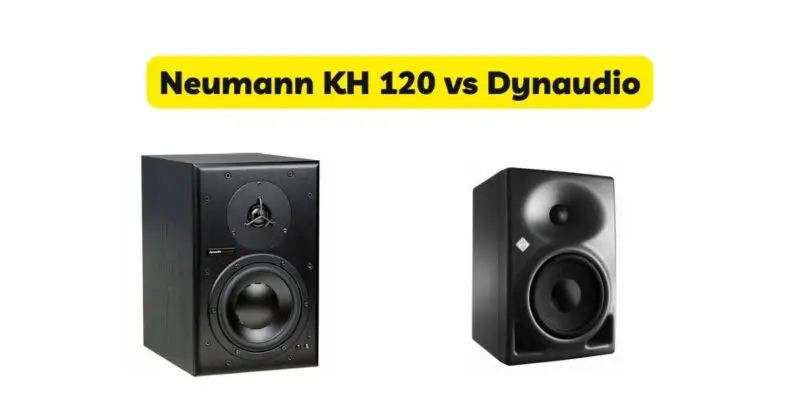
Studio monitors are an essential component in any professional audio production setup, ensuring accurate and detailed sound reproduction. In this comprehensive comparison, we will explore the differences and similarities between two renowned studio monitor models: the Neumann KH 120 and the Dynaudio series. Both monitors offer exceptional sound quality and are highly regarded by audio professionals worldwide. By examining their design, sound performance, connectivity, and additional features, we can determine which monitor best suits your needs.
Design and Build Quality
The design and build quality of studio monitors play a crucial role in their overall performance and longevity.The Neumann KH 120 features a compact and elegant design, incorporating Neumann’s decades of expertise in professional audio. Its robust enclosure is made from durable composite material, minimizing unwanted resonances and vibrations. The monitor’s front panel includes a robust metal grille that protects the drivers while allowing for optimal sound dispersion. Neumann’s attention to detail is evident in the KH 120’s precision-machined waveguide, which ensures controlled directivity and accurate sound reproduction.Similarly, Dynaudio studio monitors are renowned for their exceptional build quality. The monitors are constructed with high-quality materials, including MDF cabinets with internal bracing, ensuring excellent structural integrity and minimal resonance. Dynaudio’s craftsmanship is showcased through the monitors’ meticulous assembly and attention to detail. The front panels feature sleek designs, often with integrated waveguides to optimize dispersion and reduce diffraction.
Sound Performance
The sound performance of studio monitors is of paramount importance, as it directly influences the accuracy and quality of audio reproduction.The Neumann KH 120 excels in delivering a transparent and detailed sound. With a frequency response range of 52Hz to 21kHz, the monitor captures a wide range of frequencies with exceptional clarity. Its proprietary Mathematically Modeled Dispersion (MMD) waveguide ensures precise off-axis response, resulting in a broad sweet spot and accurate stereo imaging. The KH 120 utilizes Class-AB amplifiers and features advanced electronics, including thermal and peak limiters, to ensure distortion-free sound reproduction at all volume levels.Dynaudio studio monitors, known for their natural and balanced sound signature, offer exceptional sound performance. The monitors typically have a frequency response range of 48Hz to 22kHz, providing a comprehensive representation of the audio spectrum. Dynaudio’s advanced driver technology, including their renowned MSP (Magnesium Silicate Polymer) woofers and soft-dome tweeters, contributes to the monitors’ accurate and detailed sound reproduction. Additionally, Dynaudio designs their monitors with advanced crossover networks and precise time alignment to ensure seamless integration between drivers.
Connectivity and Additional Features
Both the Neumann KH 120 and Dynaudio studio monitors offer a range of connectivity options and additional features to enhance the user experience.The Neumann KH 120 provides balanced XLR and unbalanced RCA inputs, allowing for seamless integration with a variety of audio sources and equipment. It also includes a ground lift switch to eliminate hum caused by ground loops. The monitor features an extensive range of controls, including input gain, output level, and bass and treble adjustments, allowing for precise sound tailoring to the room acoustics. The KH 120 also incorporates automatic standby mode, conserving energy when not in use.Dynaudio studio monitors typically offer balanced XLR and unbalanced RCA inputs, ensuring compatibility with various audio interfaces and devices. Some models may also feature additional input options such as AES/EBU or digital optical inputs. The monitors often include adjustable sensitivity settings to accommodate different setups and signal sources. Dynaudio also incorporates innovative technologies such as advanced DSP (Digital Signal Processing) and room calibration tools, allowing users to optimize the monitors’ performance according to their specific listening environment.
Price and Value
Price is an important consideration for many when choosing studio monitors, as it often reflects the overall quality, performance, and features offered.The Neumann KH 120 falls into the higher price range of studio monitors, reflecting its exceptional build quality, sound performance, and renowned brand reputation. While it may be a significant investment for some, the KH 120’s accuracy, transparency, and precise imaging make it a valuable tool for critical listening, mixing, and mastering applications.Dynaudio studio monitors, depending on the model and features, cover a wide price range, offering options for different budgets. While some higher-end models may have a price comparable to the Neumann KH 120, Dynaudio also provides more affordable options without compromising on sound quality and performance.
Conclusion
In conclusion, both the Neumann KH 120 and Dynaudio studio monitors exemplify excellence in sound reproduction and engineering. The Neumann KH 120 delivers exceptional transparency, accurate imaging, and precise off-axis response, making it a favored choice among audio professionals. Dynaudio studio monitors offer a natural and balanced sound signature, meticulous build quality, and innovative features that cater to different budgets and requirements.When choosing between the Neumann KH 120 and Dynaudio studio monitors, consider factors such as your specific sound preferences, studio requirements, budget constraints, and intended use. Ultimately, both brands have established themselves as industry leaders, and your decision should be based on personal preference and the specific demands of your audio production setup.