
Studio monitors are essential tools for professional audio production, providing accurate and precise sound reproduction. In this comprehensive comparison, we will examine two highly regarded studio monitors: the Yamaha HS8 and the Genelec series. By analyzing their features, sound performance, design, build quality, and other important aspects, we aim to help you make an informed decision based on your specific needs and preferences.
Design and Build Quality
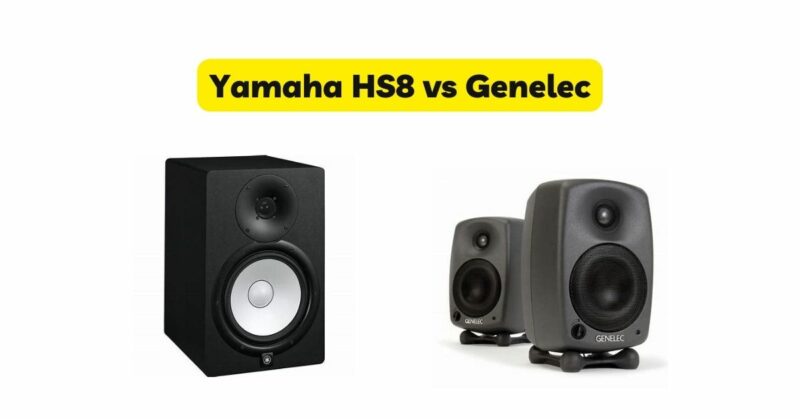
The design and build quality of studio monitors play a crucial role in their overall performance and durability.The Yamaha HS8 features a classic design with a black enclosure and a white woofer cone. It is equipped with an 8-inch cone woofer and a 1-inch dome tweeter, both designed by Yamaha for optimal performance. The monitor’s enclosure is specifically designed to reduce unwanted resonance and provide a balanced sound reproduction. The HS8’s build quality is exceptional, ensuring stability and longevity.In contrast, Genelec studio monitors are renowned for their unique and distinctive design. The enclosure is often rectangular or oval-shaped, constructed from high-quality materials to minimize vibration and resonance. Genelec monitors feature advanced driver technology, including Directivity Control Waveguide (DCW) and Minimum Diffraction Enclosure (MDE) designs, which enhance the accuracy and precision of sound reproduction. The build quality of Genelec monitors is exceptional, reflecting their commitment to excellence.
Sound Performance
The sound performance of studio monitors is a crucial aspect to consider when evaluating their suitability for different applications.The Yamaha HS8 delivers a frequency response range of 38Hz to 30kHz, offering an extended low-frequency response compared to many other monitors in its price range. The HS8’s sound signature is known for its accuracy and neutrality, making it ideal for critical listening, mixing, and mastering tasks. The monitor provides detailed imaging, precise transient response, and a wide sweet spot, ensuring consistent and accurate monitoring across various listening positions.Genelec studio monitors are renowned for their exceptional sound quality and precise imaging. The monitors often offer a wider frequency response range, typically starting at lower frequencies compared to the Yamaha HS8. Genelec’s advanced driver technology and cabinet design result in accurate and detailed sound reproduction, allowing for critical monitoring and analysis of audio material. The monitors excel in capturing the nuances and subtleties of the audio, making them a preferred choice for professional studios and audio enthusiasts.
Connectivity and Features
Both the Yamaha HS8 and Genelec studio monitors offer a range of connectivity options and additional features to enhance the user experience.The Yamaha HS8 provides balanced XLR and 1/4-inch TRS inputs, ensuring compatibility with a wide range of audio sources. It also includes room control and high-trim switches to compensate for room acoustics and speaker placement. The monitor’s rear panel features a level control knob, indicator lights, and a dedicated subwoofer output for convenient integration with a separate subwoofer.Genelec studio monitors offer a variety of connectivity options, including balanced XLR and 1/4-inch TRS inputs, as well as digital inputs in some models. Many Genelec monitors feature advanced DSP (Digital Signal Processing) technology, allowing for precise calibration and adjustment of the monitor’s response according to room acoustics. Genelec monitors also often include dedicated subwoofer outputs, allowing for seamless integration with a subwoofer for extended low-frequency response.
Price and Application Considerations
When considering the price, the Yamaha HS8 is generally more affordable compared to Genelec studio monitors. However, it’s essential to evaluate the overall value, sound quality, and specific application requirements when making a purchasing decision.The Yamaha HS8 is an excellent choice for home studios, project studios, and music enthusiasts seeking accurate and neutral sound reproduction at an affordable price point. Its extended low-frequency response, wide sweet spot, and precise imaging make it suitable for critical listening, mixing, and mastering applications.Genelec studio monitors are often found in professional recording studios, mastering facilities, and high-end audio production environments. The exceptional sound quality, advanced driver technology, and precise imaging capabilities of Genelec monitors make them well-suited for critical monitoring tasks where accuracy and detail are paramount. However, they come at a higher price point, reflecting their professional-grade quality.
Conclusion
In conclusion, both the Yamaha HS8 and Genelec studio monitors offer exceptional sound performance, design, and build quality. The Yamaha HS8 provides a balanced and neutral sound signature, making it an ideal choice for home studios and music enthusiasts on a budget. On the other hand, Genelec studio monitors, with their advanced driver technology and precise imaging capabilities, cater to professional recording studios and audio production environments where accuracy and detail are of utmost importance.Consider your budget, specific application requirements, and desired sound characteristics when making a decision between the Yamaha HS8 and Genelec monitors. Both options will provide reliable and accurate monitoring, allowing you to create and enjoy high-quality audio productions.