
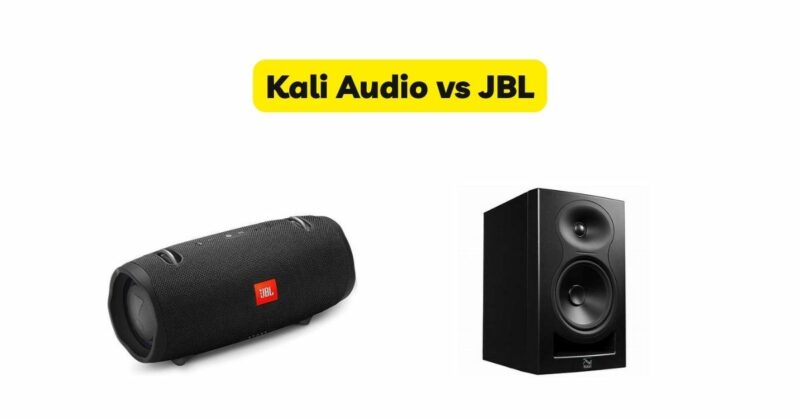
Choosing the right studio monitor is crucial for accurate audio reproduction and critical listening during the music production process. In this detailed comparison, we will explore two prominent brands in the studio monitor market: Kali Audio and JBL. By examining their product lines, design and build quality, sound performance, and overall value, we aim to help you make an informed decision when selecting the ideal studio monitor for your needs.
Product Lines
Kali Audio and JBL offer diverse product lines that cater to different budgets and studio requirements.Kali Audio focuses on providing affordable yet high-quality studio monitors. Their product line includes the LP Series and IN Series, featuring models like the LP-6, LP-8, IN-5, and IN-8. Kali Audio monitors are known for their accurate sound reproduction and balanced frequency response. They incorporate advanced waveguide technology, ensuring precise dispersion and minimized distortion. Kali Audio’s product range is well-suited for budget-conscious users, home studios, and aspiring audio professionals.JBL, a renowned name in the audio industry, offers a wide range of studio monitors catering to different needs. Their product line includes the 3 Series, 7 Series, and LSR-PRO Series, among others. JBL monitors are designed to deliver high-quality sound with a focus on accuracy and clarity. They incorporate advanced technologies such as Image Control Waveguide, high-frequency transducers, and low-frequency ported designs. JBL monitors are popular choices for both professional studios and home setups.
Design and Build Quality
The design and build quality of studio monitors play a vital role in their performance and longevity.Kali Audio’s monitors feature sleek and modern designs with sturdy enclosures constructed from high-density fiberboard (HDF). The cabinets are built to minimize resonance and vibrations, resulting in improved sound clarity. Kali Audio pays attention to detail in their designs, incorporating advanced waveguides for optimized dispersion and seamless integration between the drivers. The monitors also utilize Class D amplifiers, providing efficient power delivery and low heat generation.JBL is well-known for its expertise in speaker design and build quality. Their monitors feature robust cabinets made from high-quality materials to minimize unwanted resonances. JBL monitors are engineered to deliver durability and reliability, even in demanding studio environments. They utilize advanced driver technologies, such as high-performance transducers and bi-amplified designs, to ensure accurate sound reproduction and optimal performance.
Sound Performance
The sound performance of studio monitors is of utmost importance, as it directly impacts the accuracy and precision of audio monitoring.Kali Audio’s monitors are lauded for their neutral and balanced sound signature. The LP Series and IN Series deliver accurate frequency response, allowing for precise audio monitoring and production. Kali Audio monitors provide a well-defined stereo image and a balanced representation of different frequencies. They excel in providing clear mid-range and extended low-end response, making them suitable for various music genres and audio production tasks.JBL monitors are renowned for their impressive sound performance, offering a combination of accuracy, clarity, and depth. With their advanced driver technologies and precise tuning, JBL monitors provide excellent frequency response and detailed imaging. They deliver balanced sound across the entire frequency spectrum, allowing users to make critical mix decisions with confidence. JBL monitors are highly regarded for their ability to reproduce both subtle nuances and dynamic transients with precision.
Features and Connectivity
Both Kali Audio and JBL offer a range of features and connectivity options to enhance the functionality of their studio monitors.Kali Audio’s monitors come equipped with various rear-panel controls, including volume, low-frequency, and high-frequency adjustments. These controls allow users to tailor the sound according to their listening environment and personal preferences. Kali Audio monitors also provide balanced XLR and TRS inputs, ensuring compatibility with a wide range of audio interfaces and equipment.JBL’s monitors offer similar rear-panel controls, allowing users to fine-tune the sound to their liking. Additionally, JBL incorporates advanced features in some models, such as room correction technology and boundary control settings. These features optimize the monitor’s response to the specific acoustic characteristics of the listening environment. JBL monitors provide multiple input options, including XLR, TRS, and RCA connections, ensuring flexibility and compatibility with various audio sources.
Value and Price
The value proposition of studio monitors is an essential consideration, particularly when comparing different brands and models.Kali Audio’s monitors are highly regarded for their excellent value for money. Their affordable price points make them accessible to a wide range of users, including home studio owners and aspiring audio professionals. Kali Audio’s commitment to providing accurate sound reproduction and reliable performance at competitive prices makes their monitors an attractive choice for those on a limited budget.JBL’s monitors are positioned at different price points, reflecting the range of features and capabilities they offer. While some JBL models may be more expensive, they provide exceptional sound quality, precise imaging, and advanced features. JBL monitors are commonly found in professional studios and critical listening environments where accuracy and detail are paramount.
Conclusion
In conclusion, both Kali Audio and JBL offer compelling studio monitor options with their respective product lines. Kali Audio excels in providing affordable yet high-quality monitors, making them an excellent choice for budget-conscious users and home studio setups. JBL, on the other hand, offers a wide range of monitors with exceptional build quality, advanced technologies, and outstanding sound performance, making them ideal for professional studios and audiophiles seeking the highest level of accuracy and transparency.When making a decision between Kali Audio and JBL, consider your budget, intended use, and specific requirements. Assess the size of your studio, the nature of your audio production tasks, and the desired sound signature. Ultimately, choosing the right studio monitor involves finding the balance between affordability, performance, and personal preference. Both Kali Audio and JBL have established themselves as reputable brands in the industry, ensuring that your investment will be backed by quality and reliability.