
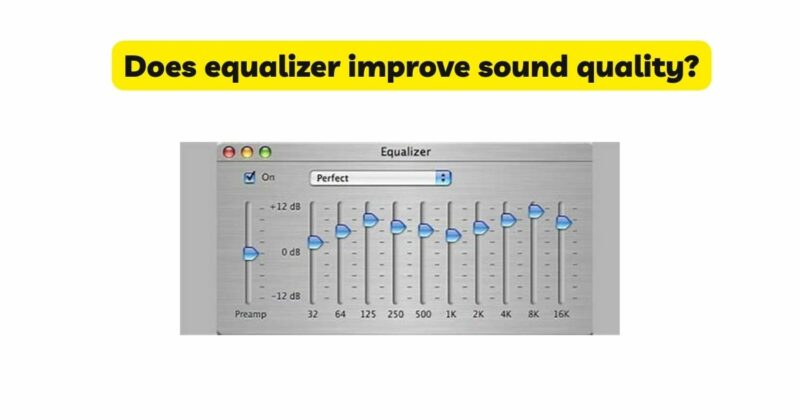
When it comes to audio playback, achieving the best sound quality is a top priority for many music enthusiasts. To enhance the listening experience, various tools and technologies are available, one of which is the equalizer. An equalizer allows users to adjust the frequency response of audio signals, enabling customization and fine-tuning of the sound. However, the question remains: Does an equalizer truly improve sound quality? In this article, we will delve into the role of an equalizer and explore its impact on sound quality, considering both its potential benefits and limitations.
- Frequency Response Tailoring
One of the primary functions of an equalizer is to shape the frequency response of audio signals. By adjusting specific frequency bands, an equalizer enables users to emphasize or attenuate certain frequencies according to personal preferences or the characteristics of the audio content being played. This ability to tailor the frequency response can help compensate for room acoustics, correct imbalances in audio playback systems, and optimize the sound for different genres or listening environments. Therefore, when used judiciously and with an understanding of the audio content, an equalizer can indeed improve sound quality by achieving a more balanced and pleasing listening experience.
- Room Acoustics Correction
The acoustic properties of a room can significantly impact sound quality. Factors such as reflections, resonances, and standing waves can introduce colorations, uneven frequency response, and other distortions that affect the overall audio experience. In such cases, an equalizer can be a valuable tool for room acoustics correction. By identifying and mitigating problematic frequencies through equalization, it is possible to achieve a more accurate and transparent sound reproduction. Properly addressing room acoustics using an equalizer can lead to improved sound quality, especially in environments where acoustic treatments are limited or impractical.
- Compensation for Audio System Limitations
Audio playback systems, including speakers and headphones, often have their own unique frequency response characteristics and limitations. These characteristics can introduce colorations, frequency imbalances, or deficiencies that affect the fidelity of the reproduced sound. An equalizer can be employed to compensate for these limitations by adjusting the frequency response to achieve a more accurate representation of the original audio. By fine-tuning the output of the audio system using an equalizer, it is possible to mitigate specific weaknesses or enhance certain aspects of the sound reproduction, thereby improving overall sound quality.
- Personal Listening Preferences
Sound perception is subjective, and individual listeners may have different preferences when it comes to audio reproduction. An equalizer provides a means for tailoring the sound to personal preferences. Some listeners may prefer a more bass-heavy response, while others may desire a brighter sound with emphasis on higher frequencies. By using an equalizer, listeners can customize the frequency response to align with their personal taste, leading to a more enjoyable and satisfying listening experience. In this context, an equalizer can significantly improve sound quality by catering to individual preferences and creating a personalized sonic signature.
- Potential Limitations
While an equalizer has the potential to improve sound quality, it is essential to acknowledge its limitations. Improper or excessive equalization can introduce distortions, phase issues, and unintended artifacts that degrade sound quality. Care must be taken to apply equalization judiciously and avoid overcompensation or excessive boosting, which can lead to unnatural or unbalanced sound reproduction. Additionally, the quality of the equalizer itself, including its precision, transparency, and processing capabilities, can impact the overall sound quality. Using a high-quality equalizer, either as a standalone hardware unit or integrated within audio playback software, can help ensure accurate adjustments and minimize potential negative effects.
- Source Material Considerations
Another crucial aspect to consider when evaluating the impact of an equalizer on sound quality is the quality of the source material. An equalizer can only manipulate the frequency response of the audio signal it receives. If the source material itself has inherent limitations or deficiencies, equalization may not fully compensate for these issues. It is important to start with high-quality recordings and audio sources to maximize the benefits of equalization. Additionally, certain genres of music or audio recordings are mastered to achieve specific tonal balances or artistic intentions. Altering the frequency response through equalization may deviate from the original artistic vision or intended sound presentation.
Conclusion
In conclusion, the role of an equalizer in improving sound quality is both significant and nuanced. When used appropriately, an equalizer allows users to tailor the frequency response, correct room acoustics, compensate for audio system limitations, and cater to personal listening preferences. By achieving a more balanced and accurate sound reproduction, an equalizer can enhance the overall listening experience. However, it is essential to exercise caution and use equalization judiciously to avoid introducing distortions or unintended artifacts. Additionally, the quality of the source material and the precision of the equalizer itself should be considered. With a thoughtful approach, an equalizer can be a valuable tool for optimizing sound quality and achieving a more personalized and satisfying audio playback experience.