
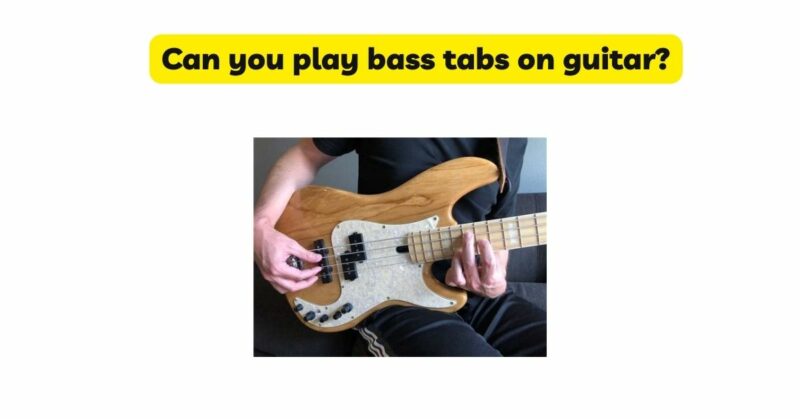
The guitar and the bass guitar are both beloved instruments in the world of music, each offering unique qualities and contributing to the overall sound of a band or ensemble. As a guitarist, you may find yourself intrigued by the bass guitar’s role and the captivating bass lines it produces. You may wonder: Can you play bass tabs on a guitar? This article aims to explore the possibilities, challenges, and adaptations required to play bass tabs on a guitar. By delving into the techniques and considerations involved, we will shed light on whether the guitar can effectively simulate the bass guitar’s role and deliver convincing bass lines. So, let us embark on this musical journey and uncover the secrets of bringing the bass to life on a six-stringed instrument.
I. Understanding Bass Tabs and Their Purpose
Before we explore playing bass tabs on a guitar, it is crucial to understand what bass tabs are and their purpose. Bass tabs are a form of musical notation specifically designed for the bass guitar. They consist of horizontal lines representing the strings and numbers indicating the frets to be played. Bass tabs provide a simplified way of notating bass lines, allowing bassists to learn and reproduce specific musical passages accurately.
The primary purpose of bass tabs is to provide a rhythmic and harmonic foundation to a song. Bassists use them to create grooves, establish the chord progression, and support the overall musical structure. Bass lines are integral to a band’s sound, contributing depth and defining the low end of the music.
II. Techniques for Playing Bass Tabs on Guitar
While the guitar and the bass guitar have distinct characteristics, there are techniques that can be employed to simulate bass lines on a guitar effectively.
- String Selection: The guitar has six strings, while the bass guitar typically has four. To play bass tabs on a guitar, the lower-pitched strings (typically E, A, and D) are used to replicate the bass guitar’s range. By focusing on these strings, guitarists can create a similar tonal foundation.
- Palm Muting: Palm muting is a technique commonly used by bassists to create a percussive and controlled sound. Guitarists can adapt this technique by lightly resting the edge of their picking hand on the strings near the bridge, producing a muted and rhythmic tone that emulates the bass guitar’s attack.
- Fingerstyle Technique: Many bassists use their fingers to pluck the strings instead of a pick, allowing for greater control and articulation. Guitarists can adopt a similar approach by using their fingers to pluck the lower strings, creating a more distinct and prominent bass sound.
- Incorporating Slides and Hammer-Ons: Slides and hammer-ons are techniques frequently employed by bassists to add dynamics and fluidity to their playing. These techniques can be adapted to the guitar, allowing guitarists to emulate the slides and hammer-ons used in bass lines, creating a smoother and more expressive bass-like sound.
III. Challenges and Considerations
While it is possible to play bass tabs on a guitar, several challenges and considerations should be kept in mind.
- Sound Reproduction: The bass guitar’s distinct sound and deep resonance are difficult to fully replicate on a standard guitar. The guitar’s tonal range is wider, emphasizing higher frequencies, which may not capture the fullness and depth of the bass guitar’s low-end frequencies.
- Range Limitations: The bass guitar’s extended range allows bassists to explore lower notes, contributing to the instrument’s unique role. The guitar’s limited range may present challenges when attempting to faithfully reproduce bass lines that venture into the lower octaves.
- Technique Adaptation: While the guitar and the bass guitar share similar techniques, transitioning from guitar playing to bass-like playing requires some adaptation. The wider string spacing and increased string tension on a bass guitar demand different fingerings and playing styles.
- Band Dynamics: In a band setting, the bass guitar interacts with the drums, providing the rhythmic foundation and supporting the overall groove. Using a guitar in place of a bass guitar may impact the band’s dynamics, as the guitar’s different tonal characteristics may not blend seamlessly with the other instruments.
IV. Adaptations and Creative Approaches
To overcome the challenges and limitations of playing bass tabs on a guitar, several adaptations and creative approaches can be explored.
- Octave Transposition: When encountering bass lines that extend beyond the guitar’s range, one approach is to transpose the notes up or down an octave. This allows for the inclusion of the full bass line while adapting it to fit within the guitar’s range.
- Chordal Playing: While bass lines are typically played as single notes, incorporating chordal playing on the guitar can add richness and depth to the sound. Emphasizing the lower notes of a chord progression or playing bass notes within the context of chords can create a bass-like effect.
- Utilizing Effects: Effects pedals and processors can be employed to shape the guitar’s tone and replicate some of the bass guitar’s characteristics. Octave pedals, bass simulation effects, and equalization adjustments can help enhance the low-end frequencies and create a more convincing bass sound.
- Collaboration and Layering: Another approach is to collaborate with a bassist or utilize recording techniques to layer multiple guitar tracks. This allows for the separation of bass and guitar parts, enabling each instrument to fulfill its respective role and contribute to a more authentic and dynamic sound.
Conclusion
While playing bass tabs on a guitar presents challenges and limitations, with proper technique adaptation and creative approaches, it is possible to simulate the bass guitar’s role to some extent. The guitar’s string selection, techniques such as palm muting and fingerstyle playing, and incorporating slides and hammer-ons can contribute to a more convincing bass-like sound. However, it is essential to acknowledge that the guitar’s range, sound reproduction, and instrument dynamics differ from the bass guitar, making a complete replication challenging. Exploring adaptations, utilizing effects, and collaborating with bassists can help bridge the gap and create a more satisfying musical experience. Ultimately, while playing bass tabs on a guitar may not fully replicate the authentic bass guitar experience, it can offer unique creative possibilities and enhance your musical expression as a guitarist.