
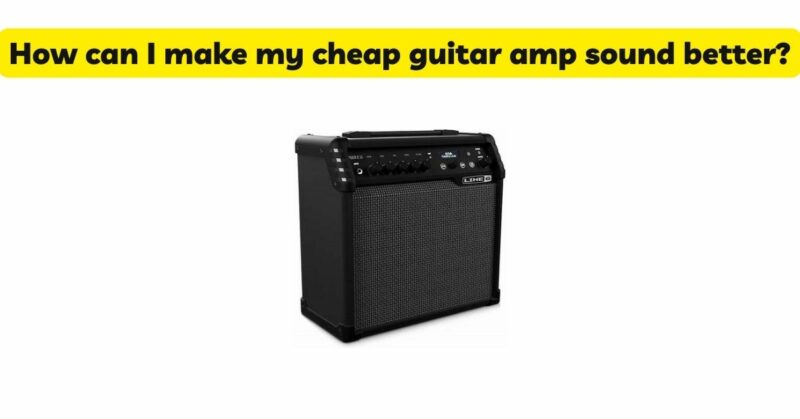
Owning a budget-friendly guitar amp doesn’t mean you have to settle for subpar sound quality. While expensive amplifiers may offer advanced features and premium components, there are numerous techniques and strategies you can employ to make your cheap guitar amp sound better. In this article, we will explore various methods that can help you maximize the potential of your budget amp. By focusing on optimizing settings, utilizing external pedals and effects, experimenting with positioning and acoustics, and considering speaker upgrades, you can transform your inexpensive amp into a powerful tool for creating inspiring tones and enhancing your overall playing experience.
I. Optimize Your Amp’s Settings
Understanding and optimizing the settings on your cheap guitar amp is a fundamental step towards improving its sound quality. By familiarizing yourself with the amp’s controls and making strategic adjustments, you can unlock hidden potential and tailor the tone to your preferences.
- EQ Settings: Experiment with the bass, mid, and treble controls to find the optimal balance for your desired tone. Adjusting these settings can help shape the frequencies and achieve a more pleasing sound.
- Gain and Volume: Finding the sweet spot between the gain and volume controls can significantly impact your amp’s sound. Adjust the gain for desired distortion or overdrive levels, and adjust the volume to achieve the appropriate balance between power and clarity.
- Reverb and Effects: Cheap guitar amps often come with built-in reverb and basic effects. Experiment with these features to add depth and ambiance to your sound. However, be mindful not to overuse effects, as they can sometimes degrade the overall quality of the tone.
II. Harness the Power of External Effects
Expanding your tonal possibilities by incorporating external effects pedals and processors can greatly enhance the sound of your cheap guitar amp. These tools allow you to shape your tone, add texture, and emulate different sounds, irrespective of the limitations of your amp’s built-in effects.
- Overdrive and Distortion Pedals: Adding a dedicated overdrive or distortion pedal can provide richer and more dynamic tones than relying solely on your amp’s onboard gain controls. Experiment with different pedals to find the one that best complements your playing style and desired tone.
- Modulation Effects: Pedals such as chorus, phaser, flanger, and tremolo can add depth, movement, and character to your sound. These effects can help simulate the sonic qualities of higher-end amplifiers, giving your cheap amp a more professional and versatile sound palette.
- Time-Based Effects: Delays and reverbs are essential tools for adding spaciousness and dimension to your sound. A quality delay pedal can create echoes and repeats, while a reverb pedal can simulate the ambience of different environments, making your cheap amp sound more immersive and inspiring.
III. Experiment with Positioning and Acoustic Considerations
How you position your amp and consider the acoustic properties of your playing environment can significantly impact the sound quality and projection of your guitar.
- Amp Placement: Experiment with the placement of your amp in the room. Try different positions, such as against a wall, in a corner, or elevated on a stand, to find the spot that offers the best sound projection and resonance.
- Acoustic Treatment: Consider the acoustics of your practice space. If the room produces unwanted echoes or excessive reflections, strategically placing furniture, curtains, or acoustic panels can help absorb and control the sound, resulting in a clearer and more focused tone.
- Speaker Positioning: If your cheap amp has a separate speaker cabinet, try adjusting the positioning and angle of the speakers. Tilting the cabinet or placing it at ear level can help direct the sound towards you and improve the overall listening experience.
IV. Consider Speaker Upgrades
One significant factor that can significantly enhance the sound quality of a cheap guitar amp is upgrading the speaker. The speaker plays a crucial role in shaping the amp’s tone, and investing in a higher-quality speaker can yield noticeable improvements.
- Speaker Selection: Research and explore different speaker options that are compatible with your amp. Look for speakers known for their clarity, responsiveness, and tonal characteristics that align with your preferences and playing style.
- Installation Process: If you are comfortable with basic technical tasks, you can install the new speaker yourself. However, if you are uncertain or unfamiliar with speaker replacement, it is advisable to seek assistance from a professional to ensure proper installation and avoid any potential damage to your amp.
- Impedance Matching: When replacing the speaker, ensure that the new speaker’s impedance matches the requirements of your amplifier. Mismatched impedance can result in poor performance and potential damage to your amp.
Conclusion
While expensive guitar amps may offer premium components and advanced features, there are numerous ways to enhance the sound quality of your cheap guitar amp. By optimizing the amp’s settings, utilizing external effects pedals, experimenting with positioning and acoustics, and considering a speaker upgrade, you can unlock the potential of your budget amp and achieve more pleasing and inspiring tones. Remember, the key lies in understanding your equipment, experimenting with different techniques, and tailoring the sound to your preferences. With patience, creativity, and a willingness to explore, you can elevate the sound of your cheap guitar amp and embark on a rewarding musical journey without breaking the bank.