
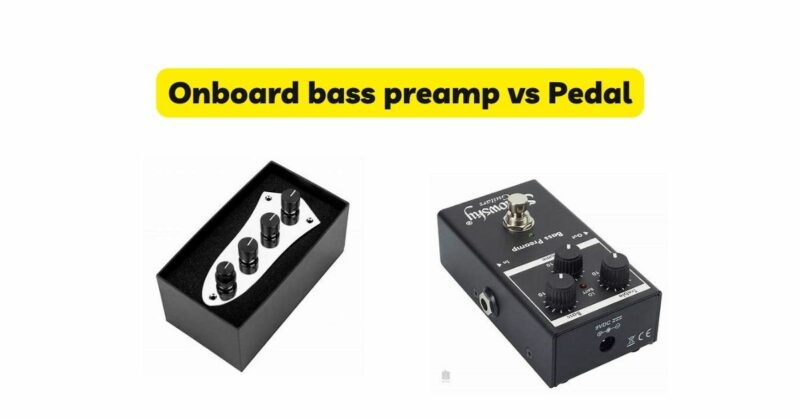
Bass players often seek ways to shape and enhance their sound, and two popular options for achieving this are onboard bass preamps and pedal-based effects. Onboard preamps are built directly into the bass guitar, while pedals are external devices that can be connected to the instrument. In this article, we will delve into the pros and cons of onboard bass preamps and pedals, examining their unique features, advantages, and limitations. By understanding the characteristics of each option, bassists can make informed decisions to optimize their tonal capabilities.
- Onboard Bass Preamps: Onboard bass preamps, also known as active electronics, are integrated into the body of the bass guitar. They offer a range of tone-shaping features and can significantly impact the overall sound of the instrument. Let’s explore the benefits and considerations associated with onboard bass preamps.
1.1 Enhanced Tone Control: Onboard preamps typically provide comprehensive tone control options, including bass, midrange, and treble controls. This allows bassists to fine-tune their sound directly from the instrument, tailoring the frequencies to suit different musical styles and playing situations. The precise control offered by onboard preamps can help sculpt the desired tonal characteristics without the need for additional external devices.
1.2 Active/Passive Switching: Many onboard preamps feature a switch that allows players to toggle between active and passive modes. In active mode, the preamp is engaged, providing a boosted signal and additional tonal shaping capabilities. In passive mode, the preamp is bypassed, allowing the bass to operate in a more traditional, passive manner. This flexibility allows bassists to choose between a wide range of tonal options and adapt to various musical contexts.
1.3 Noise Reduction and Signal Boosting: Onboard preamps often include features such as noise reduction circuits and signal boosters. Noise reduction technology helps minimize unwanted hum and interference, resulting in a cleaner and quieter signal. Signal boosters can provide an extra kick to the bass signal, allowing players to achieve higher output levels without sacrificing sound quality. These built-in features contribute to a more professional and polished performance.
1.4 Integration and Convenience: One of the significant advantages of onboard preamps is their seamless integration with the bass guitar. Since they are built directly into the instrument, there is no need for additional cables or connections. This simplifies the setup process, reduces clutter, and enhances overall convenience, particularly for live performances or situations where quick adjustments are necessary.
- Pedal-Based Effects : Pedals have long been a staple for bass players looking to expand their sonic palette. They provide a wide range of effects and tonal possibilities that can be added to the bass signal chain. Let’s explore the advantages and considerations associated with pedal-based effects.
2.1 Versatility and Diverse Effects: Pedals offer unparalleled versatility, with a vast array of effects available for bass players. From classic staples like distortion, chorus, and delay to more experimental and niche effects, pedals allow bassists to explore and craft unique sounds. The ability to mix and match different pedals provides infinite possibilities for tonal experimentation and customization.
2.2 Separate Signal Chain: Using pedals allows bassists to create a separate signal chain for effects, independent of the bass guitar’s onboard preamp. This separation provides greater control over the effects’ parameters and enables players to maintain the integrity of the instrument’s original tone. It also allows for easy swapping and rearranging of pedals, facilitating quick changes and adaptability in different musical contexts.
2.3 Expression and Dynamics: Pedals often offer features such as expression pedals or footswitches, allowing players to manipulate parameters in real-time. This adds a dynamic and expressive element to the performance, enabling bassists to shape their sound on the fly. The ability to control effects independently of the bass guitar’s onboard preamp offers enhanced creativity and sonic exploration.
2.4 Cost and Flexibility: Pedals provide a cost-effective solution for accessing a wide range of effects. Instead of investing in a bass guitar with an onboard preamp that offers specific tonal options, pedals allow for a more flexible approach. Bassists can choose and invest in pedals that suit their specific needs and preferences, gradually expanding their collection as desired. This flexibility allows for experimentation and adaptation to evolving musical requirements.
- Finding the Right Balance : When considering onboard bass preamps vs. pedals, it’s crucial to find the right balance based on personal preferences and musical goals. Here are a few factors to consider when making a decision:
3.1 Sound Preference: Different players have different tonal preferences. Some may prefer the simplicity and convenience of onboard preamps, while others may gravitate towards the versatility and flexibility of pedals. Consider the sonic characteristics you desire and how each option aligns with your musical vision.
3.2 Musical Context: The musical context in which you primarily perform should influence your decision. If you require quick and on-the-fly adjustments during live performances, onboard preamps might offer greater convenience. On the other hand, if you value tonal experimentation and the ability to switch between various effects seamlessly, pedals may be the better choice.
3.3 Budget and Expandability: Consider your budget and long-term goals. Pedals offer the advantage of expandability, allowing you to gradually build your collection and explore a variety of effects. On the other hand, onboard preamps provide a complete package without the need for additional purchases, making them a more cost-effective option upfront.
Conclusion : Onboard bass preamps and pedal-based effects each offer unique advantages and considerations. Onboard preamps provide comprehensive tone control, noise reduction, and convenient integration, while pedals offer unparalleled versatility, separate signal chains, and creative expression. The decision between the two ultimately depends on personal preferences, desired sound characteristics, and the specific musical context. Some bassists may prefer the simplicity and convenience of onboard preamps, while others may gravitate towards the expansive possibilities of pedals. Regardless of the chosen route, both options provide bass players with tools to shape and enhance their sound, contributing to their overall musical expression and performance.