
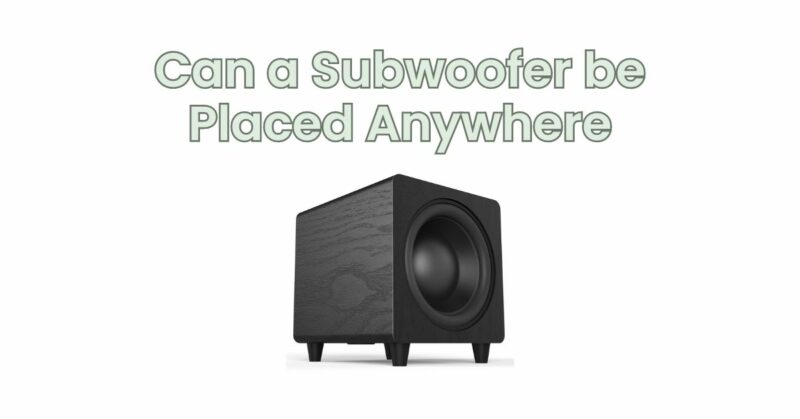
Subwoofers play a crucial role in delivering deep, low-frequency bass in audio systems. However, finding the right placement for a subwoofer can significantly impact its performance and the overall sound quality of your audio setup. In this article, we will explore the question: “Can a subwoofer be placed anywhere?” and provide guidelines to help you find the optimal spot for your subwoofer placement.
Consider the Room Acoustics: Room acoustics play a vital role in how a subwoofer performs. The size, shape, and construction materials of the room can influence the way sound waves interact with surfaces, affecting bass response and overall audio quality. Understanding your room’s acoustics is crucial before determining the placement of your subwoofer.
Experiment with Different Locations: While subwoofers are typically placed in specific positions for optimal performance, there is room for flexibility based on your preferences and room layout. Here are some common placement options to consider:
- Front Placement: Placing the subwoofer near the front of the room, such as next to or underneath the main speakers, is a popular choice. This placement can provide good integration between the subwoofer and the main speakers, resulting in a cohesive soundstage.
- Corner Placement: Placing the subwoofer in a corner of the room can enhance bass response, as the corner can act as an amplifier for low-frequency energy. However, be mindful of potential boomy or overpowering bass in certain room configurations.
- Center Placement: Placing the subwoofer in the center of the room can distribute bass evenly, but it may not always be practical due to aesthetic or space constraints.
- Multiple Subwoofers: Using multiple subwoofers can help achieve more balanced bass response throughout the room. Strategic placement, such as opposite corners or mid-wall positions, can help mitigate room resonances and optimize bass distribution.
Consider Room Calibration and Placement Tools: To further enhance subwoofer performance, consider using room calibration and placement tools. These tools, such as room correction software or audio measurement devices, can help analyze the room’s acoustics and guide you in optimizing the subwoofer’s placement and settings.
Addressing Potential Issues: While you have some flexibility in subwoofer placement, there are a few considerations to keep in mind:
- Avoid Obstructions: Ensure that the subwoofer is not obstructed by furniture, walls, or other objects that could impede sound waves. Clear space around the subwoofer allows for better bass dispersion.
- Isolation and Decoupling: To prevent unwanted vibrations, consider using isolation pads or stands to decouple the subwoofer from the floor or supporting surface. This can minimize the transmission of vibrations and enhance bass clarity.
- Fine-tuning: After placing the subwoofer in your chosen location, experiment with subwoofer settings, such as crossover frequency, phase adjustment, and volume levels, to achieve the desired bass response and integration with the main speakers.
While subwoofers can be placed in various positions, finding the optimal spot requires consideration of room acoustics, experimentation, and fine-tuning. The best placement for a subwoofer may vary depending on the room’s characteristics, personal preferences, and audio system setup. Experiment with different locations, take advantage of room calibration tools, and be mindful of potential issues such as obstructions and vibrations. By carefully considering these factors, you can find the perfect spot for your subwoofer and enjoy a well-balanced, immersive audio experience with deep, impactful bass.