
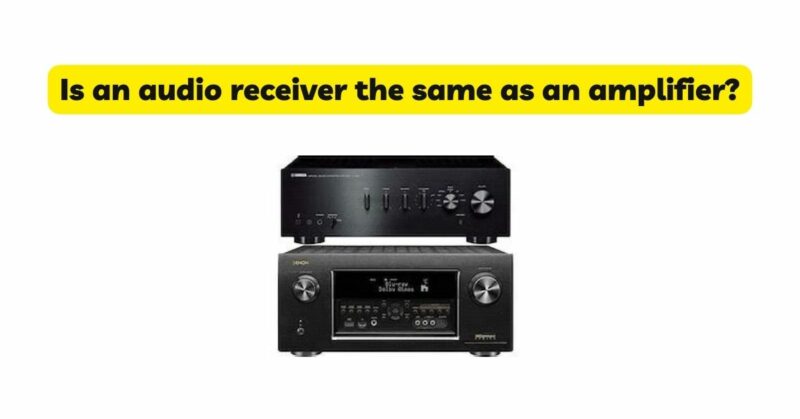
In the realm of audio systems, terms like “audio receiver” and “amplifier” are often used interchangeably, leading to confusion among audio enthusiasts. However, it is essential to understand that while these components share some similarities, they are not entirely the same. In this article, we will explore the differences and commonalities between an audio receiver and an amplifier, shedding light on their respective functionalities and roles in audio systems.
Understanding Audio Receivers: An audio receiver, commonly referred to as a stereo receiver or AV receiver, is a central hub for audio and video signals in a home entertainment system. It combines several components into a single unit, typically including an amplifier, a preamplifier, a radio tuner, audio and video inputs/outputs, and often features such as surround sound processing, HDMI connectivity, and streaming capabilities. The primary purpose of an audio receiver is to receive and process audio signals from various sources and distribute them to speakers or other audio output devices.
Exploring Amplifiers: An amplifier, on the other hand, is an electronic device designed to increase the amplitude or power of an electrical signal. It takes a weak audio signal from a source and boosts it to a level that can effectively drive speakers or headphones. Amplifiers come in various forms, including integrated amplifiers, power amplifiers, and headphone amplifiers. Their primary function is to amplify the audio signal and provide the necessary power to drive speakers or headphones.
Distinguishing Features and Functionalities: While audio receivers often include built-in amplifiers, there are key distinctions that set them apart:
- Signal Processing: Audio receivers feature extensive signal processing capabilities. They receive audio signals from multiple sources, such as CD players, streaming devices, and game consoles, and process them using built-in digital signal processing (DSP) algorithms. This allows for features like surround sound decoding, room correction, equalization, and audio effects. Amplifiers, on the other hand, focus primarily on amplifying the audio signal and do not incorporate extensive signal processing capabilities.
- Input and Output Connections: Audio receivers typically provide a wide array of input and output connections to accommodate multiple audio and video sources. They offer various analog and digital inputs, such as HDMI, optical, and RCA, allowing users to connect devices like Blu-ray players, gaming consoles, and streaming devices. Amplifiers, especially integrated amplifiers, may have a limited number of input connections and typically focus on providing high-quality amplification for a specific audio source.
- Control and User Interface: Audio receivers often feature comprehensive control options and user interfaces. They may include remote controls, front panel displays, and on-screen menus for easy operation and configuration. Amplifiers, particularly dedicated power amplifiers or headphone amplifiers, may have simpler controls and interfaces, focusing primarily on volume control and input selection.
- Multichannel Audio Support: Audio receivers excel in handling multichannel audio formats, such as Dolby Atmos or DTS:X, which require multiple speakers for an immersive surround sound experience. They have built-in amplifiers specifically designed to power multiple speakers and distribute audio signals to different channels. Amplifiers, on the other hand, can range from simple stereo amplifiers for two-channel setups to monoblock amplifiers for high-end audio systems.
Common Ground: Despite their differences, audio receivers and amplifiers also share some commonalities:
- Amplification Function: Both audio receivers and amplifiers serve the essential function of amplifying audio signals. In audio receivers, the built-in amplifier section amplifies the incoming audio signals to a level suitable for driving speakers. Standalone amplifiers focus solely on amplification, providing power to speakers or headphones.
- Integration: Many audio receivers include built-in amplifiers, combining the functionalities of both components into a single unit. This integration offers convenience, as users don’t need to purchase separate amplifiers and receivers, and simplifies the overall setup process.
- Upgradability and Customization: Both audio receivers and amplifiers offer options for customization and upgradability. Users can choose to upgrade their audio receivers or amplifiers to improve sound quality, power output, or add specific features. They can also incorporate external amplifiers into an audio receiver setup for enhanced performance or connect separate amplifiers to dedicated preamplifier outputs.
Conclusion: In conclusion, while audio receivers and amplifiers share the common goal of amplifying audio signals, they are distinct components with different functionalities. Audio receivers serve as central hubs in audio systems, providing signal processing, input/output connections, and amplification capabilities. Amplifiers, on the other hand, focus primarily on amplifying the audio signal and delivering power to speakers or headphones. However, the integration of amplifiers into audio receivers has blurred the lines between the two components, offering convenience and flexibility to users. Understanding the differences and commonalities between audio receivers and amplifiers empowers audio enthusiasts to make informed decisions when building their audio systems, ensuring optimal performance and audio enjoyment.