
Vinyl records have been a beloved format for music enthusiasts for decades. The warm sound, tactile experience, and nostalgia associated with vinyl make it a unique medium. However, one limitation of vinyl records is their playtime. In this article, we delve into the factors that determine the maximum play time on a vinyl record and discuss the trade-offs between longer playtime and sound quality.
Physical Limitations: Vinyl records have physical constraints that limit the maximum playtime. A standard 12-inch vinyl record with a 33 1/3 RPM (revolutions per minute) speed typically accommodates around 22 minutes of music per side. This is because the grooves need enough space to maintain a reasonable diameter while still fitting within the size limitations of the record.
Groove Spacing and Width: The grooves on a vinyl record contain the audio information. To fit longer playtime on a single side, the grooves would need to be spaced closer together or have narrower widths. However, reducing the spacing or width can impact the sound quality, making it prone to surface noise, distortion, and increased vulnerability to damage.
Audio Fidelity and Sound Quality: Vinyl records are cherished for their warm and rich sound quality. Achieving this requires adequate groove width to capture the audio signal accurately. When trying to fit more music on a side, the groove width may need to be reduced, potentially compromising the audio fidelity. Narrower grooves can result in a higher risk of surface noise and reduced dynamic range.
The Trade-off: Quality vs. Quantity: The maximum playtime on a vinyl record is a delicate balance between wanting to fit more music and maintaining optimal sound quality. While longer playtimes may seem appealing for certain albums or compilations, it is essential to consider the potential trade-offs. Sacrificing sound quality for longer playtime can diminish the unique qualities that make vinyl records so enjoyable.
Double Albums and Gatefold Sleeves: To accommodate longer playtime, artists and labels often release double albums or albums with gatefold sleeves. These formats allow for more music to be spread across multiple discs, ensuring a better listening experience without compromising sound quality. Double albums provide the advantage of maintaining wider grooves and, consequently, better sound reproduction.
Long-Play (LP) Records: Long-Play (LP) records, also known as 33 1/3 RPM albums, revolutionized the vinyl industry. These records introduced microgrooves, allowing for extended playtime on a single side. LP records can hold up to 22 minutes per side without significantly compromising sound quality. This format became the standard for vinyl albums and remains widely used today.
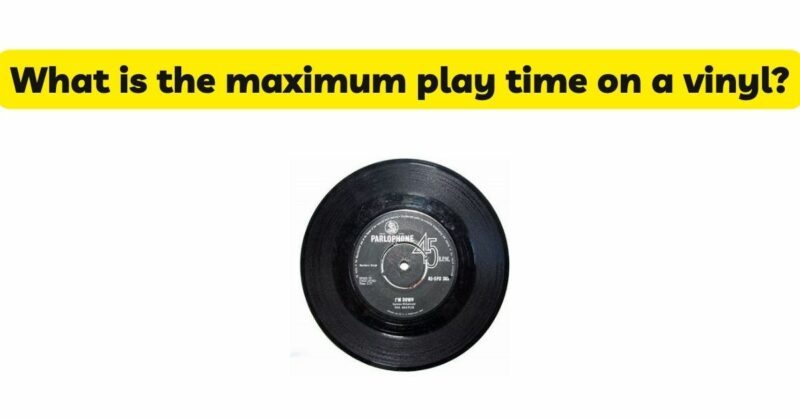
Extended Play (EP) Records: For those seeking longer playtimes, extended play (EP) records provide an alternative. EP records typically feature a smaller diameter (7 or 10 inches) and are played at 45 RPM. This format allows for shorter songs or limited selections from an album to be included, extending the playtime compared to a standard 12-inch LP record.
DJ and Remix Culture: In the realm of DJing and remixing, vinyl records are often used to create extended versions or remixes of songs. DJs employ techniques such as beat matching and mixing to seamlessly transition between records, extending the playtime beyond the original song length. In this context, vinyl records serve as a creative tool to manipulate and extend music for performance purposes.
Conclusion: While vinyl records have limitations in terms of maximum playtime, they continue to captivate music lovers with their unique sound and tactile experience. The physical constraints of vinyl records necessitate a balance between playtime and sound quality. By considering the trade-offs and exploring alternative formats like double albums or EP records, artists and labels can provide listeners with a satisfying musical experience. Ultimately, the charm of vinyl lies not in its ability to hold lengthy recordings, but in the depth, warmth, and character it brings to the music we love.