
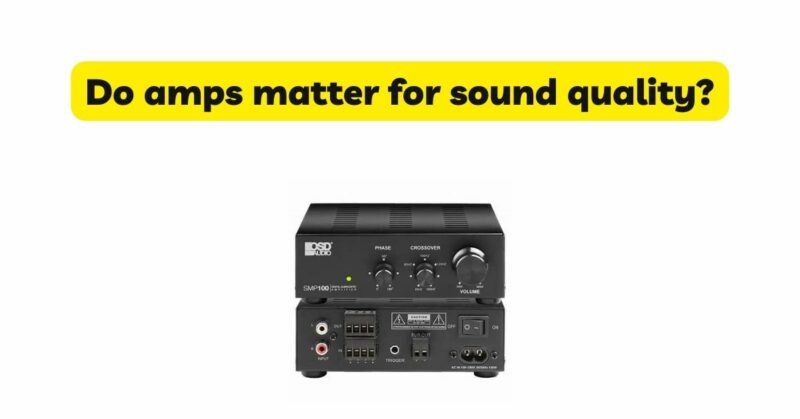
The debate surrounding the significance of amplifiers in shaping sound quality has long captivated audio enthusiasts and professionals alike. Amplifiers are crucial components in audio systems, responsible for powering speakers and amplifying audio signals. However, the question remains: Do amplifiers genuinely matter when it comes to sound quality, or are they often overemphasized in the pursuit of audio perfection? In this article, we will explore the factors that contribute to the influence of amplifiers on sound quality, examining both the technical aspects and subjective experiences associated with their usage.
I. Understanding Amplifiers:
To comprehend the impact of amplifiers on sound quality, it is essential to grasp their fundamental functions and characteristics. Amplifiers are electronic devices that take low-level audio signals and increase their amplitude to drive speakers. They play a critical role in delivering sufficient power to speakers for accurate sound reproduction. Amplifiers can be categorized into various types, including solid-state, tube, and digital, each with distinct characteristics that can shape the audio output.
II. Technical Specifications and Performance:
One way to assess the importance of amplifiers for sound quality is by considering their technical specifications and performance metrics. Parameters such as signal-to-noise ratio (SNR), total harmonic distortion (THD), frequency response, and damping factor contribute to the overall performance of an amplifier. Higher-quality amplifiers often boast superior specifications and better performance in these areas. However, the question remains whether these differences are perceptible to the human ear in real-world listening scenarios.
III. Objective Measurements vs. Subjective Experience:
While technical specifications provide valuable insights, sound quality perception is subjective and can vary among individuals. Objective measurements alone may not capture the full story, as our auditory system is complex and influenced by various factors such as personal preferences, listening environment, and psychoacoustic phenomena. While some listeners with trained ears may be able to discern subtle differences between amplifiers, others may struggle to perceive significant distinctions in controlled listening tests. This suggests that subjective experience plays a substantial role in determining the perceived impact of amplifiers on sound quality.
IV. Synergy with Audio Components:
Audio systems are intricate ecosystems, and the synergy between components significantly affects overall sound quality. Advocates of high-quality amplifiers argue that they synergize better with premium speakers, ensuring optimal performance and sonic coherence. They maintain that amplifiers can bring out the best in speakers, resulting in improved tonal balance, dynamic range, and overall fidelity. However, skeptics question whether the benefits of such synergy are truly discernible and worth the often substantial investment.
V. Power and Headroom:
One of the crucial aspects of amplifiers that can impact sound quality is their ability to provide sufficient power and headroom. Higher-quality amplifiers typically offer more power, allowing speakers to operate comfortably and reproduce audio with greater dynamic range. Ample power reserves ensure that speakers can handle demanding passages without distortion or compression. Adequate headroom allows for faithful reproduction of transients and subtle details in music, contributing to a more engaging and immersive listening experience.
VI. Room Acoustics and Speaker Placement:
The acoustic properties of the listening environment and the positioning of speakers play an integral role in sound quality. While amplifiers themselves may not directly affect room acoustics, they can indirectly influence the listening experience. Amplifiers with better control and power delivery may improve the interaction between speakers and the listening space, resulting in improved imaging, soundstage, and overall clarity. However, it is important to note that optimizing room acoustics through proper treatments and speaker placement is equally crucial in achieving the best sound quality.
VII. Psychological and Emotional Factors:
Sound quality perception is not solely a technical assessment but also influenced by psychological and emotional factors. Brand reputation, placebo effects, and personal biases can influence listeners’ perceptions of sound quality, including the impact of amplifiers. Listeners may attribute positive changes to the amplifier itself, even if the differences are subtle or placebo-induced. Understanding the psychological aspects at play can shed light on the subjectivity of sound quality evaluation.
Conclusion:
The question of whether amplifiers truly matter for sound quality does not yield a definitive answer. While technical specifications and objective measurements provide valuable insights, sound quality perception remains subjective and influenced by various factors. Amplifiers can indeed have an impact on sound quality, particularly when it comes to power delivery, headroom, and system synergy. However, the extent of this impact and its perceptibility may vary among individuals. Factors such as personal preferences, listening environment, and the overall audio system should be considered when assessing the importance of amplifiers in the pursuit of audio excellence. Ultimately, the decision to invest in high-quality amplifiers should be based on individual needs, preferences, and budget constraints.