
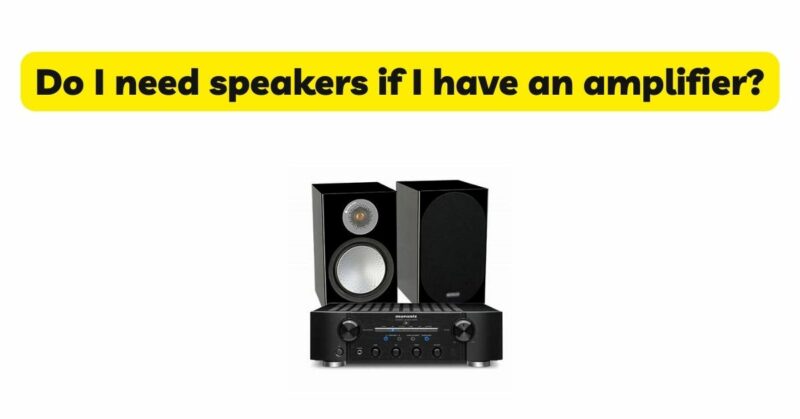
When setting up an audio system, understanding the interplay between various components is crucial. One common question that arises is whether speakers are necessary if an amplifier is already in place. In this article, we will delve into the importance of speakers in conjunction with amplifiers, clarifying their respective roles and highlighting the reasons why speakers are indispensable for a complete and immersive audio experience.
The Role of an Amplifier To appreciate the significance of speakers, it is essential to understand the role of an amplifier. An amplifier is a device that takes low-level audio signals and boosts their power to a level that can drive speakers. It amplifies the electrical current and voltage, providing the necessary energy to move the speaker drivers and produce sound. Amplifiers also play a crucial role in controlling the dynamics, equalization, and volume levels of the audio signal, allowing for adjustments and customization.
Amplifiers come in various forms, including integrated amplifiers, stereo amplifiers, and surround sound processors, catering to different audio setups and requirements. They are characterized by their power output, impedance compatibility, signal-to-noise ratio, and distortion levels, which collectively impact the quality and accuracy of the amplified signal.
The Role of Speakers While amplifiers provide the power and amplification, speakers are essential for converting the amplified electrical signals into audible sound waves. They consist of drivers, enclosures, and crossovers, all working together to reproduce sound with precision and fidelity. Each driver, including woofers, tweeters, and mid-range drivers, is responsible for handling specific frequency ranges and producing corresponding sound waves. Crossovers ensure that each driver receives the appropriate frequencies, resulting in a well-balanced and accurate sound reproduction.
Speakers play a vital role in transforming electrical energy into sound. As the amplified current flows through the speaker’s voice coil, it interacts with the magnetic field produced by the speaker’s magnet, causing the voice coil to move back and forth. This motion is transmitted to the speaker cone, which generates sound waves that propagate through the air, ultimately reaching our ears.
Why Speakers are Indispensable
- Sound Production: Without speakers, the amplified electrical signals would remain inaudible. Speakers are specifically designed to convert electrical energy into sound waves that can be heard and enjoyed. They reproduce the audio with precision, faithfully reproducing the original recording or source material.
- Sound Localization and Imaging: Speakers enable the spatial localization and imaging of sound. They create a sense of depth, width, and height in the soundstage, allowing us to perceive the direction and location of different instruments or sound sources. This contributes to a more immersive and realistic audio experience.
- Frequency Response and Audio Fidelity: Speakers are designed to handle specific frequency ranges, ensuring accurate reproduction of low, mid, and high frequencies. They are engineered to minimize distortion and resonance, enabling faithful representation of the audio content. Different types of speakers, such as woofers, tweeters, and subwoofers, complement each other to cover the full audio spectrum, delivering a balanced and rich sound experience.
- Customization and Personalization: Speakers allow for customization and personalization of the audio system. Different speakers possess unique sonic characteristics, such as tonal balance, sensitivity, and dispersion patterns. By selecting speakers that align with your preferences and acoustic environment, you can tailor the audio system to suit your specific needs and achieve the desired sound signature.
- Soundstage and Atmosphere: Speakers contribute to creating a captivating soundstage and ambiance. They generate a sense of presence, enveloping the listener in a multidimensional sonic environment. Whether you are watching a movie, listening to music, or playing video games, speakers play a significant role in conveying the intended atmosphere and immersing you in the audio content.
- Compatibility and Expandability: Speakers are compatible with a wide range of audio systems and formats. Whether you have a stereo setup, a home theater system, or a professional audio configuration, speakers can be seamlessly integrated. Additionally, speakers offer expandability options, allowing you to add more speakers or create a multi-channel setup for enhanced audio performance and surround sound experiences.
Conclusion While amplifiers are integral components of an audio system, speakers are indispensable for sound reproduction and the overall audio experience. Amplifiers provide the necessary power and amplification, while speakers convert the amplified electrical signals into audible sound waves. The combination of amplifiers and speakers creates a symbiotic relationship, working together to deliver high-quality and immersive sound.Speakers play a pivotal role in sound production, sound localization, frequency response, and personalization of the audio system. They contribute to the creation of a captivating soundstage, reproducing the intended atmosphere and ambiance. The compatibility and expandability of speakers allow for versatile integration into various audio setups.In summary, an amplifier alone cannot replace the function of speakers, as they serve distinct roles within an audio system. To achieve a complete and immersive audio experience, it is essential to invest in high-quality speakers that complement the capabilities of your amplifier, resulting in a synergistic combination that brings the audio content to life.