
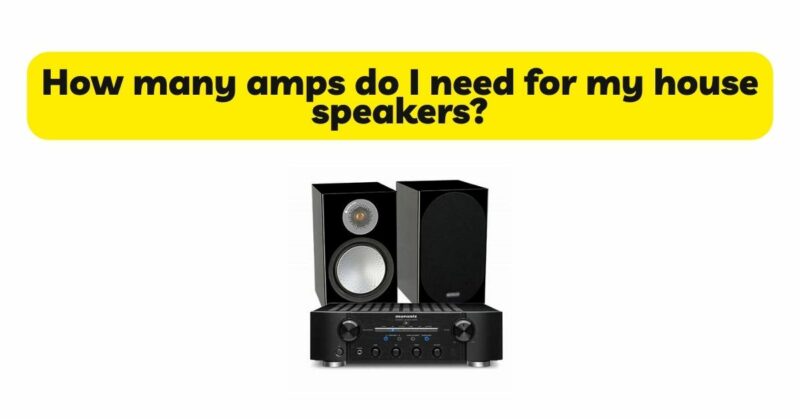
When setting up a sound system for your home, choosing the right amplifier power for your speakers is crucial. Amplifiers play a pivotal role in driving and powering speakers to deliver optimal audio performance. In this article, we will discuss the factors that influence the amount of amplifier power you need for your house speakers, including speaker sensitivity, room size, listening preferences, and speaker requirements. By understanding these factors, you can make an informed decision and ensure that your speakers are properly powered for an immersive listening experience.
I. Understanding Amplifier Power Ratings:
Amplifiers are typically rated in watts per channel (WPC) and provide an indication of the power output they can deliver to the speakers. Amplifier power ratings can be specified as “RMS” (root mean square) or “peak” power. RMS power represents the continuous power output the amplifier can sustain, while peak power denotes the maximum power output the amplifier can deliver for short durations. It is advisable to focus on RMS power ratings when determining the amplifier power needed for your speakers.
II. Speaker Sensitivity and Power Efficiency:
Speaker sensitivity plays a crucial role in determining the amplifier power requirements. Speaker sensitivity is measured in decibels (dB) and indicates the loudness a speaker can produce with a given amount of power. Speakers with higher sensitivity ratings require less amplifier power to achieve a certain volume level compared to speakers with lower sensitivity ratings. For example, speakers with a sensitivity of 90dB will require less power than speakers with a sensitivity of 85dB to produce the same volume level.
III. Room Size and Acoustic Considerations:
The size of your room and its acoustic properties are essential factors to consider when determining the amplifier power for your house speakers. Larger rooms typically require more amplifier power to fill the space with sound and maintain sufficient volume levels. Additionally, rooms with high ceilings, open layouts, or reflective surfaces may require more power to overcome sound dispersion and absorbent losses. Consider the size and characteristics of your room to ensure the amplifier power is adequate for an immersive listening experience.
IV. Listening Preferences and Musical Genres:
Your personal listening preferences and the type of music you enjoy also impact the required amplifier power. If you prefer listening at higher volume levels or enjoy music genres with dynamic peaks and powerful bass, you may need an amplifier with higher power reserves to handle these demands. Conversely, if you primarily listen at lower volume levels or enjoy acoustic genres, a lower-powered amplifier may be sufficient. Consider your listening habits and musical preferences to determine the appropriate amplifier power for your speakers.
V. Speaker Power Handling and Recommendations:
Speakers typically have power handling specifications that indicate the maximum amount of power they can handle without distortion or damage. It is crucial to match the amplifier power to the speaker’s power handling capabilities to avoid underpowering or overpowering the speakers. Underpowering can result in weak sound reproduction and potential damage to the amplifier, while overpowering can lead to distortion or even speaker damage. Review the manufacturer’s recommendations and specifications for your speakers to ensure compatibility with the amplifier power.
VI. Bi-amping and Multi-channel Configurations:
If you have a multi-channel speaker setup or consider bi-amping your speakers, the amplifier power requirements will vary. Bi-amping involves using separate amplifiers for different frequency ranges (e.g., one amplifier for lows and another for highs). In this case, the power requirements for each amplifier will be different based on the frequency range they handle. Similarly, multi-channel configurations, such as 5.1 or 7.1 surround sound systems, will require sufficient amplifier power to drive each channel effectively. Consider the specific power requirements for each amplifier in these setups to ensure balanced power distribution.
VII. Seeking Expert Advice and Auditioning:
If you are uncertain about the amplifier power requirements for your house speakers, seeking expert advice from audio professionals or consulting with speaker manufacturers can be beneficial. They can provide guidance based on your specific speaker model, room size, and listening preferences. Additionally, auditioning different amplifier-speaker combinations allows you to assess the sonic performance and determine the amplifier power that best suits your needs.
Conclusion:
Determining the right amplifier power for your house speakers involves considering factors such as speaker sensitivity, room size, listening preferences, speaker power handling, and specific setup configurations. By taking these factors into account, you can select an amplifier that delivers adequate power to drive your speakers optimally. Remember that sufficient amplifier power ensures accurate sound reproduction, dynamic range, and sufficient volume levels, while mismatched power can result in compromised audio performance or potential damage to your equipment. Taking the time to evaluate your needs and seeking expert advice when necessary will help you create a well-balanced and immersive audio system that brings your house speakers to life.