
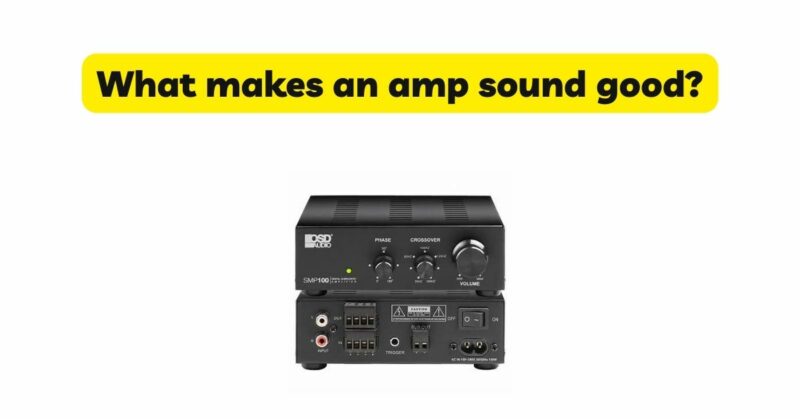
Amplifiers are vital components in audio systems, serving as the driving force behind delivering high-quality sound to speakers. When it comes to evaluating amplifiers, one key aspect that sets certain models apart is the subjective perception of sound quality. In this article, we will explore the factors that contribute to making an amplifier sound good. From technical specifications to subjective elements, we will delve into the intricacies that define exceptional sound reproduction in amplifiers. By understanding these factors, you can make informed decisions when choosing an amplifier that will satisfy your audio preferences and elevate your listening experience.
- Signal Fidelity and Transparency
One crucial aspect that defines a good-sounding amplifier is its ability to faithfully reproduce the original audio signal without adding coloration or distortion. Amplifiers with high signal fidelity and transparency preserve the integrity of the audio, ensuring that the output accurately reflects the input signal. This transparency allows for precise sound reproduction, capturing the subtle nuances and details of the music.
- Frequency Response and Linearity
A wide and flat frequency response is another characteristic of a good amplifier. An amplifier with a wide frequency response ensures that it can reproduce a broad range of frequencies accurately. Linearity is also essential, as it ensures that the amplifier maintains consistent output levels across the entire frequency spectrum. A well-designed amplifier will exhibit minimal frequency response deviations and ensure faithful reproduction of bass, midrange, and treble frequencies.
- Low Distortion and Noise
Distortion and noise can significantly impact the sound quality of an amplifier. Good amplifiers strive for low levels of harmonic distortion, ensuring that the amplified signal remains true to the original without introducing unwanted artifacts. Additionally, minimizing background noise is essential, as it allows for a clean and silent background, enabling the listener to fully appreciate the music without distractions.
- Power and Dynamic Range
Amplifiers with ample power reserves and a wide dynamic range can reproduce music with impact and authority. Power enables the amplifier to accurately reproduce transients and dynamics, ensuring that soft passages and explosive peaks are faithfully rendered. A good amplifier will possess sufficient power to handle demanding musical passages without compression or distortion.
- Speaker Compatibility and Control
The interaction between the amplifier and speakers is critical in achieving good sound. A well-designed amplifier will offer the appropriate power, impedance matching, and control to drive the connected speakers optimally. Compatibility ensures that the amplifier can fully utilize the capabilities of the speakers, resulting in balanced and accurate sound reproduction.
- Build Quality and Components
The build quality and components used in an amplifier can significantly impact sound quality. High-quality components, such as capacitors, resistors, and transistors, contribute to better signal integrity and lower distortion. Additionally, robust construction and attention to detail in circuit design can minimize vibrations and interference, leading to cleaner and more precise sound reproduction.
- Timbre and Tonal Balance
A good amplifier should faithfully reproduce the timbre and tonal balance of various instruments and voices. The ability to accurately represent the unique characteristics of different instruments ensures a realistic and immersive listening experience. A well-balanced amplifier will reproduce frequencies across the audio spectrum accurately, resulting in a natural and pleasing tonal balance.
- Subjective Listening Experience
Sound quality is subjective, and personal preferences play a significant role in determining what makes an amplifier sound good to an individual listener. Factors such as tonal warmth, soundstage, imaging, and spatial reproduction can greatly influence one’s perception of sound quality. Therefore, it is essential to audition amplifiers and trust your ears to find an amplifier that aligns with your sonic preferences.
Conclusion
The factors that contribute to making an amplifier sound good are a combination of technical specifications and subjective elements. A good amplifier faithfully reproduces the original audio signal with transparency, exhibiting a wide frequency response, low distortion, and noise levels. It possesses ample power and dynamic range to handle various musical passages with control and authority. The amplifier should also be compatible with the connected speakers and exhibit excellent build quality. Additionally, the amplifier should accurately reproduce timbre and tonal balance, while also delivering a subjective listening experience that aligns with individual preferences. By considering these factors, you can select an amplifier that will satisfy your audio expectations and provide a truly enjoyable listening experience.