
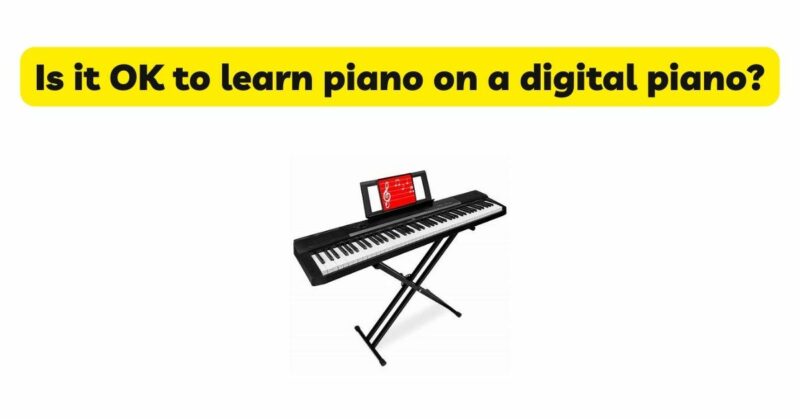
The piano is a timeless and captivating instrument, and in today’s digital age, many aspiring pianists wonder if it’s okay to learn piano on a digital piano. In this article, we will explore the advantages, considerations, and potential benefits of learning piano on a digital piano. By examining its unique features, sound quality, touch sensitivity, practicalities, and technological advancements, we aim to provide insights that will empower individuals to make an informed decision about using a digital piano as their instrument of choice for piano learning.
- Sound Quality and Reproduction: One of the significant considerations when learning piano on a digital piano is the sound quality and reproduction. Digital pianos have come a long way in replicating the sound of an acoustic piano. High-quality digital pianos utilize advanced sampling technology to capture the nuances of an acoustic piano’s sound. These pianos offer multiple sampled piano tones, accurately emulating the tonal characteristics of various acoustic pianos. While the sound may not be an exact replica of a grand or upright piano, it can still be incredibly satisfying and enjoyable for piano learners.
- Touch Sensitivity and Key Action: Another critical aspect of learning piano is the touch sensitivity and key action. Acoustic pianos have a unique touch sensitivity, where the volume and dynamics of the sound vary depending on the pressure applied to the keys. Digital pianos strive to replicate this touch sensitivity by employing weighted or graded hammer action keys. These key actions simulate the feel and response of playing on an acoustic piano, providing a more authentic playing experience. While digital pianos may not fully replicate the touch sensitivity of an acoustic piano, they come close enough to allow for proper technique development and finger control.
- Versatility and Sound Options: One of the significant advantages of learning piano on a digital piano is the versatility and sound options it offers. Digital pianos provide a wide range of instrument sounds beyond just piano tones. They often feature additional voices, including strings, organs, synthesizers, and more. This versatility allows piano learners to explore various genres and experiment with different sounds. It also adds an element of creativity, enabling learners to compose, arrange, and produce music using a variety of instrument tones. The versatility of a digital piano can inspire learners to expand their musical horizons and explore different styles of playing.
- Practice Tools and Learning Features: Digital pianos are equipped with various practice tools and learning features that can greatly benefit piano learners. Many models include built-in metronomes, recording capabilities, and playback functions. These features allow learners to practice with a steady rhythm, evaluate their playing, and track their progress over time. Additionally, some digital pianos offer integrated lesson functions, interactive tutorials, and even connectivity to educational apps or software. These practice tools and learning features can enhance the learning experience and provide valuable guidance for self-study or supplementing traditional piano lessons.
- Portability and Convenience: Learning piano on a digital piano offers the advantage of portability and convenience. Unlike acoustic pianos, which are large, heavy, and immobile, digital pianos are generally compact and lightweight. They can be easily moved, making them suitable for individuals who may need to transport their instrument or have limited space. Digital pianos also often come with headphone outputs, allowing for private practice without disturbing others. This portability and convenience make digital pianos an excellent option for those who need flexibility in their practice routine or who may want to perform in different settings.
- Maintenance and Cost: Digital pianos have a significant advantage over acoustic pianos when it comes to maintenance and cost. Acoustic pianos require regular tuning, which can be a recurring expense. They may also require occasional repairs or adjustments. In contrast, digital pianos have minimal maintenance requirements. They do not need tuning, and the components are generally more durable and less prone to wear and tear. Additionally, digital pianos are often more affordable than acoustic pianos, making them a practical choice for those on a budget.
- Transition to Acoustic Pianos: One concern for learners using digital pianos is the ability to transition smoothly to playing on an acoustic piano. While there are differences between digital and acoustic pianos in terms of sound, touch sensitivity, and overall playing experience, the core skills developed on a digital piano can be transferred to an acoustic piano. With practice and adjustment, learners can adapt to the touch and response of an acoustic piano. It can be beneficial to periodically practice on an acoustic piano to become familiar with its characteristics and nuances. Seeking guidance from a piano teacher can also aid in a smooth transition.
Conclusion: Learning piano on a digital piano is not only okay but also an excellent choice for many aspiring pianists. Digital pianos offer high-quality sound reproduction, touch sensitivity, and versatility, allowing learners to explore various styles and sounds. They provide practice tools, learning features, and the convenience of portability. Additionally, digital pianos are cost-effective, low-maintenance alternatives to acoustic pianos. While there are differences between digital and acoustic pianos, the skills developed on a digital piano can be transferred to an acoustic piano with practice and adjustment.
Ultimately, the choice of whether to learn piano on a digital piano is a personal one, based on individual circumstances, preferences, and goals. It’s important to consider factors such as sound quality, touch sensitivity, versatility, convenience, and budget when making the decision. Whichever instrument you choose, the joy of learning and playing the piano lies in your dedication, passion, and commitment to regular practice. Embrace the digital piano as a powerful tool for musical expression and embark on a fulfilling journey of piano playing.