
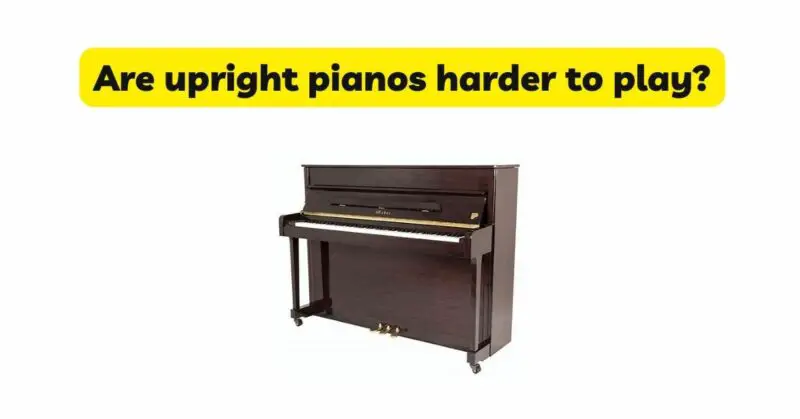
A common misconception surrounding upright pianos is that they are inherently harder to play compared to other types of pianos. This belief stems from various factors, including differences in touch, size, and sound projection. In this article, we will explore the truth behind this notion and provide an objective assessment of whether upright pianos are genuinely harder to play. By examining touch sensitivity, key action, sound projection, and other relevant aspects, we aim to dispel the myth and provide a clearer understanding of playing an upright piano.
- Touch Sensitivity: Touch sensitivity refers to the responsiveness of a piano’s keys to the player’s touch. It is often believed that upright pianos have a less sensitive touch compared to grand pianos, leading to the misconception that they are harder to play. However, touch sensitivity can vary among individual pianos, regardless of their type. Both upright pianos and grand pianos can have a range of touch sensitivities, depending on their design, manufacturing, and maintenance. It is important to note that some upright pianos, particularly high-quality models, can offer a highly responsive touch that rivals that of grand pianos. Therefore, it is incorrect to assume that all upright pianos are harder to play solely based on touch sensitivity.
- Key Action: Key action refers to the mechanism that connects the keys to the hammers, determining how the keys respond when pressed. Upright pianos generally feature different types of key actions compared to grand pianos. While grand pianos typically employ a horizontal action mechanism, upright pianos use vertical or modified vertical actions. The vertical action design in upright pianos can sometimes lead to a perception that they are harder to play due to potential differences in key resistance and response. However, it is essential to note that the key action of an upright piano can vary widely depending on the specific model, brand, and age. Some upright pianos offer key actions that provide a satisfying and responsive playing experience, making them comparable to grand pianos.
- Sound Projection: Another factor contributing to the belief that upright pianos are harder to play is their sound projection. Upright pianos, with their vertical design, may have limitations in sound projection compared to grand pianos. This can create an impression that the pianist needs to exert more effort to produce a balanced and resonant sound. However, it is important to distinguish between the playing experience and the sound projection capabilities of the instrument. While upright pianos may have limitations in sound projection, the actual act of playing the piano does not necessarily become more challenging. The pianist’s technique and ability to produce a desired sound are not inherently affected by the piano’s sound projection.
- Size and Physicality: Another aspect that contributes to the misconception that upright pianos are harder to play is their size and physicality. Upright pianos are generally more compact and have a vertical string orientation, which can lead to a different physical experience compared to grand pianos. The pianist may need to adjust their posture and hand position to accommodate the instrument’s dimensions. However, this does not imply that upright pianos are inherently more difficult to play. With proper technique and adaptation, pianists can achieve a comfortable and efficient playing experience on an upright piano.
- Practice and Adaptation: Ultimately, the perception of whether upright pianos are harder to play can vary from person to person. Some pianists may find the transition from a grand piano to an upright piano initially challenging due to differences in touch, key action, and sound projection. However, with practice and adaptation, pianists can become comfortable and proficient in playing upright pianos. Familiarizing oneself with the specific characteristics of the instrument, understanding its nuances, and adjusting playing techniques accordingly can help overcome any initial difficulties and allow for a rewarding playing experience.
Conclusion: The notion that upright pianos are harder to play is a misconception that arises from differences in touch sensitivity, key action, sound projection, size, and physicality. While there may be variations in these aspects between upright pianos and grand pianos, it is incorrect to generalize that all upright pianos are harder to play. Touch sensitivity and key action can vary among individual pianos, regardless of their type, and some upright pianos offer highly responsive and satisfying playing experiences. The sound projection capabilities of an upright piano do not affect the actual act of playing or the pianist’s ability to produce a desired sound. Moreover, with practice and adaptation, pianists can become comfortable and proficient in playing upright pianos. It is crucial to approach the evaluation of an upright piano’s playability objectively and consider individual preferences, technique, and the specific characteristics of the instrument.