
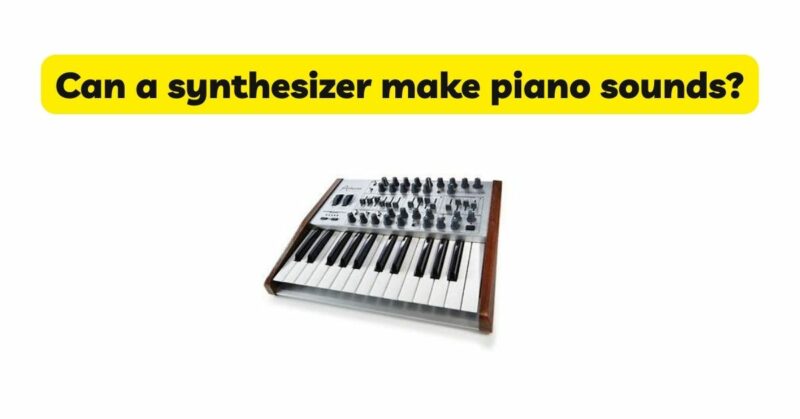
Synthesizers, with their vast array of sounds and versatile capabilities, have become a staple in modern music production. One common question that arises is whether a synthesizer can effectively replicate the timeless and beloved sound of a piano. In this article, we will explore the potential of synthesizers in emulating piano sounds. From sample-based synthesis to physical modeling and advanced digital technologies, we will uncover the techniques and considerations involved in achieving convincing piano sounds with a synthesizer.
I. Sample-Based Synthesis: Capturing the Essence
Sample-based synthesis is a widely used technique for recreating realistic piano sounds on a synthesizer. It involves recording individual notes from an acoustic piano and mapping them to corresponding keys on a synthesizer. When played, each key triggers the corresponding piano sample, resulting in a faithful reproduction of the original instrument’s sound.
Sample-based piano libraries are meticulously recorded, capturing the nuances of the acoustic piano, including the key dynamics, pedal noises, and resonances. These libraries often provide a range of piano types, such as grand, upright, or electric pianos, allowing musicians to select the desired piano sound for their compositions.
II. Physical Modeling: Emulating the Piano’s Mechanics
Physical modeling is another approach employed by synthesizers to replicate piano sounds. This technique aims to simulate the physical properties and mechanics of a piano, including the behavior of the strings, hammers, and soundboard.
In physical modeling synthesis, complex algorithms replicate the interactions between the components of a piano. The synthesizer models the behavior of the strings being struck, their vibrations, and the resonance of the soundboard. This approach offers a dynamic and expressive representation of the piano’s tonal characteristics and the mechanical aspects that contribute to its sound.
III. Advanced Digital Technologies: Modeling and Processing
Advancements in digital technology have led to the development of sophisticated algorithms and processing techniques for synthesizers, further enhancing their ability to emulate piano sounds. These technologies include advanced modeling algorithms, dynamic processing, and multi-layered sampling techniques.
Modeling algorithms analyze and replicate the characteristics of piano sound, including the attack, decay, sustain, and release phases of each note. This level of detail allows synthesizers to reproduce the nuanced timbre and expressiveness of an acoustic piano.
Dynamic processing techniques, such as velocity mapping and velocity crossfading, ensure that the sound responds to the player’s touch and dynamics, closely mirroring the behavior of an acoustic piano. Multi-layered sampling techniques involve capturing multiple layers of piano samples at different velocities, resulting in a more realistic and dynamic piano sound reproduction.
IV. Artistic Considerations: Emulating the Soul of the Piano
While synthesizers can offer impressive piano sounds, there are artistic considerations to keep in mind when using these emulations. While they capture the essence of a piano’s sound, they may not fully replicate the organic and subtle nuances found in a genuine acoustic instrument.
- Expressiveness and Dynamics: Acoustic pianos have a wide range of expressive capabilities, allowing for dynamic playing and nuances that are challenging to reproduce faithfully on a synthesizer. While some synthesizers offer expressive control through velocity sensitivity and aftertouch, achieving the full range of subtleties may still be a challenge.
- Resonance and Soundboard Interactions: The complex interactions between strings, soundboard, and resonances contribute to the unique timbre and richness of a piano’s sound. While some synthesizers simulate these interactions through advanced algorithms, the authenticity of the resonance may vary compared to an acoustic piano.
- Personal Style and Artistic Interpretation: The sound of a piano is deeply intertwined with the player’s touch, technique, and personal style. Emulating these individualistic qualities on a synthesizer may require additional customization and parameter adjustments to suit the musician’s preferences.
V. Hybrid Approaches: Combining Synthesis Techniques
To bridge the gap between synthesizers and acoustic pianos, many musicians and manufacturers have embraced hybrid approaches. These approaches involve combining sample-based synthesis, physical modeling, and advanced digital technologies to create more realistic and expressive piano sounds.
Hybrid synthesizers offer the flexibility to blend different synthesis techniques, allowing musicians to sculpt the piano sound according to their artistic vision. By combining the strengths of sample-based synthesis for capturing authentic piano timbres and the expressiveness of physical modeling, these instruments strive to offer a more convincing and versatile piano experience.
VI. Beyond Perfect Replication: Embracing Sonic Exploration
While the pursuit of replicating piano sounds on a synthesizer is a worthy endeavor, it is important to remember that synthesizers offer boundless creative possibilities beyond perfect replication. Synthesizers provide the freedom to explore unique and innovative sounds that go beyond the limitations of traditional instruments.
By embracing the sonic exploration potential of synthesizers, musicians can create new textures, experiment with unconventional piano hybrids, and craft entirely new sonic landscapes that expand the horizons of musical expression.
Conclusion:
While a synthesizer may never fully replicate the unique characteristics and nuances of an acoustic piano, it has made significant strides in emulating piano sounds through sample-based synthesis, physical modeling, and advanced digital technologies. These approaches allow musicians to create convincing and expressive piano-like tones, offering a vast range of piano options to suit various musical styles and contexts.
While the choice between a synthesizer and an acoustic piano ultimately depends on personal preferences, artistic goals, and practical considerations, synthesizers offer the advantage of versatility, sonic exploration, and the ability to create unique sounds beyond the boundaries of traditional instruments.
Ultimately, the decision to use a synthesizer or an acoustic piano should be driven by the musician’s creative vision, the desired sound palette, and the musical context in which the instrument will be employed.