
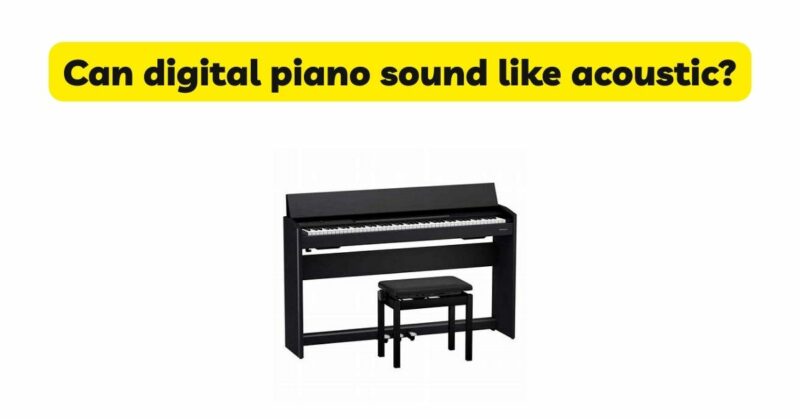
The pursuit of achieving acoustic realism in digital pianos has been an ongoing endeavor for manufacturers and musicians alike. While no digital piano can fully replicate the intricate complexities of an acoustic piano, significant advancements in technology have brought us closer than ever before to achieving a highly realistic and authentic piano sound. In this article, we explore the factors that contribute to the quest for acoustic realism in digital pianos, including sound sampling, sound modeling, resonance simulation, dynamic range, touch sensitivity, and sound processing capabilities. By examining these elements, we aim to shed light on the capabilities of digital pianos to sound like their acoustic counterparts, providing musicians with insights into the nuances, strengths, and limitations of digital piano sound reproduction.
- Sound Sampling: One of the key methods employed by digital pianos to achieve acoustic realism is through sound sampling. High-quality digital pianos incorporate extensive sample libraries recorded from real acoustic pianos. These samples capture the unique characteristics and nuances of each piano note, including the attack, sustain, and decay. By meticulously mapping these samples to the corresponding keys, digital pianos can replicate the tonal qualities, dynamics, and resonance of an acoustic piano, resulting in a highly authentic and realistic piano sound.
- Sound Modeling: Sound modeling is another approach used in digital pianos to emulate the sound of acoustic pianos. This technique involves creating algorithms that simulate the physical interactions and behavior of acoustic pianos. By modeling the complex mechanics of strings, hammers, and resonant bodies, digital pianos can reproduce the tonal nuances and subtleties that are unique to acoustic pianos. Sound modeling technology allows for greater customization and control over the piano sound, offering pianists the ability to adjust parameters and create personalized tonal profiles that closely resemble the sound of acoustic pianos.
- Resonance Simulation: Acoustic pianos possess a rich resonance that occurs when the strings and soundboard interact. Digital pianos employ advanced algorithms to simulate this resonance, enhancing the depth, warmth, and naturalness of the piano sound. Through resonance simulation techniques such as sympathetic string resonance and damper pedal resonance, digital pianos aim to replicate the complex interplay of vibrations between strings, resulting in a more immersive and authentic piano sound.
- Dynamic Range: The dynamic range is a critical aspect of the acoustic piano sound, encompassing the ability to produce a wide range of volume levels, from delicate pianissimos to powerful fortissimos. Digital pianos strive to replicate this dynamic range through a combination of velocity-sensitive keys and advanced sound processing techniques. By accurately capturing and reproducing the nuances of key velocity and touch, digital pianos can provide a similar level of dynamic expressiveness, enabling musicians to achieve highly expressive and nuanced performances that approach the richness and depth of an acoustic piano.
- Touch Sensitivity: The touch sensitivity of a digital piano is instrumental in recreating the feel and expressiveness of an acoustic piano. Acoustic pianos respond to the varying degrees of pressure applied to the keys, resulting in variations in volume and tone. Digital pianos employ velocity-sensitive keys that detect and respond to the force or speed at which each key is pressed, allowing for variations in volume and tone just like an acoustic piano. The presence of touch sensitivity enhances the expressiveness and dynamic control, bringing digital pianos closer to replicating the responsiveness and subtleties of an acoustic piano.
- Sound Processing: Digital pianos utilize advanced sound processing techniques to refine and enhance the piano sound. These techniques simulate the natural characteristics of acoustic pianos, such as damper pedal resonance, key-off samples, and sympathetic resonance. Damper pedal resonance recreates the interaction between the dampers and strings when the sustain pedal is used, resulting in a more immersive and resonant sound. Key-off samples replicate the subtle sound produced when a pianist releases a key, adding to the realism and authenticity of the piano sound. Through these sound processing features, digital pianos can achieve a more lifelike and convincing acoustic piano sound.
Conclusion: While digital pianos cannot fully replicate every aspect of the acoustic piano experience, significant advancements in technology have allowed them to come remarkably close in achieving acoustic realism. Through sound sampling, sound modeling, resonance simulation, dynamic range, touch sensitivity, and sound processing capabilities, digital pianos can reproduce highly authentic and realistic piano sounds. While there may be subtle differences between digital and acoustic pianos, the convenience, versatility, and affordability of digital pianos make them a compelling choice for musicians at all levels. Ultimately, the quest for acoustic realism in digital pianos continues, driven by the goal of providing musicians with an instrument that offers a highly immersive and expressive piano-playing experience.