
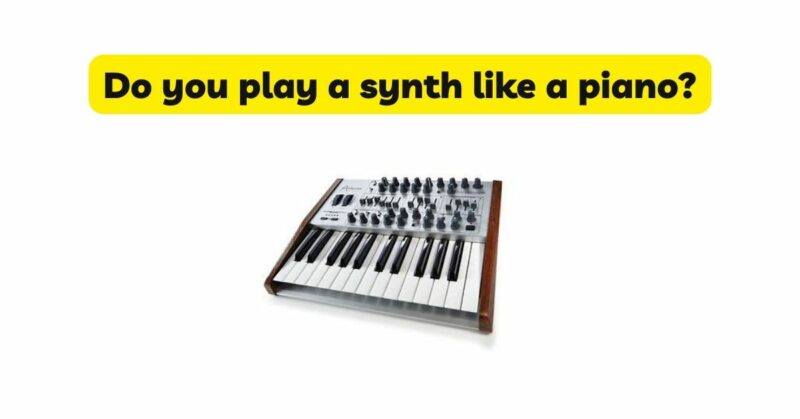
Synthesizers and pianos are two distinct musical instruments that offer unique experiences and sonic possibilities. While both instruments share similarities in terms of their keyboard layout, there are significant differences in how they are played and the techniques required to master them. In this article, we will explore the distinctions between playing a synthesizer and playing a piano. From touch sensitivity and playing techniques to sound production and expressive control, we will delve into the nuances of each instrument and shed light on the specific approaches required to effectively play them.
I. Touch Sensitivity and Key Response:
One of the fundamental differences between playing a synthesizer and playing a piano lies in the touch sensitivity and key response. Pianos, especially acoustic pianos, have weighted keys that respond to the player’s touch with varying degrees of resistance. This touch sensitivity allows pianists to express dynamics, nuances, and subtle variations in tone through the control of finger pressure on the keys. The touch and response of a piano key provide a tactile experience that contributes to the expressive capabilities of the instrument.
On the other hand, synthesizers often have lighter and less responsive keys compared to pianos. The keys on a synthesizer typically lack the weighted action found in pianos, resulting in a different touch experience. While some synthesizers may offer semi-weighted or weighted keys to mimic the piano feel, they may not fully capture the touch sensitivity and key response of an acoustic piano. Nevertheless, synthesizers compensate for this by offering other expressive control features, as we will explore further.
II. Sound Production and Tonal Expression:
Another significant distinction between playing a synthesizer and playing a piano is the process of sound production and tonal expression. Pianos produce sound acoustically through the vibration of strings when the keys are struck by hammers. The sound quality, tonal nuances, and richness of a piano are inherent in its mechanical design and the unique characteristics of each instrument. Pianists have direct control over the dynamics, articulation, and tonal quality through their touch on the keys.
In contrast, synthesizers generate sound electronically through various sound synthesis techniques. The sound produced by a synthesizer is not dependent on mechanical vibrations but is instead created through electronic circuits, oscillators, filters, and modulators. Synthesizers offer a wide range of tonal possibilities, from emulating traditional instruments to creating entirely new and experimental sounds. The tonal expression in a synthesizer is achieved through manipulating parameters, shaping waveforms, and applying effects, providing musicians with extensive control over the sound characteristics.
III. Playing Techniques and Artistic Approach:
Playing a synthesizer and playing a piano require different techniques and artistic approaches. Pianists develop techniques such as proper hand posture, finger independence, and pedaling to achieve control over the instrument’s expressive capabilities. They learn to interpret musical notation, understand music theory, and navigate the complex arrangements found in classical and traditional piano repertoire. Piano playing often involves a combination of melody, harmony, and accompaniment, requiring coordination between the hands and precise timing.
Synthesizers, on the other hand, invite a more exploratory and experimental approach. While some synthesizer players may adopt piano playing techniques to a certain extent, the focus often shifts to sound design, improvisation, and sonic exploration. Synthesizer players develop skills in programming, patch creation, and real-time manipulation of sound parameters. They may use techniques such as layering sounds, creating complex textures, and utilizing effects to sculpt unique and evolving sonic landscapes. The artistic approach in synthesizer playing is often driven by sonic experimentation, genre-specific techniques, and personal expression.
IV. Expressive Control and Performance Techniques:
Expressive control and performance techniques differ significantly between synthesizers and pianos. Pianists have direct control over dynamics, expression, and timbre through their touch on the keys. They can vary the volume, intensity, and tonal characteristics by adjusting finger pressure and velocity. Pianists also utilize techniques such as legato, staccato, pedal control, and phrasing to convey musical interpretation and emotion.
Synthesizer players achieve expressive control through various means. While the keys themselves may not provide the same touch sensitivity as pianos, synthesizers offer other mechanisms for shaping and manipulating sound. Modulation wheels, pitch bend, aftertouch, and assignable control knobs allow synthesizer players to introduce dynamic changes, pitch variations, and real-time parameter adjustments. These expressive control features enable synthesizer players to create evolving textures, perform expressive solos, and add nuances to their playing.
V. Musical Context and Performance Settings:
The musical context and performance settings also influence the distinctions between playing a synthesizer and playing a piano. Pianos have a rich history and are deeply ingrained in classical, jazz, and traditional music genres. They are often performed in concert halls, chamber ensembles, and solo recitals, demanding a refined and nuanced approach to interpretation and performance.
Synthesizers, on the other hand, are prevalent in genres such as electronic music, pop, rock, and experimental genres. They are frequently used in live performances, studio recordings, and electronic music production settings. Synthesizer players often engage in live improvisation, sound manipulation, and interactive performances, taking advantage of the instrument’s versatility and real-time control capabilities.
Conclusion:
Playing a synthesizer and playing a piano offer distinct experiences, techniques, and artistic possibilities. Pianos provide a touch-sensitive, expressive, and acoustically rich playing experience, allowing musicians to explore classical, jazz, and traditional music genres. Synthesizers, on the other hand, offer expansive sound design capabilities, electronic sonic exploration, and performance versatility across various modern genres.
The choice between playing a synthesizer or playing a piano depends on personal preferences, musical goals, and the desired sonic and expressive capabilities. While the keyboard layout is shared between the two instruments, it is crucial to recognize and embrace the distinctions in touch sensitivity, sound production, playing techniques, expressive control, and performance settings.
Ultimately, both synthesizers and pianos offer unique opportunities for artistic expression and creative exploration. Whether you are drawn to the timeless elegance of a piano or the sonic possibilities of a synthesizer, the instrument you choose should align with your musical aspirations, inspire your creativity, and contribute to your enjoyment and fulfillment as a musician.