
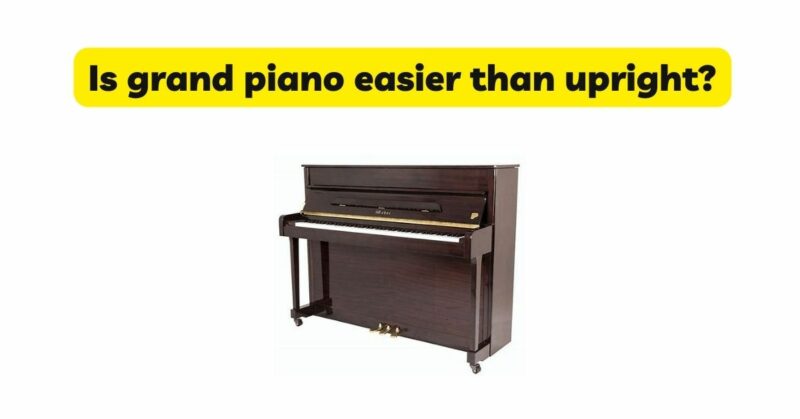
A common belief among pianists is that grand pianos are inherently easier to play compared to upright pianos. This notion stems from various factors, including touch sensitivity, key action, and sound projection. However, the ease of playing a piano is influenced by multiple variables, and it is important to examine these factors objectively. In this article, we will explore the myth surrounding the ease of playing a grand piano versus an upright piano. By delving into touch sensitivity, key action, sound projection, and individual preferences, we aim to provide a comprehensive understanding of whether a grand piano is indeed easier to play than an upright piano.
- Touch Sensitivity: Touch sensitivity refers to the responsiveness of a piano’s keys to the player’s touch. It is often believed that grand pianos have a more sensitive touch, allowing for greater control and expressiveness. While it is true that grand pianos typically offer a wider range of touch sensitivity due to their superior design and craftsmanship, it is important to note that touch sensitivity can vary among individual pianos, regardless of their type. Both grand pianos and upright pianos can exhibit a range of touch sensitivities, influenced by factors such as the piano’s age, condition, and maintenance. It is incorrect to assume that all grand pianos are easier to play solely based on touch sensitivity.
- Key Action: Key action refers to the mechanism that connects the keys to the hammers, determining how the keys respond when pressed. Grand pianos often employ more sophisticated and responsive key actions compared to upright pianos, allowing for greater control and precision. The longer keys, heavier weights, and more intricate mechanisms in grand pianos contribute to their reputation for ease of playing. However, it is essential to note that the key action of a piano can vary widely depending on the specific model, brand, and maintenance. Some upright pianos feature high-quality key actions that provide a satisfying and responsive playing experience. Therefore, it is incorrect to generalize that all grand pianos are easier to play solely based on key action.
- Sound Projection: Another factor that contributes to the belief that grand pianos are easier to play is their superior sound projection capabilities. Grand pianos, with their larger size and horizontal string orientation, have an advantage in projecting sound with depth and resonance. This can create an impression that the pianist needs to exert less effort to produce a balanced and resonant sound. However, it is important to distinguish between sound projection and the actual act of playing the piano. While grand pianos may have an advantage in sound projection, the ease of playing is not directly related to the instrument’s sound projection capabilities. The pianist’s technique and ability to produce a desired sound are not inherently affected by the piano’s sound projection.
- Individual Preferences and Musical Context: The ease of playing a piano is subjective and can vary from person to person. Some pianists may find the transition from an upright piano to a grand piano initially challenging due to differences in touch sensitivity, key action, and sound projection. However, with practice and adaptation, pianists can become comfortable and proficient in playing grand pianos. It is also essential to consider individual preferences and the musical context in which the piano will be used. While grand pianos are often preferred for concert halls and large venues, upright pianos can excel in smaller performance spaces, studios, and practice rooms. Ease of playing is influenced by personal preferences, musical goals, and the specific demands of the musical context.
- Technique and Adaptability: The ease of playing a piano is heavily dependent on the pianist’s technique and adaptability. Skilled pianists can adapt their technique to different pianos, whether grand or upright, and extract the best possible sound from each instrument. The ability to adapt to different touch sensitivities, key actions, and sound projection characteristics is a valuable skill that can be developed through practice and experience. Pianists who possess good technique and adaptability can achieve ease of playing on various types of pianos, regardless of whether they are grand or upright.
- Personalized Playing Experience: The ease of playing a piano is ultimately a personal experience that varies from individual to individual. Factors such as hand size, playing style, and personal preference can influence the perceived ease of playing a piano. Some pianists may find certain upright pianos easier to play due to the size and touch sensitivity that suit their physical attributes and playing technique. Others may feel more comfortable and find greater ease in playing grand pianos. It is crucial for pianists to experiment with different pianos, assess their own playing experience, and choose an instrument that best aligns with their individual needs and preferences.
Conclusion: The belief that grand pianos are inherently easier to play than upright pianos is a myth that requires careful examination. Touch sensitivity, key action, and sound projection are factors that contribute to this misconception. However, it is important to consider that touch sensitivity and key action can vary among individual pianos, regardless of their type. Moreover, sound projection capabilities do not directly impact the ease of playing. Ease of playing is influenced by individual preferences, adaptability, technique, and the specific demands of the musical context. Skilled pianists can adapt their technique to different pianos and achieve ease of playing on both grand and upright pianos. Ultimately, the perceived ease of playing is subjective and can vary from person to person. It is crucial for pianists to choose a piano that suits their individual needs, playing style, and personal preferences, rather than relying solely on generalizations about grand or upright pianos.