
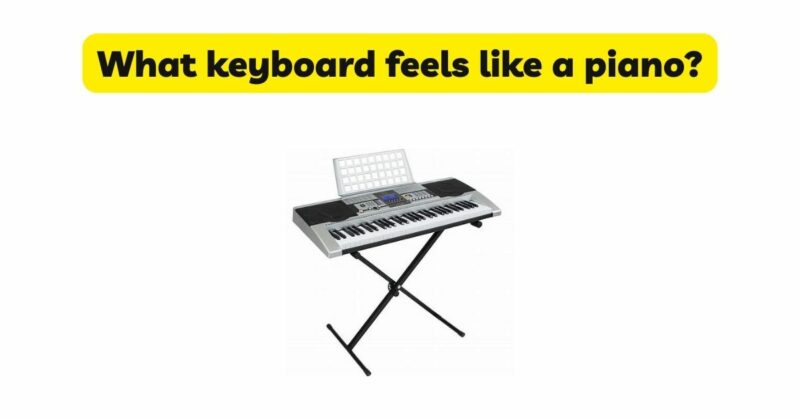
For musicians seeking a keyboard that closely emulates the tactile experience of playing a piano, finding an instrument with a realistic key feel is of utmost importance. The touch and responsiveness of the keys significantly impact a musician’s ability to express their musicality and connect with the instrument. In this article, we delve into the factors that contribute to a keyboard feeling like a piano, including key action, weight, responsiveness, escapement, and key material. By examining these factors, we aim to provide insights into the keyboards that come closest to replicating the authentic feel of a piano, helping musicians make an informed decision based on their playing style, preferences, and musical aspirations.
- Hammer Action Keyboards: Keyboards with hammer action key mechanisms are designed to mimic the feel of an acoustic piano. These keyboards incorporate weighted keys that simulate the weight and resistance of traditional piano keys. Hammer action keyboards go a step further by adding a mechanical system that replicates the movement and interaction of hammers with strings. This feature allows musicians to experience the sensation of pressing down on the keys and the subsequent action of the hammers, closely resembling the tactile response of playing an acoustic piano.
- Graded Key Action: Graded key action is another key element that contributes to a keyboard feeling like a piano. Acoustic pianos have keys that become progressively heavier as you move from the lower to the higher register. Keyboards with graded key action mimic this weight variation, offering keys that are lighter in the higher range and gradually become heavier as you descend. This characteristic allows musicians to develop a sense of control and familiarity similar to playing on an acoustic piano, as the key weight distribution closely aligns with their muscle memory.
- Responsiveness and Touch Sensitivity: An essential aspect of replicating the piano feel on a keyboard is the ability to convey the nuances and dynamics of a musician’s playing. Keyboards with high responsiveness and touch sensitivity accurately capture the subtleties of a musician’s touch, allowing for expressive control over the sound. These keyboards register subtle changes in velocity, enabling musicians to achieve variations in volume and timbre, just as they would on a piano. The sensitivity and responsiveness of the keys contribute to a more dynamic and immersive playing experience.
- Escapement and Key Release: Escapement is a mechanism found in acoustic pianos that provides a slight “notch” or “click” sensation when a key is depressed and released. This mechanical feature adds to the authenticity of the piano playing experience. Some high-end keyboards incorporate escapement simulation, which replicates this distinctive sensation when pressing and releasing keys. The inclusion of escapement in a keyboard enhances the realism and tactile feedback, allowing musicians to feel a familiar connection to the instrument.
- Key Material and Texture: The material and texture of the keys themselves can greatly influence the feel of a keyboard. Many keyboards use synthetic materials like plastic for the keys, while others employ materials such as synthetic ivory or ebony. These materials are designed to replicate the feel and texture of the natural materials used in acoustic pianos. The use of high-quality key materials can enhance the tactile experience and provide a closer resemblance to the touch and feel of playing on an acoustic piano.
- Hybrid Pianos: Hybrid pianos offer a unique combination of acoustic and digital elements, providing a realistic key feel while also offering the advantages of digital technology. These instruments feature a real acoustic piano action integrated with digital sound generation and customization options. The acoustic components provide the authentic touch and response of a real piano, ensuring a truly immersive playing experience. Hybrid pianos offer musicians the best of both worlds, merging the authentic feel of a piano with the versatility and digital capabilities of a keyboard.
Conclusion: While nothing can fully replace the tactile experience of playing an acoustic piano, keyboards have made significant advancements in replicating the authentic feel of the instrument. Keyboards with hammer action, graded key action, responsiveness, touch sensitivity, escapement simulation, and high-quality key materials come closest to emulating the feel of a piano. Additionally, hybrid pianos provide an excellent compromise, combining the real piano action with digital features. Each musician’s preferences, playing style, and musical aspirations will ultimately determine the most suitable keyboard that replicates the feel of a piano for them. It is important for musicians to try different keyboards, test the key action, and consider their personal connection and comfort with the instrument. By selecting a keyboard that closely resembles the touch and feel of a piano, musicians can enhance their musical expression, creativity, and enjoyment of playing.