
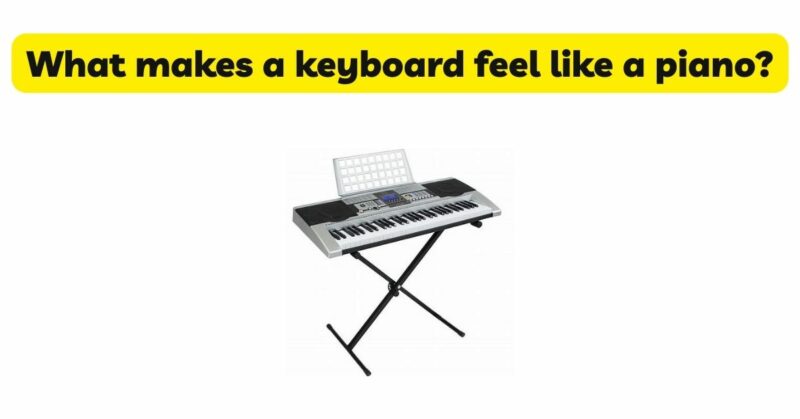
For musicians seeking an immersive and authentic playing experience, the feel of a keyboard is of utmost importance. Capturing the touch and response of a traditional piano can greatly enhance a musician’s ability to express their musicality and connect with the instrument. In this article, we delve into the elements that contribute to a keyboard feeling like a piano, including key action, key weight, key material, key shape, and key size. By examining these factors, we aim to provide insights into the features that create a piano-like feel in keyboards, helping musicians make an informed decision based on their playing style, preferences, and musical aspirations.
- Key Action: Key action refers to the mechanism by which the keys on a keyboard respond to the touch of the player. In a piano, the keys are connected to hammers that strike the strings, creating the sound. Keyboards aim to replicate this mechanism to create a piano-like feel. Weighted keys, also known as hammer action, simulate the weight and resistance of traditional piano keys. Some keyboards feature graded hammer action, where the keys in the lower register are heavier and gradually become lighter as you move up the keyboard. This key action mimics the feel of playing on an acoustic piano, allowing for a more authentic playing experience.
- Key Weight: The weight of the keys is an essential aspect of creating a piano-like feel. Acoustic piano keys have a specific weight and responsiveness that is unique to the instrument. Keyboards strive to replicate this weight by incorporating weighted or semi-weighted keys. Weighted keys provide resistance and a sense of touch that closely resembles playing on an acoustic piano. The level of key weight varies among keyboards, and musicians should consider their preferences and playing style to determine the ideal key weight that provides a piano-like experience.
- Key Material: The material used for the keys plays a role in creating a piano-like feel. Acoustic pianos traditionally use materials such as wood, and higher-end keyboards often mimic this material with synthetic alternatives. Some keyboards utilize synthetic ivory or ebony surfaces for their keys to replicate the feel and texture of real piano keys. The choice of key material can contribute to the tactile experience and authenticity of playing a piano, adding to the overall piano-like feel of the keyboard.
- Key Shape and Size: The shape and size of the keys are important factors in replicating the feel of a piano. Acoustic pianos have specific key dimensions and shape that are comfortable for most players. Keyboards aim to mirror these dimensions to provide a familiar and natural playing experience. Keys that are too small or irregularly shaped may not provide the same level of comfort and familiarity as those designed to resemble piano keys. Keyboards that closely match the size and shape of traditional piano keys can enhance the piano-like feel and facilitate seamless transitioning between a keyboard and a piano.
- Key Travel and Response: The travel distance and responsiveness of the keys also contribute to the piano-like feel. Acoustic pianos have a specific key travel distance, and the keys respond to subtle variations in touch and dynamics. Keyboards aim to replicate this key travel distance to provide a similar feel and response. Keyboards with a longer key travel distance and responsive sensors can capture the nuances of a musician’s playing, allowing for greater expressiveness and control over the sound. The combination of key travel and response enhances the authenticity and realism of the piano-like feel.
- Touch Sensitivity: Touch sensitivity is an essential element of a piano-like feel. Acoustic pianos respond to the varying degrees of pressure applied to the keys, resulting in variations in volume and tone. Keyboards with touch-sensitive keys can detect the velocity and intensity of a player’s touch, translating it into expressive and nuanced playing. This feature allows for dynamic control and articulation, closely resembling the responsiveness of an acoustic piano. Musicians should consider the touch sensitivity capabilities of keyboards to ensure a piano-like feel that facilitates their playing style and musical expression.
Conclusion: While keyboards cannot fully replicate the intricate mechanisms and nuances of playing an acoustic piano, advancements in technology and engineering have allowed them to come remarkably close in emulating the piano-like feel. Elements such as key action, key weight, key material, key shape, key size, key travel, and touch sensitivity contribute to creating a piano-like feel in keyboards. The combination of these factors can enhance a musician’s ability to express their musicality and connect with the instrument. It is important for musicians to consider their playing style, preferences, and budget when selecting a keyboard that delivers a piano-like feel. Ultimately, the choice between a keyboard and a piano depends on individual needs, portability requirements, and the balance between authenticity and versatility desired by each musician. By selecting a keyboard that provides a piano-like feel, musicians can enhance their playing experience, unlock their creativity, and enjoy the pleasure of making music.