
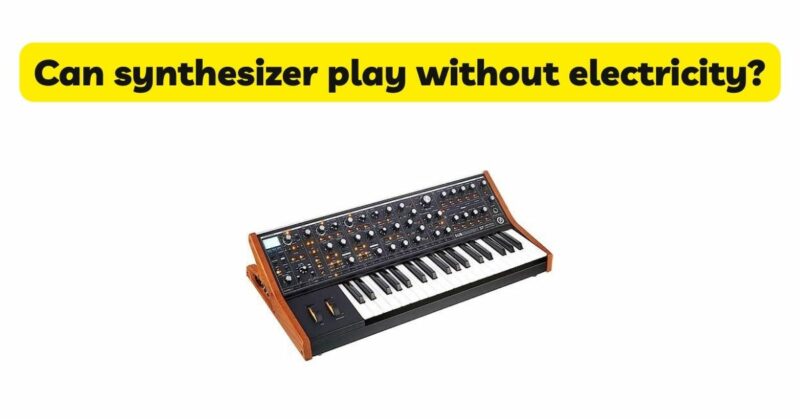
Synthesizers have long been associated with their reliance on electricity to generate sound. However, the question arises: Can a synthesizer play without electricity? In this article, we will explore the possibilities and alternative methods of playing synthesizers without traditional electrical power. By uncovering non-electrical avenues, we can discover new dimensions of creativity and expand the sonic potential of synthesizers.
- Acoustic Resonance and Mechanical Techniques: Although synthesizers are primarily electronic instruments, some components can resonate and produce sound through mechanical means. For example, striking or plucking the strings of a prepared piano can create unique and unconventional sounds. By creatively utilizing mechanical interactions and exploring acoustic resonance, synthesizer players can produce music that transcends traditional electrical boundaries.
- Wind-Powered Synthesizers: Some synthesizers can be adapted to utilize wind power as an alternative energy source. By incorporating bellows or other air-based mechanisms, players can generate airflow to trigger sound generation. These wind-powered synthesizers often require modifications or custom-built components to harness the power of moving air. Such instruments offer a unique and organic approach to sound creation, driven by natural forces.
- Analog Synthesis without Power: Analog synthesizers, known for their voltage-controlled circuits, can still produce sound without electrical power. By manually manipulating the control voltages, oscillators, and filters, players can generate tones and modulate the sound in real-time. This technique, known as “hand-cranking,” allows for an immediate and tactile interaction with the synthesizer, creating dynamic and ever-evolving sonic textures.
- Acoustic Instruments as Sound Sources: Synthesizers can also be used to process and manipulate the sound of acoustic instruments. By connecting an acoustic instrument, such as a guitar or flute, to a synthesizer’s input, players can explore the realm of sound manipulation and effects processing. The acoustic instrument serves as the sound source, while the synthesizer adds depth, modulation, and sonic transformation to create unique timbres and textures.
- Electromechanical Resonators: Electromechanical resonators provide an avenue for synthesizers to produce sound without relying solely on electrical power. By employing devices such as springs, metal plates, or resonant chambers, players can create sound through physical vibrations. When combined with the synthesis capabilities of the instrument, these resonators offer a blend of electronic control and physical interaction, resulting in distinctive and unconventional soundscapes.
- Sunlight and Solar-Powered Synthesizers: Innovative synthesizer designs have explored the possibilities of solar power as an alternative energy source. Solar-powered synthesizers incorporate photovoltaic cells to harness sunlight and convert it into electrical energy. While these instruments may require careful positioning and direct exposure to sunlight, they offer a sustainable and environmentally-friendly approach to playing synthesizers in outdoor or off-grid settings.
- Piezoelectric and Vibrational Sources: Piezoelectric elements can convert mechanical vibrations into electrical signals. By incorporating piezoelectric transducers or contact microphones, players can capture and amplify sounds generated by various vibrating sources, such as objects, surfaces, or even the human body. These signals can then be processed and manipulated by the synthesizer, opening up new avenues for experimentation and sonic exploration.
- DIY and Experimental Approaches: The world of DIY (Do-It-Yourself) and experimental instrument building provides an opportunity for musicians and enthusiasts to create synthesizers that operate without traditional electrical power. By incorporating alternative energy sources like hand-crank generators, mechanical contraptions, or even bioelectrical interfaces, players can challenge conventional notions of synthesizer performance and create unique sonic experiences.
Conclusion: While synthesizers are predominantly associated with their reliance on electricity, exploring non-electrical possibilities unveils a realm of creative potential. From acoustic resonance and mechanical techniques to wind-powered synthesizers and hand-cranking analog synths, the boundaries of sound creation expand beyond traditional electrical power sources. By embracing these alternative approaches, musicians can push the boundaries of sonic exploration, create unique timbres, and redefine the relationship between technology and sound. Whether through experimentation, DIY endeavors, or incorporating natural forces, the world of non-electrical synthesizer performance offers a glimpse into an untapped universe of sonic possibilities.