
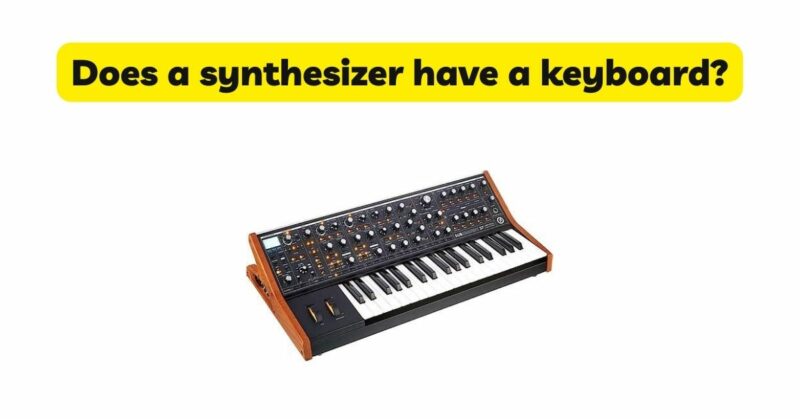
The world of synthesizers has always been fascinating, with its ability to create a wide range of unique and captivating sounds. One common question that arises among music enthusiasts is whether a synthesizer has a keyboard. This article aims to dispel the confusion and delve into the role of keyboards in synthesizers. By exploring the history, evolution, and diverse types of synthesizers, we will uncover the truth behind the presence or absence of keyboards in these versatile electronic instruments.
I. A Brief Overview of Synthesizers: Before addressing the keyboard aspect, let us briefly understand what a synthesizer is. Synthesizers are electronic musical instruments that generate and manipulate sound through various means, including oscillators, filters, amplifiers, and modulators. They allow musicians to create and shape sounds by combining and manipulating different parameters. Synthesizers have played a crucial role in shaping modern music, particularly in genres like electronic, pop, and experimental music.
II. The Historical Significance of Keyboards in Synthesizers: When synthesizers first emerged in the mid-20th century, they did not initially incorporate keyboards. The earliest synthesizers, such as the RCA Mark II Synthesizer and the Buchla Series, were modular in nature, consisting of separate components that musicians manipulated using cables and patching systems. These early synthesizers were primarily designed for experimental and academic purposes.
However, the integration of a keyboard into synthesizers occurred with the advent of the Moog synthesizer in the late 1960s. Robert Moog, a pioneer in the field, introduced the Minimoog Model D, which combined the synthesizer’s sound-generating components with a keyboard interface. This innovation marked a significant milestone, as it made synthesizers more accessible and playable for musicians, particularly those with a background in piano or keyboard instruments.
III. The Evolution of Keyboard-less Synthesizers: While the association between synthesizers and keyboards was established with the introduction of the Minimoog, it is essential to recognize that not all synthesizers include a traditional piano-like keyboard. As the field of electronic music expanded, synthesizer designs diversified to cater to different musical needs and experimental approaches. This led to the emergence of keyboard-less synthesizers that rely on alternative control interfaces.
A. Modular Synthesizers: Modular synthesizers, which harken back to the early days of synthesis, remain popular among electronic music enthusiasts. These systems consist of separate modules, such as oscillators, filters, envelope generators, and sequencers, which are connected using patch cables. Although some modular synthesizers offer optional keyboard modules or external keyboard controllers, the core system itself does not include a built-in keyboard.
B. Desktop and Rackmount Synthesizers: To meet the demands of professional studios and musicians seeking compact and portable solutions, manufacturers started producing synthesizers without built-in keyboards. These devices, often referred to as desktop or rackmount synthesizers, provide all the sound-generating components and controls necessary for sound manipulation. However, they require external MIDI controllers or sequencers to trigger and play the sounds.
C. Digital and Virtual Synthesizers: With advancements in technology, the rise of digital and virtual synthesizers brought about a new wave of keyboard-less instruments. Digital synthesizers, often in the form of software plugins or standalone units, rely on graphical interfaces to manipulate sounds. Virtual synthesizers, on the other hand, are software-based emulations of classic analog synthesizers, offering extensive sound design capabilities without the physical presence of a keyboard.
IV. The Role of Keyboards in Modern Synthesizers: Despite the availability of keyboard-less synthesizers, keyboards continue to play a significant role in the modern synthesizer landscape. Many synthesizers on the market today feature integrated keyboards, catering to musicians who prefer a tactile and familiar playing experience. These keyboards range from compact mini-keys to full-size, velocity-sensitive, and even aftertouch-enabled keys, providing expressive control over the synthesized sounds.
A. Performance and Live Applications: Synthesizers with integrated keyboards are particularly advantageous for live performances. The presence of a keyboard allows musicians to play melodies, chords, and intricate sequences in real-time, enhancing their stage presence and interaction with the audience. It also enables performers to explore various playing techniques, such as glissandos, pitch bending, and modulation, adding an extra layer of expressiveness to their performances.
B. Intuitive Sound Exploration: For musicians who have a background in piano or keyboard instruments, the integration of a keyboard into synthesizers offers a seamless transition and intuitive approach to sound exploration. The familiar layout of keys allows for easy experimentation with different scales, chord voicings, and improvisation techniques, facilitating creative expression and musicality.
C. MIDI Control and Integration: Keyboards in synthesizers often feature MIDI connectivity, enabling them to function as MIDI controllers for external devices, software, or other synthesizers. This versatility allows musicians to expand their sonic palette by triggering and controlling additional sound modules, virtual instruments, or digital audio workstations (DAWs), creating intricate and layered compositions.
Conclusion: In conclusion, the presence or absence of a keyboard in a synthesizer is not a definitive characteristic that defines the instrument. While synthesizers historically incorporated keyboards to enhance accessibility and playability, the evolution of the field has led to the development of keyboard-less alternatives. Nevertheless, keyboards continue to hold a prominent role in modern synthesizers, offering intuitive playing interfaces, expressive control, and enhanced live performance capabilities. Ultimately, the choice between a keyboard-equipped or keyboard-less synthesizer depends on the musician’s preferences, musical goals, and the specific creative possibilities they wish to explore.