
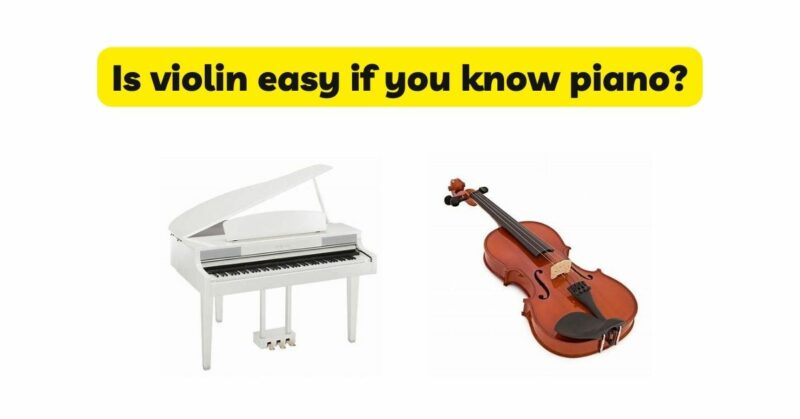
The relationship between learning the piano and the violin extends beyond the transferable skills mentioned in the previous article. If you already possess piano skills, you may wonder if this prior knowledge makes learning the violin easier. While the two instruments differ in many aspects, there are certain areas where your piano background can provide a solid foundation and facilitate your journey into the world of violin playing. In this article, we will explore the ways in which knowing the piano can potentially make learning the violin a more accessible and smoother process.
- Musical Fundamentals: One of the key advantages of having prior piano knowledge when learning the violin is a solid understanding of musical fundamentals. Concepts such as rhythm, pitch, dynamics, and notation are already familiar to you as a pianist. This familiarity helps you grasp these fundamentals quicker when applied to the violin. For example, you are already accustomed to reading sheet music, identifying note values, and understanding time signatures, which will give you a head start in learning the violin’s musical notation.
- Music Theory and Scales: Piano players often have a strong foundation in music theory, including scales and key signatures. This theoretical knowledge translates well to the violin, as scales and key signatures are crucial aspects of violin technique and repertoire. By knowing the theory behind scales, you can quickly adapt your piano knowledge to the violin fingerings and learn new scales efficiently. Understanding the relationships between scales and their corresponding key signatures will aid in memorization and overall comprehension of violin music.
- Finger Dexterity and Coordination: Playing the piano requires intricate finger dexterity and hand-eye coordination. These skills directly transfer to the violin, where precise finger placement and bowing techniques are crucial for producing clear and accurate notes. Piano-trained fingers are often nimble, accustomed to independent movement, and can adapt to the unique challenges of violin fingerings and shifting. Moreover, the hand-eye coordination developed while playing the piano can help you navigate the violin fingerboard with greater ease and accuracy.
- Ear Training and Intonation: Piano players often possess a well-developed sense of relative pitch due to the fixed tuning of the piano. This relative pitch recognition can aid in developing a good ear for intonation on the violin. The ability to recognize intervals and harmonies, honed through piano training, will help you discern and adjust your intonation more effectively on the violin. This skill allows for greater precision when playing in tune and contributes to the overall quality of your sound as a violinist.
- Sight-Reading and Music Interpretation: Sight-reading is an essential skill for any musician, and piano players tend to excel in this area. The ability to read multiple lines of music simultaneously and decipher complex rhythms transfers well to violin playing. While the specific techniques and fingerings may differ, your experience with sight-reading on the piano can significantly shorten the learning curve when reading violin sheet music. Additionally, your musical interpretation skills developed through piano playing can be applied to the violin, enabling you to bring out the expressive nuances of the music with greater ease.
- Performance Confidence: If you have experience performing on the piano, you already possess a certain level of performance confidence. This confidence can carry over to your violin playing, allowing you to feel more at ease when performing in front of others. Familiarity with stage presence, overcoming performance anxiety, and understanding the process of preparation and practice can positively impact your violin performances. Drawing from your piano performance experience, you can transfer your knowledge of stage etiquette, expression, and musical presentation to your violin performances, giving you an edge in your musical journey.
Conclusion: While the violin and piano are distinct instruments with unique techniques and challenges, there are undeniable benefits to learning the violin if you already possess piano skills. The musical foundation, knowledge of theory, finger dexterity, hand-eye coordination, ear training, sight-reading ability, and performance confidence gained from playing the piano can all contribute to a smoother and more accessible path when embarking on the violin journey. While the learning process will still require dedication, practice, and patience, your prior piano knowledge provides a valuable framework that will accelerate your progress and deepen your understanding of music as you embark on mastering the beautiful art of playing the violin.