
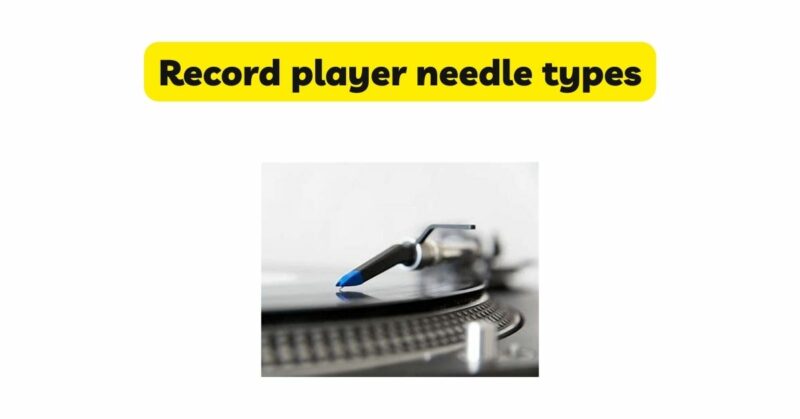
Record player needles, also known as stylus, are essential components that directly interact with the grooves of vinyl records, translating the physical vibrations into audible sound. Understanding the different types of record player needles is crucial for achieving optimal sound quality, extending the life of your records, and maximizing the performance of your turntable. In this article, we will explore various record player needle types, including their designs, materials, profiles, and their impact on sound reproduction. By gaining knowledge about these needle types, you can make informed decisions when selecting the most suitable needle for your record player setup.
- Conical Needle: The conical needle is the most common and basic type of record player needle. Its stylus profile is conical-shaped, featuring a rounded tip that comes into contact with the record grooves. Key features of the conical needle include:
- Design: The conical needle has a simple design, with a rounded tip that tracks the grooves of the record. It is often made of diamond or synthetic materials.
- Sound Characteristics: Conical needles offer reliable tracking and are less prone to damage caused by off-center records. However, they may not provide the same level of detail and accuracy as more advanced needle types.
- Suitable Applications: Conical needles are suitable for general listening purposes and are commonly found in entry-level turntables.
- Elliptical Needle: The elliptical needle features an elliptical-shaped stylus profile, which provides improved contact with the record grooves compared to the conical needle. Here are the key aspects of the elliptical needle:
- Design: The elliptical needle has a more elongated and narrow stylus tip compared to the conical needle. It allows for better tracking and retrieval of audio information from the record grooves.
- Sound Characteristics: Elliptical needles offer enhanced sound quality with improved detail, clarity, and channel separation compared to conical needles. They are particularly effective at reproducing high-frequency sounds and capturing subtle nuances.
- Suitable Applications: Elliptical needles are suitable for both casual listening and more demanding audiophile applications. They are often found in mid-range to high-end turntables.
- Microline (Shibata) Needle: The microline needle, also known as the Shibata needle, features a highly refined and narrow stylus profile. It is designed to maximize contact with the record grooves and extract the most accurate audio information. Here are the key characteristics of the microline needle:
- Design: The microline needle has an intricate, advanced stylus profile that allows for precise tracking of the record grooves. It is often made of diamond or other high-quality materials.
- Sound Characteristics: Microline needles offer exceptional sound reproduction, with improved detail, clarity, and channel separation compared to both conical and elliptical needles. They excel at retrieving high-frequency information and capturing the finest nuances of the music.
- Suitable Applications: Microline needles are typically found in high-end turntables and are favored by audiophiles and enthusiasts seeking the utmost fidelity and accuracy in their vinyl playback.
- Line Contact (Contact Line) Needle: The line contact needle, also referred to as the contact line needle, features a stylus profile that combines elements of both conical and elliptical designs. It offers a compromise between wide groove compatibility and enhanced audio reproduction. Consider the following aspects of the line contact needle:
- Design: The line contact needle has a stylus profile with a narrow contact area that resembles a line. It provides improved groove tracking while still maintaining a wider contact surface compared to microline needles.
- Sound Characteristics: Line contact needles offer enhanced sound quality, with improved detail, separation, and low-frequency response compared to conical needles. They strike a balance between compatibility and audio fidelity.
- Suitable Applications: Line contact needles are suitable for users who desire a balance between compatibility with a wide range of records and improved sound reproduction. They are commonly found in mid-range to high-end turntables.
It is worth noting that some needle manufacturers may use different terminology to describe their needle types. For example, the elliptical and microline needles may be marketed under proprietary names by different manufacturers.
Conclusion: Understanding the various types of record player needles is essential for selecting the right one that suits your listening preferences, turntable capabilities, and the condition of your vinyl records. The conical, elliptical, microline, and line contact needles each offer different levels of performance, sound quality, and compatibility. While the conical needle provides a basic option suitable for general listening, the elliptical needle offers improved sound reproduction. The microline needle excels in accuracy and detail, while the line contact needle strikes a balance between compatibility and audio fidelity. Consider the capabilities of your turntable, the condition of your records, and your desired sound quality when selecting the most appropriate needle type. By making an informed choice, you can enhance your vinyl listening experience and ensure the longevity of your cherished record collection.