
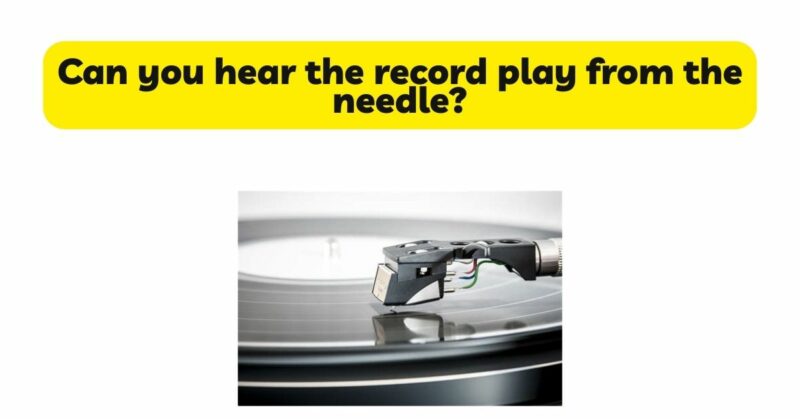
The advent of digital technology has revolutionized the way we experience and consume music. Today, the majority of music is streamed or downloaded from online platforms, while physical formats such as vinyl records have been overshadowed. However, there remains a devoted community of audiophiles and music enthusiasts who champion the unique qualities of analog sound reproduction. One of the fundamental components of this analog experience is the needle or stylus, which translates the physical grooves of a vinyl record into audible sound. In this article, we will delve into the intricate workings of the needle and explore whether it is possible to hear the record play directly from this delicate component.
- The Anatomy of a Record Player: To understand how the needle plays a role in sound reproduction, it is essential to familiarize ourselves with the components of a record player. A typical turntable consists of a platter, tonearm, cartridge, and stylus. The stylus, also known as the needle, is attached to the cartridge, which houses the mechanism responsible for generating electrical signals from the grooves on the record.
- The Mechanics of Sound Reproduction: When a vinyl record is played, the stylus traces the grooves, which encode the audio information. As the stylus moves, it vibrates within the grooves, transmitting these vibrations to the cartridge. The cartridge then converts these mechanical vibrations into electrical signals, which are subsequently amplified and sent to the speakers or headphones, allowing us to hear the recorded sound.
- The Needle as a Transducer: The needle serves as a crucial transducer in the audio chain. Its primary function is to convert the physical motion of the stylus within the grooves into electrical signals. The shape, size, and material composition of the needle greatly influence its ability to accurately track the grooves and reproduce the audio faithfully.
- Tracking and the Importance of Alignment: One of the key challenges faced by the needle is maintaining proper tracking, which refers to the needle’s ability to accurately follow the intricate contours of the grooves. Alignment, the proper positioning of the stylus in relation to the record, is critical for achieving optimal tracking. A well-aligned needle ensures minimal distortion and wear on the record.
- The Role of Needle Design: Needles come in different shapes and sizes, each designed to meet specific requirements and preferences. The two main categories are the spherical (conical) and elliptical (bi-radial) stylus types. Spherical needles have a rounded tip and are known for their durability, while elliptical needles have a finer profile, resulting in improved tracking and higher fidelity.
- Tactile Sensations: Can You Feel the Needle? While the primary purpose of the needle is to convert the grooves’ physical motion into electrical signals, there is a tactile aspect to the experience as well. When listening to a record, particularly with a high-quality sound system, one can often feel subtle vibrations and resonance through the turntable, tonearm, and even the needle itself. These tactile sensations add another layer to the listening experience.
- Debunking the Myth: Can You Hear the Record Play? Contrary to popular belief, it is not possible to hear the record play directly from the needle itself. The needle’s primary role is to convert the physical vibrations into electrical signals, which are then amplified and transformed into audible sound by the speakers or headphones. The needle acts as a conduit, not a sound source.
- The Importance of Proper Setup and Maintenance: To ensure the best possible sound reproduction and longevity of both the needle and the records, proper setup and regular maintenance are essential. This includes correct alignment, appropriate tracking force, and periodic cleaning of the needle. Neglecting these aspects can result in degraded sound quality, premature wear on the record, and potential damage to the needle itself.
Conclusion: Although the needle or stylus is a critical component of analog sound reproduction, it does not directly produce the audible sound. Instead, the needle acts as a transducer, converting the physical vibrations of the grooves into electrical signals that are then amplified and transformed into sound by speakers or headphones. Understanding the intricacies of the needle and its role in the audio chain can enhance our appreciation for the art of analog sound reproduction. So, the next time you listen to a vinyl record, remember that the magic lies not in the needle alone, but in the entire system working harmoniously to bring music to life.