
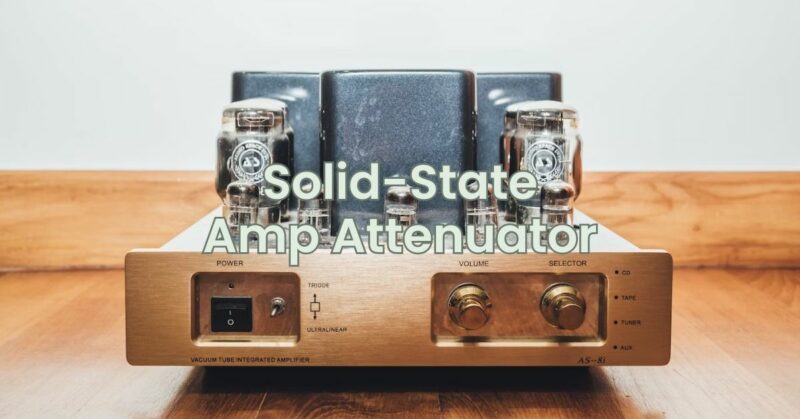
Solid-state amplifiers are known for their accurate and transparent sound reproduction. To achieve optimal sound levels and precise volume control, many solid-state amplifiers are equipped with an attenuator. In this article, we will delve into the world of solid-state amp attenuators, exploring their purpose, functionality, types, and the benefits they offer to audio enthusiasts.
Understanding Solid-State Amp Attenuators: An attenuator, in the context of solid-state amplifiers, refers to a control mechanism that allows users to adjust the volume level of the amplifier output. Attenuators act as a passive or active interface between the amplifier and the speakers, providing control over the signal strength while maintaining signal integrity.
- Purpose and Functionality: The primary purpose of a solid-state amp attenuator is to provide precise volume control. It enables users to adjust the output level of the amplifier to match their listening preferences or the requirements of the audio content. Attenuators allow for both attenuation (reduction of signal level) and unity gain (no level change).
- Types of Attenuators: a. Passive Attenuators: Passive attenuators consist of resistors and potentiometers (volume knobs) that reduce the signal level by varying the resistance in the signal path. These attenuators do not require additional power and are simple in design. They can be incorporated as part of the amplifier circuit or as external devices connected to the amplifier’s output.
b. Active Attenuators: Active attenuators utilize active circuitry, such as operational amplifiers (op-amps), to attenuate the signal level. They often provide additional features such as impedance matching and amplification compensation to maintain consistent audio quality across various volume settings. Active attenuators may require a power source for their operation.
- Benefits of Solid-State Amp Attenuators: a. Precise Volume Control: Attenuators allow users to finely adjust the volume level, enabling them to find the optimal listening level for their environment and personal preferences.
b. Signal Integrity: Well-designed attenuators maintain signal integrity and transparency, ensuring minimal impact on the audio quality and dynamics of the amplified signal.
c. Speaker Protection: Attenuators help protect speakers from excessive power levels, particularly when used with high-power amplifiers. By allowing users to set appropriate output levels, attenuators can prevent damage to speakers and ensure safe operation.
d. Improved Signal-to-Noise Ratio: Attenuators can effectively attenuate the signal level, reducing the noise floor and improving the overall signal-to-noise ratio of the audio system.
- Integration and Control: Solid-state amp attenuators can be integrated into the amplifier as built-in controls or offered as standalone units. Built-in attenuators are typically operated through knobs or buttons located on the amplifier itself. Standalone attenuators provide flexibility and can be placed in the signal path between the amplifier and speakers, allowing for easy adjustment and control.
Conclusion: Solid-state amp attenuators play a vital role in achieving precise volume control and optimal listening experiences. Whether they are passive or active, attenuators offer the ability to adjust the output level of the amplifier while maintaining signal integrity and protecting speakers. By incorporating a solid-state amp attenuator into your audio system, you can fine-tune the volume to suit your preferences, ensure proper speaker handling, and enjoy a more immersive and controlled listening experience.