
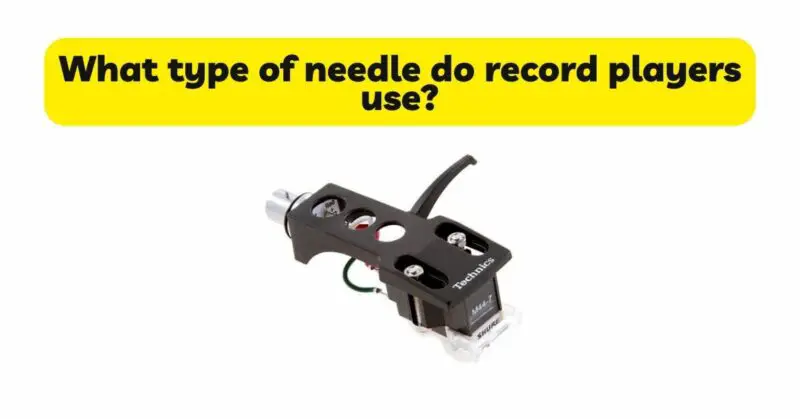
Record players, also known as turntables, rely on a crucial component called the needle or stylus to accurately track the grooves of vinyl records. Needles play a significant role in the playback process, converting the physical grooves into electrical signals that can be amplified and reproduced as sound. In this article, we will delve into the world of record player needles, exploring the different types available and their characteristics, helping you understand which type of needle is commonly used in record players.
- Standard Elliptical Needle: One of the most common types of needles used in record players is the standard elliptical needle. These needles have an elliptical-shaped diamond tip that contacts the grooves of the record. The elliptical shape allows for precise tracking and good sound reproduction. Standard elliptical needles strike a balance between sound quality and record wear, making them suitable for general playback purposes.
- Conical Needle: Conical needles feature a rounded tip, similar to the shape of a cone. They are often found on entry-level or vintage record players. While conical needles are less precise than elliptical or more advanced designs, they can still provide adequate sound reproduction for casual listening. Conical needles are generally more forgiving in terms of tracking and can be a suitable option for older or lower-quality records.
- Microline and Line Contact Needles: Microline and line contact needles are advanced designs that feature a finer, tapered profile compared to standard elliptical needles. These needles excel at tracking high-frequency information and extracting fine details from the record grooves. The microline design, also known as the fine-line stylus, has a narrower contact area, enabling improved tracking and reduced distortion. Line contact needles, also known as Shibata or Van den Hul needles, have a wider contact area that helps minimize distortion and retrieve more information from the record grooves. Microline and line contact needles are commonly found in higher-end record players and offer enhanced clarity and resolution.
- Moving Magnet (MM) and Moving Coil (MC) Cartridges: Record players use cartridges that house the needle or stylus. Two common types of cartridges are moving magnet (MM) and moving coil (MC) cartridges. MM cartridges have a replaceable needle/stylus attached to a small magnet. They are typically more affordable and offer a wide variety of needle options. MC cartridges, on the other hand, have a coil attached to the needle/stylus, which moves between magnets. MC cartridges are generally more expensive and offer higher fidelity and detail retrieval but may require a more specialized needle replacement process.
- P-Mount (T4P) Cartridges: P-Mount cartridges, also known as T4P cartridges, have a standardized plug-and-play design. These cartridges are commonly found on entry-level or automatic turntables. P-Mount cartridges feature a fixed vertical tracking angle, which eliminates the need for tonearm adjustments. The needles for P-Mount cartridges are generally interchangeable and easily replaceable.
- Half-Inch Mount Cartridges: Half-inch mount cartridges have a half-inch distance between the two screw holes on the headshell. They are commonly used on higher-end record players and offer greater flexibility for cartridge and needle upgrades. Half-inch mount cartridges allow for more precise alignment adjustments and offer a wider range of needle options.
- 78 RPM Needles: In addition to the aforementioned types, there are specialized needles designed specifically for playing 78 RPM records. 78 RPM records have wider grooves and require a different type of needle to achieve optimal playback. These needles are typically wider and have a more robust construction to handle the demands of 78 RPM playback. They are not compatible with standard LP records and require either a specialized cartridge or interchangeable stylus options for versatile playback.
- Customization and Upgrades: Record player enthusiasts often seek opportunities to upgrade their cartridges and needles to improve sound quality and cater to their specific preferences. Customized and audiophile-grade needles are available, offering superior materials, advanced designs, and meticulous craftsmanship. These options provide enhanced performance and cater to the needs of discerning audiophiles.
Conclusion: Record players utilize various types of needles depending on the design, model, and intended purpose. Standard elliptical needles are the most common and strike a balance between sound quality and record wear. Conical needles are suitable for entry-level or vintage record players. Microline and line contact needles offer advanced tracking capabilities and improved detail retrieval. Moving magnet and moving coil cartridges house the needles and offer different levels of fidelity. P-Mount and half-inch mount cartridges provide compatibility and flexibility for needle replacements and upgrades. Specialized 78 RPM needles cater to the unique demands of 78 RPM records. Ultimately, the choice of needle depends on the specific requirements of your record player and your desired sound quality. Understanding the different needle types empowers you to make informed decisions when selecting or upgrading the needle for your record player, enhancing your vinyl listening experience.