
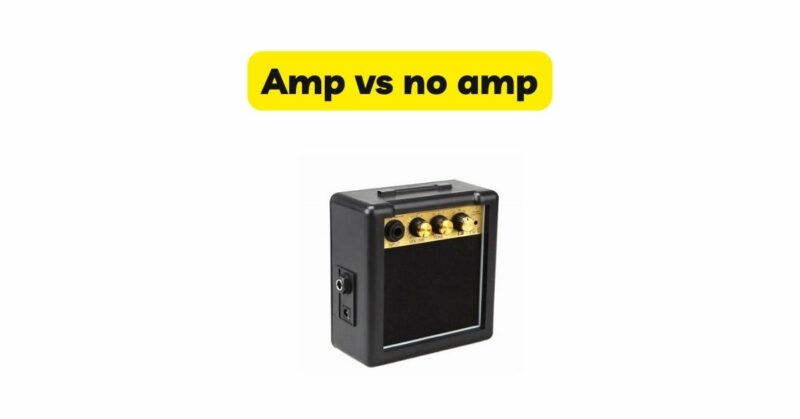
When setting up an audio system, one important decision to consider is whether to use an amplifier or rely solely on the built-in amplification of source devices or active speakers. The choice between an amplifier and no amplifier can significantly impact the overall sound quality and listening experience. In this article, we will explore the differences and advantages of using an amplifier versus not using one, helping you make an informed decision based on your audio needs and preferences.
- Power and Control: One of the primary advantages of using an amplifier is the increased power it provides to drive speakers or headphones. Amplifiers are designed to deliver clean and robust power, ensuring that speakers can reproduce sound accurately and with greater control. The additional power reserves enable speakers to handle dynamic peaks effortlessly, resulting in improved clarity, transient response, and overall sound reproduction. Without an amplifier, the power output may be limited, leading to compromised dynamics and reduced sonic impact.
- Improved Sound Quality: Using an amplifier can significantly enhance the sound quality of an audio system. Dedicated amplifiers are engineered to minimize distortion and maintain signal integrity, ensuring faithful reproduction of the audio signal. They operate with lower levels of noise, resulting in a higher signal-to-noise ratio and improved clarity. Amplifiers provide better control over speaker drivers, reducing resonances and colorations that can affect sound accuracy. As a result, using an amplifier often leads to a more transparent, detailed, and immersive listening experience.
- Customization and Flexibility: Amplifiers offer greater customization and flexibility compared to relying solely on built-in amplification. Many amplifiers provide tone controls, equalization options, or adjustable settings that allow users to tailor the sound to their preferences or the acoustic characteristics of the listening environment. This customization empowers listeners to adjust the tonal balance, tweak frequency responses, or fine-tune the sound to achieve a more personalized and satisfying audio experience. Without an amplifier, users may have limited control over the sound characteristics.
- Driving Challenging Loads: Certain speakers or headphones may have demanding impedance or power requirements that cannot be adequately met by the built-in amplification of source devices. Using a dedicated amplifier ensures that speakers or headphones receive the necessary power and drive to perform optimally. Amplifiers with higher power output capabilities ensure that challenging loads are properly driven, resulting in improved sound quality without distortion or compromise. Without an amplifier, users may experience limitations in the compatibility and performance of their audio system.
- Expandability and Future-Proofing: Using an amplifier allows for expandability and future-proofing of the audio system. Amplifiers often feature multiple inputs and outputs, enabling users to connect various audio sources and expand the system as needed. This versatility allows for seamless integration of new components, such as turntables, CD players, or streaming devices, without sacrificing sound quality. Additionally, upgrading an amplifier in the future can lead to noticeable improvements in sound quality, ensuring that the audio system remains adaptable to evolving technologies and preferences.
- Compatibility with Passive Speakers: Amplifiers are essential when using passive speakers that require external amplification. Passive speakers lack built-in amplifiers and rely on dedicated power sources to function. In such cases, using an amplifier is not optional but necessary to drive the passive speakers effectively. Amplifiers provide the necessary power and control to achieve optimal performance from passive speakers, ensuring accurate sound reproduction and enabling users to take full advantage of their speaker’s capabilities.
- Space and Cost Considerations: On the other hand, not using an amplifier can be advantageous in terms of space and cost considerations. Many active speakers, soundbars, or powered monitors come with built-in amplifiers, eliminating the need for a separate amplifier unit. This integration can simplify the setup process, reduce cable clutter, and potentially lower the overall cost of the audio system. Additionally, integrated amplification in these active speakers is often optimized for the specific speaker model, ensuring a good balance between the amplifier and speaker components.
- Portability and Convenience: Not using an external amplifier can offer portability and convenience, especially for those who require a compact and portable audio setup. Integrated amplification in active speakers or portable audio devices allows for easy transport and setup without the need for additional components. This portability is beneficial for those who frequently move their audio system or need flexibility in different environments. Portable audio devices, such as headphones or portable speakers, often feature built-in amplification, ensuring a self-contained and convenient audio solution.
- System Integration and Aesthetic Appeal: The decision to use or not use an amplifier also depends on the desired system integration and aesthetic appeal. Some users prefer a minimalist setup, where audio components are hidden or integrated seamlessly into the room decor. In such cases, relying on active speakers or built-in amplification can provide a cleaner and more visually appealing setup. On the other hand, using a separate amplifier can allow for a more modular system configuration, providing flexibility for component upgrades and customization.
Conclusion: The choice between using an amplifier or relying solely on built-in amplification depends on various factors, including power requirements, desired sound quality, customization options, and system integration preferences. Amplifiers offer increased power, improved sound quality, customization capabilities, and compatibility with passive speakers. They provide the necessary control, dynamics, and fidelity for optimal sound reproduction. However, not using an external amplifier can be advantageous in terms of space, cost, portability, and aesthetic appeal. Ultimately, the decision should be based on individual audio needs, preferences, and the specific requirements of the audio system.