
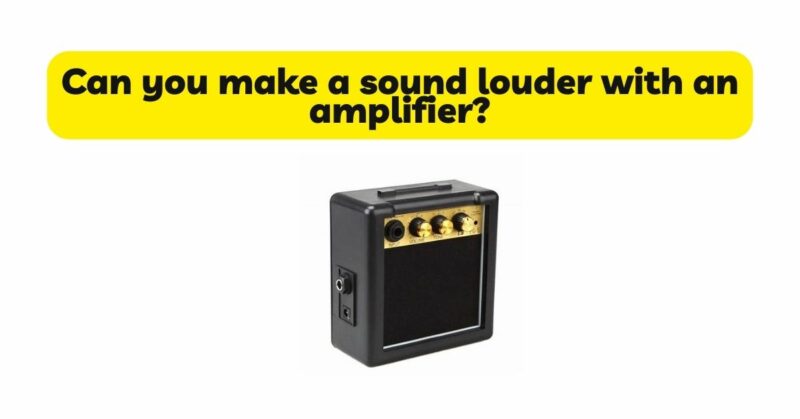
Sound, a fundamental aspect of our daily lives, has the power to captivate, inspire, and move us. Whether it’s the soaring melodies of a symphony orchestra or the thundering beats at a rock concert, sound plays a crucial role in shaping our experiences. In this article, we delve into the fascinating world of audio amplification and explore the question: Can you make a sound louder with an amplifier? Join us as we uncover the science behind amplification and discover how this technology unlocks the potential for creating and enhancing sound.
Understanding Sound and Amplification: Before we dive into the concept of amplification, it’s important to understand the nature of sound. Sound is a mechanical wave that propagates through various mediums, such as air, water, or solids. It consists of compressions and rarefactions, creating a pattern of high and low-pressure regions. The loudness or volume of a sound is determined by its amplitude, which refers to the magnitude of these pressure variations.
Amplification, on the other hand, is the process of increasing the amplitude or power of a signal without distorting its original characteristics. An audio amplifier, a device commonly used in sound systems, is designed to receive an input signal and boost its power to produce a stronger output signal. This enhanced signal can then drive speakers or headphones, resulting in a louder sound.
The Role of Amplifiers: Amplifiers serve as the backbone of audio systems, whether it’s a home stereo, a live concert setup, or a public address (PA) system. They take a weak electrical signal from a source, such as a microphone or a musical instrument, and amplify it to a level suitable for driving speakers or other audio devices. The primary function of an amplifier is to increase the amplitude of the signal while maintaining fidelity and minimizing distortion.
Types of Amplifiers: There are various types of amplifiers, each with its unique characteristics and applications. Some common types include:
- Vacuum Tube Amplifiers: These classic amplifiers, often referred to as “tube amps,” use vacuum tubes to amplify the signal. They are known for their warm, rich, and sometimes “vintage” sound. Tube amps are popular among audiophiles and musicians seeking a particular sonic character.
- Solid-State Amplifiers: Solid-state amplifiers utilize transistors and other semiconductor devices to amplify the signal. They are more compact, efficient, and durable compared to tube amps. Solid-state amplifiers are widely used in a range of audio applications, including home theater systems, guitar amplifiers, and professional sound reinforcement setups.
- Digital Amplifiers: Digital amplifiers, also known as Class-D amplifiers, employ pulse-width modulation (PWM) techniques to amplify the signal. They offer high efficiency and compactness, making them suitable for portable audio devices, car audio systems, and modern home theater setups.
The Amplification Process: Now, let’s explore the amplification process itself. When an audio signal enters an amplifier, it passes through several stages that collectively increase its power and amplitude. These stages typically include:
- Input Stage: The input stage of an amplifier receives the weak audio signal and prepares it for further processing. It may involve impedance matching, voltage amplification, and filtering to ensure compatibility with the amplifier’s subsequent stages.
- Gain Stage: The gain stage is responsible for amplifying the signal to the desired level. It uses active components, such as transistors or tubes, to boost the voltage or current of the signal while maintaining linearity and minimizing distortion.
- Output Stage: The output stage is where the amplified signal is delivered to the speakers or other audio devices. This stage provides the necessary power to drive the load (e.g., speakers) and match their impedance for optimal performance.
Signal-to-Noise Ratio and Distortion: While amplification increases the sound’s volume, it’s essential to maintain signal integrity and minimize unwanted noise or distortion. Two crucial aspects in this regard are the signal-to-noise ratio (SNR) and distortion levels.
The SNR represents the ratio of the desired signal level to the background noise level introduced by the amplifier itself. A high SNR indicates a cleaner and more accurate sound reproduction.
Distortion refers to any alterations or deviations from the original signal. Amplifiers strive to keep distortion levels as low as possible to preserve the sound’s fidelity. Different types of amplifiers exhibit varying levels and types of distortion, leading to subjective preferences among listeners and audio professionals.
Beyond Volume: Sound Quality and Speaker Efficiency: Amplification not only increases the sound’s volume but also influences its overall quality and impact. The choice of amplifier and its interaction with the speakers can significantly affect the tonal characteristics, frequency response, and dynamics of the sound.
Additionally, the efficiency of the speakers plays a vital role in the overall loudness achieved. An amplifier can provide substantial power, but if the speakers cannot efficiently convert that power into acoustic energy, the desired volume may not be achieved. Therefore, the selection and matching of amplifiers and speakers are crucial to achieving optimal sound reproduction.
Conclusion: In conclusion, an amplifier is a powerful tool for making sound louder. By increasing the amplitude or power of an audio signal, amplifiers unlock the potential for enhanced sound experiences in various settings, ranging from personal audio setups to large-scale concert systems. However, amplification is not solely about volume; it also shapes the quality, dynamics, and fidelity of the sound. As technology advances, amplifiers continue to evolve, offering new possibilities for sound reproduction and pushing the boundaries of our auditory experiences.