
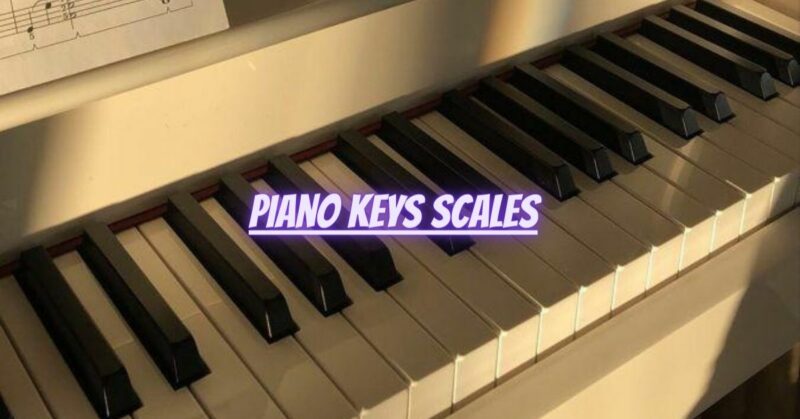
Scales are the building blocks of music, providing a framework for melodies, harmonies, and compositions. As a pianist, understanding and mastering scales on the piano keys are fundamental skills that open doors to creativity and musical expression. In this article, we will delve into the world of piano keys scales, exploring their structure, types, and significance in piano playing.
1. The Foundation of Scales:
Scales are sequences of musical notes played in ascending or descending order, following specific patterns of whole steps (W) and half steps (H). The most basic scale is the major scale, which serves as the foundation for many other scales.
2. Major Scale:
The major scale is a fundamental piano keys scale, consisting of seven notes, with specific intervals between each note. The pattern for a major scale is W-W-H-W-W-W-H (whole-whole-half-whole-whole-whole-half). Understanding this pattern enables pianists to play major scales in any key.
3. Natural Minor Scale:
The natural minor scale is another essential scale, sharing the same notes as its relative major scale but starting and ending on a different note. The pattern for a natural minor scale is W-H-W-W-H-W-W (whole-half-whole-whole-half-whole-whole).
4. Harmonic and Melodic Minor Scales:
The harmonic minor scale features a raised seventh note compared to the natural minor scale, creating a unique sound and providing more options for harmonic progression. The melodic minor scale has different ascending and descending patterns, with a raised sixth and seventh notes in the ascending scale and natural notes in the descending scale.
5. Pentatonic Scales:
Pentatonic scales are five-note scales that omit specific notes, creating a pleasing and versatile sound. The major pentatonic scale comprises five notes of the major scale, while the minor pentatonic scale includes five notes of the natural minor scale.
6. Chromatic Scale:
The chromatic scale includes all twelve notes within an octave, moving in half steps. It provides a colorful and expressive palette for creating tension and resolution in music.
7. Blues Scale:
The blues scale is a variation of the minor pentatonic scale, incorporating an additional lowered fifth note. It is commonly used in blues and jazz genres for its distinctive sound and expressive possibilities.
8. Modes:
Modes are variations of the major scale, starting on different degrees of the scale. Each mode has its unique pattern of whole and half steps, resulting in diverse tonalities and emotions.
9. Practicing Scales:
Regularly practicing scales on the piano keys enhances finger dexterity, strengthens finger independence, and improves overall technique. Focus on playing scales with precision and evenness to develop a solid foundation for more complex pieces.
10. Applying Scales in Music:
As a pianist, scales are essential tools for understanding music theory, improvisation, and creating melodies. Composers and improvisers use scales to craft beautiful melodies and harmonies, infusing their music with emotion and creativity.
Conclusion:
Piano keys scales are the keys to understanding the language of music and unlocking the full potential of piano playing. Mastering scales provides a solid foundation for musical exploration, creativity, and expression. By practicing scales regularly and understanding their patterns and structures, pianists can elevate their playing and confidently venture into various musical genres and styles. Embrace the world of piano keys scales, and let it guide you on a captivating journey of musical discovery and self-expression. Happy playing!