
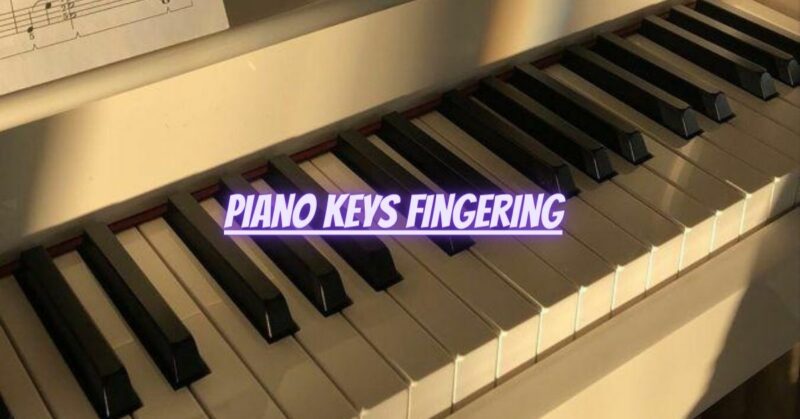
Fingering is a fundamental aspect of piano playing that involves the strategic assignment of fingers to specific piano keys, facilitating smooth and effortless execution of musical passages. Proper fingering allows pianists to navigate complex pieces with precision, control, and speed, enhancing their overall performance quality. In this article, we’ll explore the significance of piano keys fingering, the benefits it offers, and practical tips to develop effective fingering techniques.
The Importance of Piano Keys Fingering:
- Efficiency: Well-chosen fingering minimizes hand movements, enabling pianists to play with greater efficiency and accuracy.
- Control: Proper fingering allows for better control over dynamics, articulation, and phrasing, enhancing the expressiveness of the music.
- Technical Mastery: Effective fingering facilitates the execution of challenging passages, contributing to a higher level of technical proficiency.
- Avoiding Tension: Appropriate fingering reduces tension in the hands and fingers, promoting a relaxed and comfortable playing experience.
Principles of Piano Keys Fingering:
- Natural Hand Shape: Follow the natural curvature of the fingers, utilizing the fingertips to strike the keys. Avoid flat or tense hand positions.
- Thumb Under: Use the “thumb under” technique to smoothly transition the thumb from one hand position to another. This is particularly useful when moving from one octave to another.
- Avoiding the Weak Finger: Avoid using the weakest finger (usually the fifth finger) to begin a passage, as it may lead to uneven playing. Use stronger fingers when possible.
- Finger Substitution: When playing consecutive notes with the same finger, consider using finger substitution to avoid unnecessary hand movements.
Developing Effective Fingering Techniques:
- Study the Score: Before starting to play a piece, study the score carefully and identify sections where fingering changes are necessary.
- Start Slowly: Begin practicing at a slow tempo, focusing on the correct fingering and hand positions. Gradually increase the speed as you become more comfortable.
- Break it Down: Divide challenging passages into smaller segments and practice them separately with appropriate fingering. Then, gradually combine the sections.
- Experiment and Adapt: Don’t be afraid to experiment with different fingerings to find what works best for you. Adapt the fingering to suit your hand size and comfort.
- Practice Hands Separately: Practice each hand separately with the correct fingering before attempting to play hands together.
- Use Finger Numbers: Write finger numbers in your music score as a helpful reminder during practice sessions.
Conclusion:
Piano keys fingering is a valuable tool that empowers pianists to tackle complex music with ease and confidence. By paying attention to proper fingering techniques and practicing diligently, pianists can unlock the full potential of their playing, achieve greater control and expressiveness, and experience the joy of making music at its finest.
Remember, fingering is not a rigid set of rules but a guide to optimize your piano playing. Develop a deep understanding of fingering principles, and with time and dedication, you’ll witness a remarkable improvement in your performance and musical interpretation. Happy playing!