
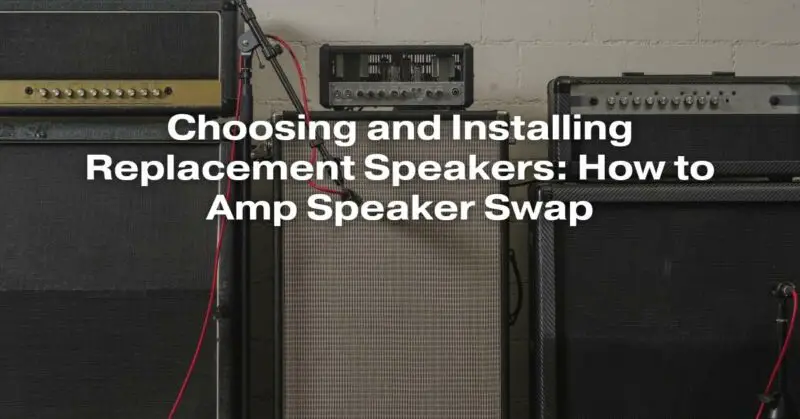
If you’re an audio enthusiast or simply looking to upgrade your car or home audio system, replacing your speakers can be a great way to achieve better sound quality. However, the process of choosing and installing replacement speakers, often referred to as a “speaker swap,” can be quite daunting if you’re not familiar with the intricacies of audio equipment. In this comprehensive guide, we’ll walk you through the steps to choose the right replacement speakers and provide you with a detailed installation process. Get ready to amp up your audio experience!
Part 1: Choosing the Right Replacement Speakers
1. Determine Your Needs
Before diving into the world of replacement speakers, it’s crucial to determine what you want to achieve with the upgrade. Are you looking for better bass response, crisper highs, or a balanced sound? Understanding your audio preferences will help you select the appropriate speakers.
2. Know Your Speaker Types
There are several types of speakers to choose from, each with its own advantages and limitations:
- Coaxial (Full-Range) Speakers: These speakers combine multiple speaker elements into a single unit, typically with a tweeter for high frequencies and a woofer for mid and low frequencies. They are easy to install and provide a broad range of sound.
- Component Speakers: These systems separate the speaker elements, allowing for more precise sound customization. They typically consist of separate tweeters, woofers, and crossovers. Component speakers provide superior sound quality but require more complex installation.
- Subwoofers: Subwoofers are designed specifically for low-frequency reproduction (bass). If you want to enhance your system’s bass output, consider adding a subwoofer in addition to your main speakers.
3. Consider Speaker Size
Speaker size plays a significant role in determining the sound output. Larger speakers generally produce deeper bass, while smaller ones focus on mid and high frequencies. Check your vehicle or room’s compatibility to ensure the selected speaker size fits your available space.
4. Check Power Handling
Pay attention to the speaker’s power handling capabilities. This includes both RMS (continuous) power and peak power. Matching your speakers’ power handling with your amplifier’s capabilities is essential to avoid damaging your new speakers.
5. Sensitivity Rating
The sensitivity rating measures how effectively a speaker converts power into sound. Higher sensitivity speakers require less power to produce the same volume as lower sensitivity ones. Match your speakers’ sensitivity with your amplifier for optimal performance.
6. Review Speaker Materials
Speaker materials, such as cones (usually made of paper, polypropylene, or metal), affect sound quality and durability. Materials like polypropylene are common for their balance of affordability and performance. Premium speakers may feature materials like Kevlar or woven fibers for enhanced sound quality.
7. Brand and Reviews
Research speaker brands and read reviews from other users. Well-established brands often offer better reliability and customer support. However, don’t discount lesser-known brands if they have positive reviews and meet your requirements.
8. Budget
Set a budget for your speaker upgrade. While there are speakers available at various price points, it’s essential to balance your budget with your audio expectations.
Part 2: Installing Replacement Speakers
1. Gather Tools and Supplies
Before starting the installation process, ensure you have the necessary tools and supplies, including:
- Screwdrivers (Phillips and flat-head)
- Wire stripper and crimping tool
- Socket and ratchet set
- Wiring harness adapter (if needed)
- Crimp connectors and electrical tape
- Wire connectors and heat shrink tubing
- Mounting brackets (if required)
- Panel removal tools (for cars)
2. Safety First
Disconnect the car’s battery if you’re working on a vehicle to avoid any electrical mishaps. If you’re working on a home audio system, unplug it from the power source.
3. Remove the Old Speakers
For car audio:
- Use panel removal tools to access the speaker locations.
- Unscrew and remove the old speakers.
- Disconnect the wiring harness from the speakers.
For home audio:
- Unscrew or unclip the old speakers from their mounts.
- Carefully disconnect the speaker wires.
4. Prepare the New Speakers
- If your new speakers have different connectors than the old ones, use crimp connectors or soldering to adapt the wiring.
- Ensure that the new speakers fit in the existing mounting holes. Use brackets or adapters if necessary.
5. Connect the New Speakers
- Connect the speaker wires to the new speakers, ensuring proper polarity (positive to positive, negative to negative).
- Use crimp connectors and heat shrink tubing to secure the connections and prevent shorts.
6. Mount the New Speakers
- Secure the new speakers in place using screws or mounting brackets.
- For car audio, reattach any panels or trim you removed earlier.
7. Test the System
Before finalizing the installation, reconnect the car’s battery or plug in your home audio system and test the new speakers. Check for any distortion, imbalances, or unusual noises.
8. Fine-Tune Your Sound
Once you’re satisfied with the installation, fine-tune the sound settings on your amplifier or receiver to match your preferences. Adjust the balance, fade, and equalizer settings as needed.
Part 3: Troubleshooting and Maintenance
1. Troubleshooting
If you encounter issues such as distorted sound, no audio, or unbalanced sound, double-check your connections and wiring. Ensure that all wires are securely connected and that the speaker polarity is correct.
2. Regular Maintenance
To ensure the longevity of your replacement speakers, clean them periodically to remove dust and debris. Be gentle when cleaning speaker cones and tweeters to avoid damage.
Conclusion
Choosing and installing replacement speakers can significantly enhance your audio experience, whether in your car or home. By following the steps outlined in this guide and carefully selecting the right speakers for your needs, you can achieve the sound quality you desire. Remember to take your time during installation and troubleshoot any issues that may arise. With the right speakers and proper installation, you’ll be able to enjoy music, movies, and more with a newfound audio clarity and richness. So, go ahead and amp up your speaker swap adventure!