
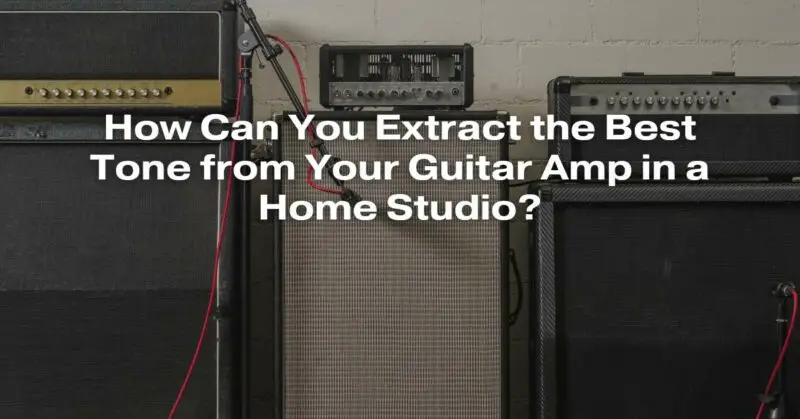
Creating great guitar tones is a fundamental aspect of music production, and it often starts with your guitar amp. Whether you’re a seasoned guitarist or a budding musician, understanding how to extract the best tone from your guitar amp in a home studio is crucial for achieving professional-quality recordings. In this comprehensive guide, we will explore the techniques and tips that will help you optimize your amp settings, mic placement, and post-processing to unlock the full potential of your guitar’s sonic capabilities.
- Choose the Right Amp
The first step in achieving the best tone from your guitar amp is selecting the right one for your needs. Different amps have unique tonal characteristics and are suitable for various musical genres. Consider factors such as:
a. Amplifier Type: Tube, solid-state, or modeling amps each have distinct tonal qualities. Tubes offer warm, organic tones, while solid-state amps are known for their reliability and clean sound. Modeling amps provide versatility by emulating various classic amp tones.
b. Wattage: The wattage of an amp impacts its volume and headroom. Higher wattage amps generally produce cleaner tones at higher volumes, while lower wattage amps can saturate earlier, delivering a natural overdrive.
c. Speaker Configuration: The type and number of speakers in your amp cabinet can significantly affect your tone. Experiment with different speaker sizes and configurations to find what suits your sound best.
- Amp Settings
Once you’ve selected the right amp, it’s essential to understand how to optimize its settings:
a. Gain: The gain control adjusts the amount of overdrive or distortion. Start with a low gain setting and gradually increase it until you achieve the desired level of saturation without excessive noise.
b. EQ Controls: Tweak the bass, midrange, and treble controls to shape your tone. A common starting point is to set them all to 12 o’clock and make subtle adjustments from there.
c. Presence and Reverb: These controls add dimension to your tone. Presence can affect the sharpness and brightness, while reverb creates a sense of space. Use these settings to enhance your sound’s character.
d. Master Volume: Adjust the master volume to control the overall loudness of the amp. Keep it at a reasonable level for recording to prevent distortion and maintain clarity.
- Mic Placement
Capturing the perfect guitar amp tone also relies heavily on microphone placement:
a. Microphone Choice: Dynamic microphones like the Shure SM57 are popular for close-miking guitar amps due to their durability and ability to handle high sound pressure levels. Experiment with different microphones to find the one that complements your amp’s character.
b. Positioning: Start with the microphone placed near the center of the speaker cone for a bright, focused sound. Move it around to find the sweet spot that suits your desired tone. Closer to the center produces a brighter sound, while moving toward the edge can yield a warmer tone.
c. Distance: Adjust the distance between the microphone and the amp to control the amount of room ambience in your recording. Closer miking captures more direct sound, while pulling the mic away adds natural reverb and room characteristics.
- Post-Processing
Once you’ve captured the amp’s tone, it’s time for post-processing:
a. Equalization: Use EQ plugins to fine-tune your guitar tone. You can remove unwanted frequencies, boost specific ranges, or shape your sound to fit within the mix.
b. Compression: Apply light compression to even out the dynamics and add sustain to your guitar sound. Be cautious not to overcompress, as it can squash the natural dynamics.
c. Effects: Consider adding effects such as delay, reverb, or modulation to enhance your guitar’s character. These can be applied during recording or in the mixing phase.
d. Double-Tracking: To create a fuller guitar sound, record multiple takes and pan them left and right in the mix. This technique, known as double-tracking, can add depth and width to your recordings.
Conclusion
Achieving the best tone from your guitar amp in a home studio requires a combination of equipment, technique, and creative experimentation. Selecting the right amp, optimizing its settings, mic placement, and post-processing are all crucial steps in the journey to crafting your signature guitar sound. Remember that there are no strict rules, and the ultimate tone is a matter of personal preference. Embrace the process of discovery, and with time and practice, you’ll unlock the full potential of your guitar’s sonic capabilities, allowing your music to shine in your home studio recordings.