
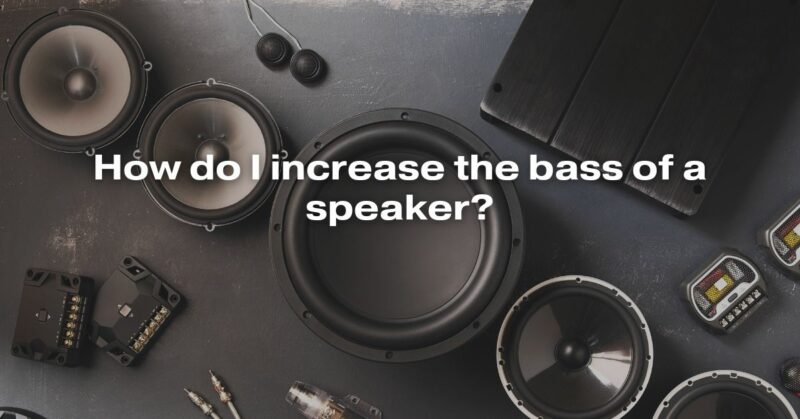
Enhancing the bass of your speakers can significantly elevate your audio listening experience, whether you’re an audiophile, a music enthusiast, or just looking to improve the sound quality of your home entertainment system. While it might seem like a complex task, increasing the bass of a speaker is a manageable endeavor with the right knowledge and tools. In this comprehensive guide, we will explore various methods and techniques to help you achieve that rich, booming bass you desire.
Understanding Bass Frequencies
Before diving into the methods for boosting bass, it’s essential to understand what bass frequencies are and why they matter. Bass frequencies typically refer to the low-frequency sounds in the audio spectrum, typically ranging from 20 Hz to 250 Hz. These frequencies are responsible for the deep, rumbling, and thumping sounds you hear in music and movies. Properly enhancing the bass can add depth and power to your audio experience.
- Choose the Right Speakers
The foundation of good bass begins with selecting the right speakers. Some speakers are naturally better at producing deep bass tones due to their design and specifications. Look for speakers with larger woofers (the speakers responsible for low frequencies) and a frequency response that includes lower frequencies. Subwoofers are specifically designed for bass and can be added to your system to enhance low-frequency performance.
- Positioning Matters
Proper speaker placement can significantly impact bass output. Placing speakers near walls or in corners can result in bass reinforcement as sound waves bounce off these surfaces. Experiment with speaker placement to find the optimal position for the best bass response in your room.
- Use Equalization (EQ)
Most audio systems come with built-in equalization controls or graphic equalizers that allow you to adjust the bass and treble levels. Experiment with these settings to boost the bass frequencies. Increase the bass while maintaining clarity in the rest of the audio spectrum. Be cautious not to overdo it, as excessive bass can lead to distortion.
- Add a Subwoofer
If your speakers lack sufficient bass capability, consider adding a subwoofer to your setup. Subwoofers are designed to reproduce low frequencies accurately and can significantly enhance the bass in your audio. They can be placed strategically in your room to maximize bass response.
- Use Bass-Boosting Apps or Software
Several software applications and audio enhancement tools can help increase the bass output of your speakers. These programs allow you to fine-tune your audio settings, applying bass boosts and adjustments to your liking. Popular options include Equalizer APO, Boom 3D, and Voicemeeter.
- Speaker Enclosures and Ports
Understanding the type of speaker enclosure and port design can also impact bass. Sealed enclosures tend to provide tighter and more controlled bass, while ported enclosures can deliver louder and deeper bass. Select a speaker or enclosure type that aligns with your bass preferences.
- Consider Bass-Boosting Accessories
There are various accessories available designed to enhance bass output. Bass traps, acoustic panels, and bass shakers can be strategically placed in your listening space to improve bass response. These accessories can help eliminate unwanted vibrations and echoes, allowing for a cleaner and more pronounced bass.
- Upgrade Your Audio Source
The quality of your audio source matters. Ensure that you are playing high-quality audio files or streaming from platforms that offer high-bitrate audio. A poor audio source can limit your ability to achieve a satisfying bass response.
- Professional Help
If you’re still unsatisfied with your speaker’s bass performance, consider seeking professional assistance. Acoustic engineers and audio experts can analyze your room’s acoustics and recommend speaker placement, room treatment, and equipment upgrades tailored to your specific needs.
Conclusion
Enhancing the bass of your speakers is a rewarding endeavor that can greatly improve your audio listening experience. By understanding the principles of bass frequencies and employing various techniques such as speaker selection, positioning, equalization, and the addition of subwoofers or accessories, you can achieve a deep, powerful bass that complements your favorite music and movies. Experiment with different methods to find the right balance and enjoy the full spectrum of sound that your speakers can offer.