
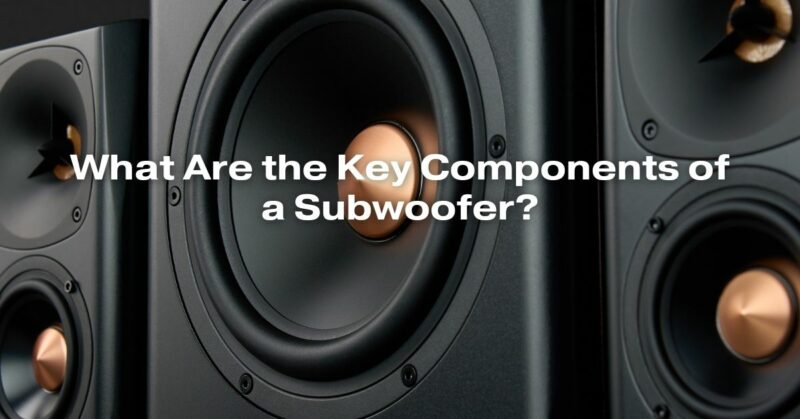
Subwoofers are an essential part of any home theater system, providing the deep bass that can bring movies and music to life. But what exactly goes into a subwoofer, and how do all the different components work together to produce such powerful sound?
Woofer
The woofer, also known as the driver, is the main speaker component of a subwoofer. It’s responsible for converting electrical signals from the amplifier into sound waves. Woofers are typically made up of a cone, surround, spider, and voice coil.
- Cone: The cone is the visible part of the woofer and is what vibrates to produce sound waves. Cones can be made from a variety of materials, including paper, polypropylene, and carbon fiber.
- Surround: The surround is the flexible ring that connects the cone to the basket. It allows the cone to move freely without distorting the sound.
- Spider: The spider is a suspension system that keeps the cone centered and prevents it from over-extending.
- Voice coil: The voice coil is a copper wire wrapped around a former. When an electrical current flows through the voice coil, it creates a magnetic field that interacts with the magnet to move the cone.
Cabinet
The cabinet houses all of the subwoofer’s components. It’s typically made of wood or MDF (Medium-Density Fiberboard) and is designed to be both rigid and acoustically inert. This means that the cabinet itself doesn’t resonate or produce any unwanted noise.
The type of cabinet design can have a significant impact on the sound of a subwoofer. The most common types of subwoofer cabinets are:
- Sealed cabinets: Sealed cabinets are airtight and produce a very tight, accurate bass response.
- Ported cabinets: Ported cabinets have a hole in the cabinet that allows air to move freely. This type of cabinet produces a louder, more powerful bass response, but it may not be as accurate as a sealed cabinet.
- Bandpass cabinets: Bandpass cabinets are a hybrid of sealed and ported cabinets. They have one or more chambers inside the cabinet that are tuned to specific frequencies. Bandpass cabinets can produce very loud and powerful bass, but they can also be very difficult to design and tune correctly.
Amplifier
The amplifier provides the electrical power that the woofer needs to produce sound. Subwoofer amplifiers are typically rated in watts RMS (Root Mean Square). The higher the wattage rating, the louder the subwoofer can play.
However, it’s important to note that wattage isn’t the only factor that determines a subwoofer’s performance. The quality of the amplifier and the way it’s matched to the woofer is also important.
Other components
In addition to the woofer, cabinet, and amplifier, subwoofers may also have a number of other components, such as:
- Crossover: A crossover is a filter that separates the high-frequency and low-frequency signals from the audio source. This allows the subwoofer to focus on reproducing the low-frequency bass notes.
- EQ: An EQ (Equalizer) allows you to adjust the frequency response of the subwoofer to match your room and your personal preferences.
- Phase control: A phase control allows you to adjust the timing of the subwoofer’s output relative to the other speakers in your system. This can help to improve bass response and soundstage.
Conclusion
Subwoofers are complex devices with a variety of different components. Understanding the different components and how they work together can help you to choose the right subwoofer for your needs and to get the best possible performance from it.