
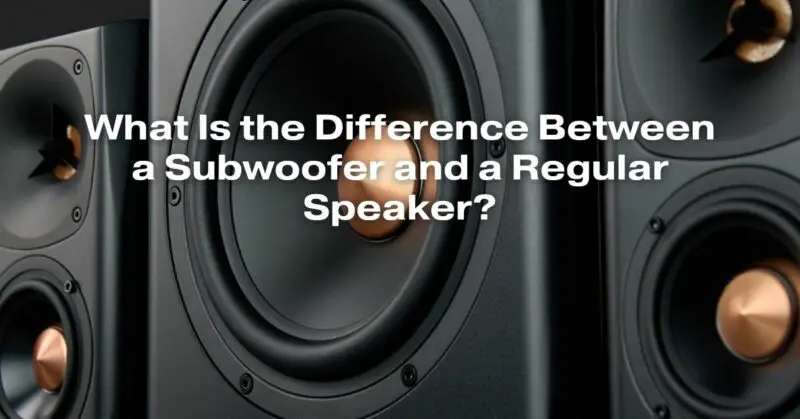
Speakers play a pivotal role in our audio experiences, whether we are listening to music, watching movies, or playing video games. However, not all speakers are created equal. Among the diverse range of speakers available, subwoofers and regular speakers serve distinct purposes in delivering sound. This article delves into the fundamental disparities between a subwoofer and a regular speaker, exploring their unique functions, designs, and applications.
I. Anatomy of Sound: How Speakers Work
Before delving into the differences between subwoofers and regular speakers, it is essential to understand the basic principles of speaker technology. Both types of speakers operate on the same fundamental concepts:
- Cone or Diaphragm: Speakers contain a diaphragm, commonly made of paper, plastic, or metal, which vibrates to produce sound waves.
- Voice Coil and Magnet: An electromagnetic coil, known as the voice coil, is attached to the diaphragm. When an electrical current passes through the voice coil, it interacts with a magnet, causing the diaphragm to move and produce sound.
II. Regular Speakers: The All-Purpose Audio Workhorses
Regular speakers, also known as full-range or loudspeakers, are designed to cover a broad range of audio frequencies. They typically consist of several components, including tweeters for high frequencies and woofers for mid-range frequencies. Regular speakers are versatile and can reproduce a wide spectrum of sounds, making them suitable for various audio applications, from music playback to dialogue in movies.
III. Subwoofers: Unraveling the Deep Bass Mystique
Subwoofers, on the other hand, are specialized speakers dedicated to reproducing low-frequency sounds, commonly referred to as bass. Unlike regular speakers, subwoofers focus on frequencies below 200 Hz, capturing the deep, rumbling tones that add richness and depth to audio content. Subwoofers are pivotal in enhancing the auditory experience, especially in home theaters and music systems where powerful, room-filling bass is desired.
IV. Key Differences: Subwoofer vs. Regular Speaker
- Frequency Range: The most significant difference lies in the frequency range each speaker is designed to handle. Regular speakers cover a broad range of frequencies, including highs, mids, and some lows, whereas subwoofers specialize in reproducing deep bass frequencies.
- Size and Enclosure: Subwoofers are typically larger than regular speakers due to the need for larger drivers to move air for low-frequency reproduction. They often come in larger enclosures, allowing them to produce the necessary bass response. Regular speakers, being more compact, are suitable for mid and high frequencies.
- Amplification: Subwoofers often require a separate amplifier, known as a subwoofer amplifier, to power the low-frequency drivers efficiently. Regular speakers can be powered directly by the audio source or an external amplifier, depending on their size and power requirements.
- Applications: Subwoofers are commonly used in home theaters, car audio systems, and professional audio setups where deep, powerful bass is crucial. Regular speakers find applications in various settings, including stereo systems, surround sound setups, and public address systems.
Conclusion
In essence, the difference between a subwoofer and a regular speaker lies in their specialized functions within the realm of audio reproduction. Regular speakers are versatile, handling a wide range of frequencies, while subwoofers excel at delivering the low-frequency nuances that add intensity and realism to our auditory experiences. Understanding these distinctions is essential for designing audio setups tailored to specific needs, ensuring that listeners can enjoy a well-balanced and immersive sound experience in any context.