
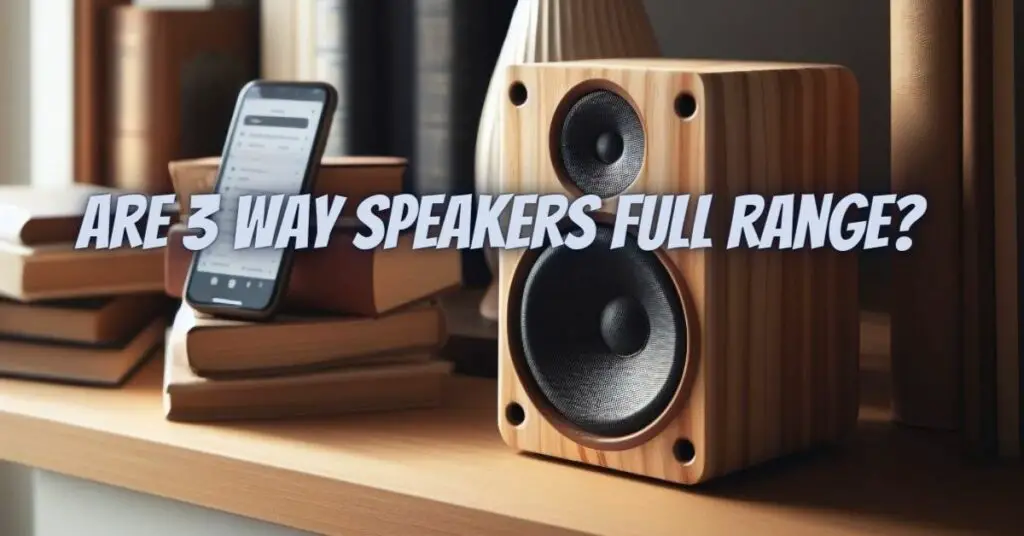
The world of audio equipment can be a complex realm, filled with various speaker configurations and terminologies. Among these, 3-way speakers often generate curiosity, especially regarding their ability to produce full-range sound. In this article, we will explore what “full range” means in the context of speaker systems and whether 3-way speakers can indeed be considered full range.
Understanding Speaker Configurations
Before we dive into the concept of full-range speakers, let’s briefly review the fundamental elements of 3-way speakers:
- 3-Way Speakers:
- A 3-way speaker system consists of three main components: a woofer, a midrange driver, and a tweeter.
- The woofer is responsible for reproducing low-frequency sounds (bass), the midrange driver covers the mid-frequency range, and the tweeter handles high-frequency sounds (treble).
- The idea behind 3-way speakers is to provide a more comprehensive sound coverage across the entire audible frequency spectrum.
What Does “Full Range” Mean?
In the context of speakers, “full range” refers to a speaker system’s ability to reproduce sound across the entire audible frequency spectrum, which typically ranges from about 20 Hz (the lower limit of human hearing) to 20,000 Hz (the upper limit of human hearing). A full-range speaker is capable of reproducing bass, midrange, and treble frequencies without significant distortion or drop-offs in any part of this spectrum.
Are 3-Way Speakers Full Range?
3-way speakers are often considered more capable of reproducing a broader range of frequencies compared to 2-way speakers due to the inclusion of a midrange driver. However, whether a 3-way speaker is truly full range depends on several factors:
- Driver Capabilities:
- The effectiveness of a 3-way speaker in covering the full audible frequency spectrum depends on the capabilities of its individual drivers (woofer, midrange, and tweeter).
- High-quality, well-designed drivers with extended frequency responses are more likely to make a 3-way speaker approach full-range performance.
- Crossover Design:
- The crossover network in a 3-way speaker plays a crucial role in directing the appropriate frequencies to each driver. A well-designed crossover ensures a seamless transition between the woofer, midrange, and tweeter, minimizing frequency gaps or overlaps.
- Room Acoustics:
- The acoustic characteristics of the listening environment can impact how a 3-way speaker performs. Room size, layout, and materials can affect bass response and the overall perception of full-range sound.
- Speaker Design and Brand:
- Different brands and speaker designs can vary significantly in their ability to deliver full-range sound. It’s essential to consider the reputation and specifications of the specific 3-way speaker you’re interested in.
In conclusion, 3-way speakers have the potential to provide a more comprehensive sound coverage across the audible frequency spectrum compared to 2-way speakers, thanks to their additional midrange driver. However, whether a 3-way speaker is truly full range depends on various factors, including the capabilities of its drivers, the quality of its crossover design, room acoustics, and the specific speaker brand and model.
When shopping for speakers, it’s crucial to review the specifications and performance characteristics of the particular 3-way speaker you’re considering. This will help you determine whether it meets your expectations for full-range sound reproduction and whether it aligns with your audio needs and preferences. Ultimately, the term “full range” is a benchmark for audiophiles and audio enthusiasts to seek in their quest for high-quality sound reproduction.