
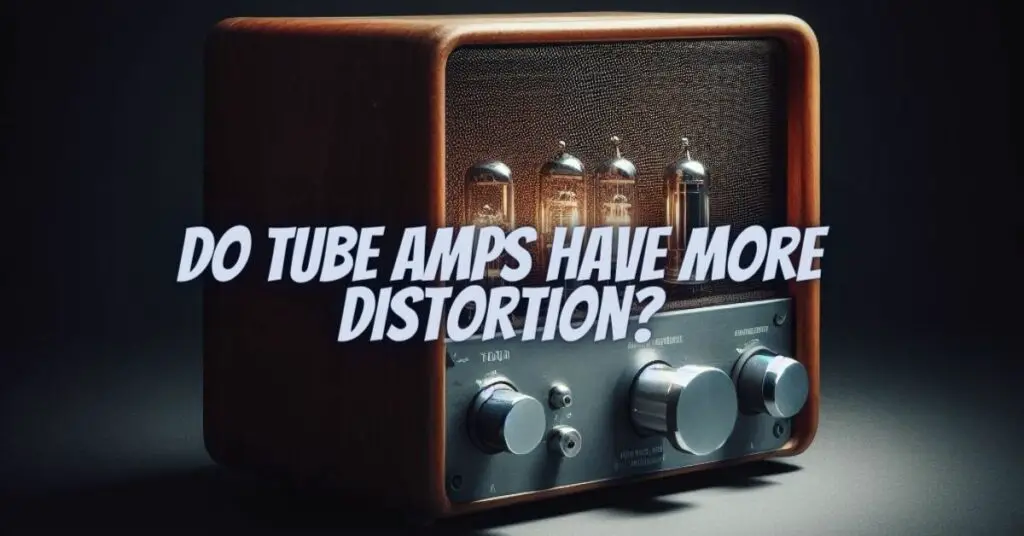
Tube amplifiers, also known as tube amps, have a timeless appeal in the world of music and audio. Renowned for their warm and harmonically rich sound, they occupy a special place in the hearts of musicians and audiophiles. A common perception is that tube amps inherently produce more distortion than solid-state counterparts. In this article, we will explore the intricacies of distortion in tube amplifiers, dispelling myths and understanding how it contributes to their unique sound.
I. Distortion in Amplification
Before delving into tube amplifiers, it’s crucial to grasp the concept of distortion in audio amplification:
- Distortion Types: Distortion refers to the alteration of an audio signal from its original form. There are various types of distortion, including harmonic distortion, intermodulation distortion, and transient distortion. Each type has distinct characteristics and can manifest differently in amplifiers.
- Desirable and Undesirable: While excessive or unwanted distortion is undesirable, a controlled amount of distortion can be musically pleasing. This is particularly true in electric guitars, where distortion is often used to create expressive and tonally rich sounds.
II. Harmonic Distortion in Tube Amplifiers
One of the defining characteristics of tube amplifiers is harmonic distortion. Unlike solid-state amplifiers, which aim for linearity and low distortion, tube amplifiers embrace distortion as a crucial element of their character. Harmonic distortion is integral to their sound, and here’s why:
- Even-Order Harmonics: Tube amplifiers predominantly produce even-order harmonics when distortion occurs. These harmonics are considered “musical” and contribute to the warm, rich, and harmonically pleasing sound associated with tube amplifiers.
- Tonal Warmth: The introduction of harmonic distortion is responsible for the tonal warmth of tube amplifiers. This warmth is particularly appealing for certain musical genres, including jazz, blues, and classic rock.
- Overdrive Characteristics: Tube amplifiers provide a natural overdrive when pushed beyond their clean capacity. This overdrive quality is gradual, smooth, and often described as “singing.” It is highly valued by guitarists for its musicality and expressive capabilities.
III. Distortion in Solid-State Amplifiers
In contrast to tube amplifiers, solid-state amplifiers strive for minimal distortion. They are designed to produce a clean and linear amplification of the input signal, reducing the introduction of harmonic distortion.
- Harmonic Characteristics: Solid-state amplifiers primarily produce odd-order harmonics when distortion occurs. These harmonics are less musically consonant than even-order harmonics and can create a sharper, more abrasive sound when compared to tube amplifiers.
- Transistor Saturation: Transistor-based solid-state amplifiers can introduce distortion when the transistors reach their saturation points. This type of distortion is often less forgiving and can lead to harsh, unpleasing tones when pushed too hard.
IV. Distortion Control in Tube Amps
The amount of distortion in a tube amplifier can be controlled by factors such as:
- Input Signal Level: The level of distortion is directly proportional to the input signal level. Musicians can manipulate distortion by adjusting their playing dynamics.
- Amplifier Gain and Volume: Adjusting the gain and volume controls on a tube amplifier allows users to dial in the desired amount of distortion.
V. Distortion Perception
The perception of whether tube amps have “more” distortion is subjective and context-dependent. For many musicians, the distortion produced by tube amplifiers is musically desirable and adds expressive depth to their performances. In contrast, solid-state amplifiers are often favored for their cleaner, more linear amplification.
Tube amplifiers are celebrated for their harmonic distortion, which adds warmth, richness, and tonal character to their sound. While the perception that tube amps have “more” distortion than solid-state amps is valid, it’s important to recognize that distortion in itself isn’t inherently negative. Instead, it’s a tool for musicians to shape their sound, evoke emotion, and create captivating tones. Whether one prefers the harmonic-rich distortion of tube amplifiers or the cleaner sound of solid-state technology, both have their place in the world of music, contributing to the diverse and expressive landscape of audio amplification.