
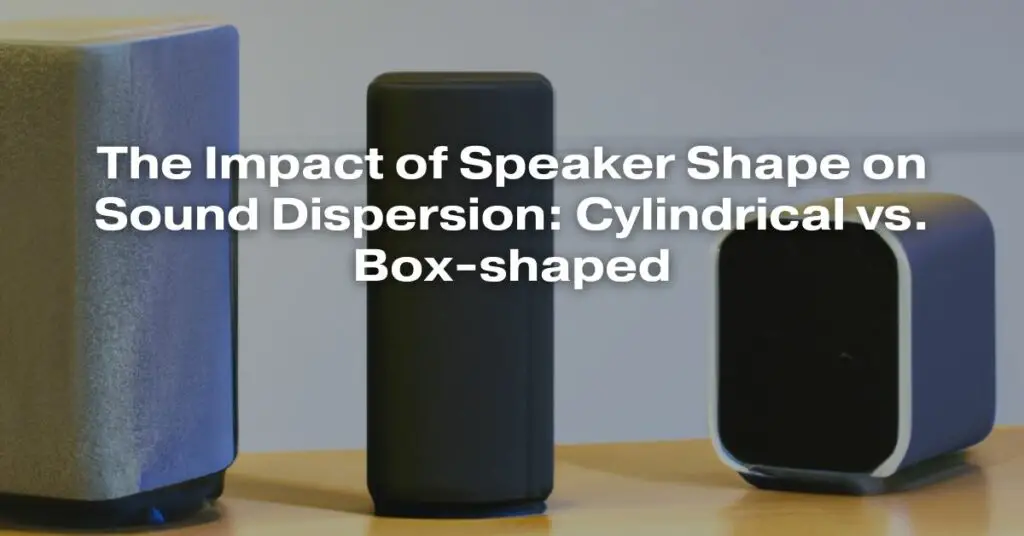
In the world of audio, the shape of a speaker enclosure plays a crucial role in determining how sound waves are dispersed throughout a listening environment. Two common speaker shapes, cylindrical and box-shaped, exhibit distinct sound dispersion characteristics, influencing the overall listening experience. This article delves into the intricacies of sound dispersion and explores the impact of speaker shape on the distribution of sound waves.
Sound Dispersion: A Fundamental Concept
Sound dispersion refers to the manner in which sound waves radiate from a source, spreading out and interacting with the surrounding environment. The dispersion pattern is influenced by various factors, including the frequency of the sound waves, the characteristics of the source, and the presence of obstacles or reflective surfaces.
Cylindrical Speakers: Smooth and Even Dispersion
Cylindrical speakers, often seen in column-style designs, are known for their smooth and even dispersion of sound waves. This is due to the symmetrical shape of the enclosure, which allows sound waves to radiate uniformly in all directions. As a result, cylindrical speakers are well-suited for environments where consistent sound coverage is desired, such as large rooms or open spaces.
Box-shaped Speakers: Directional Dispersion and Controlled Sound
Box-shaped speakers, commonly found in bookshelf or floor-standing designs, exhibit a more directional dispersion pattern. This means that sound waves are projected more strongly in certain directions, typically towards the front of the speaker. This characteristic makes box-shaped speakers ideal for environments where focused listening is preferred, such as home theaters or dedicated listening rooms.
Comparing the Dispersion Characteristics
Cylindrical speakers excel in providing a wide and even soundstage, enveloping the listener with a consistent auditory experience. They are less prone to creating “hot spots” or areas of concentrated sound, making them suitable for casual listening or background music.
Box-shaped speakers, on the other hand, offer a more controlled and directional sound, ideal for critical listening or situations where precise sound placement is desired. They can create a more immersive experience for movies or music, particularly when positioned correctly within the listening environment.
Applications and Considerations
The choice between cylindrical and box-shaped speakers depends on the specific listening environment and desired audio experience. For large rooms or open spaces where consistent sound coverage is essential, cylindrical speakers are often preferred. In contrast, box-shaped speakers are better suited for focused listening environments, such as home theaters or dedicated listening rooms.
It is important to consider the size and shape of the listening space when selecting speaker shapes. Cylindrical speakers may be less effective in smaller rooms due to their wider dispersion pattern, potentially creating unwanted reflections or standing waves. Conversely, box-shaped speakers may not provide adequate sound coverage in larger spaces, leaving some areas with diminished sound quality.
Conclusion
The shape of a speaker enclosure plays a significant role in determining the dispersion of sound waves, influencing the overall listening experience. Cylindrical speakers offer smooth and even dispersion, while box-shaped speakers provide more directional and controlled sound. The choice between the two depends on the specific listening environment and desired audio experience. Understanding the impact of speaker shape on sound dispersion empowers audiophiles to make informed decisions when selecting speakers for their unique listening needs.