
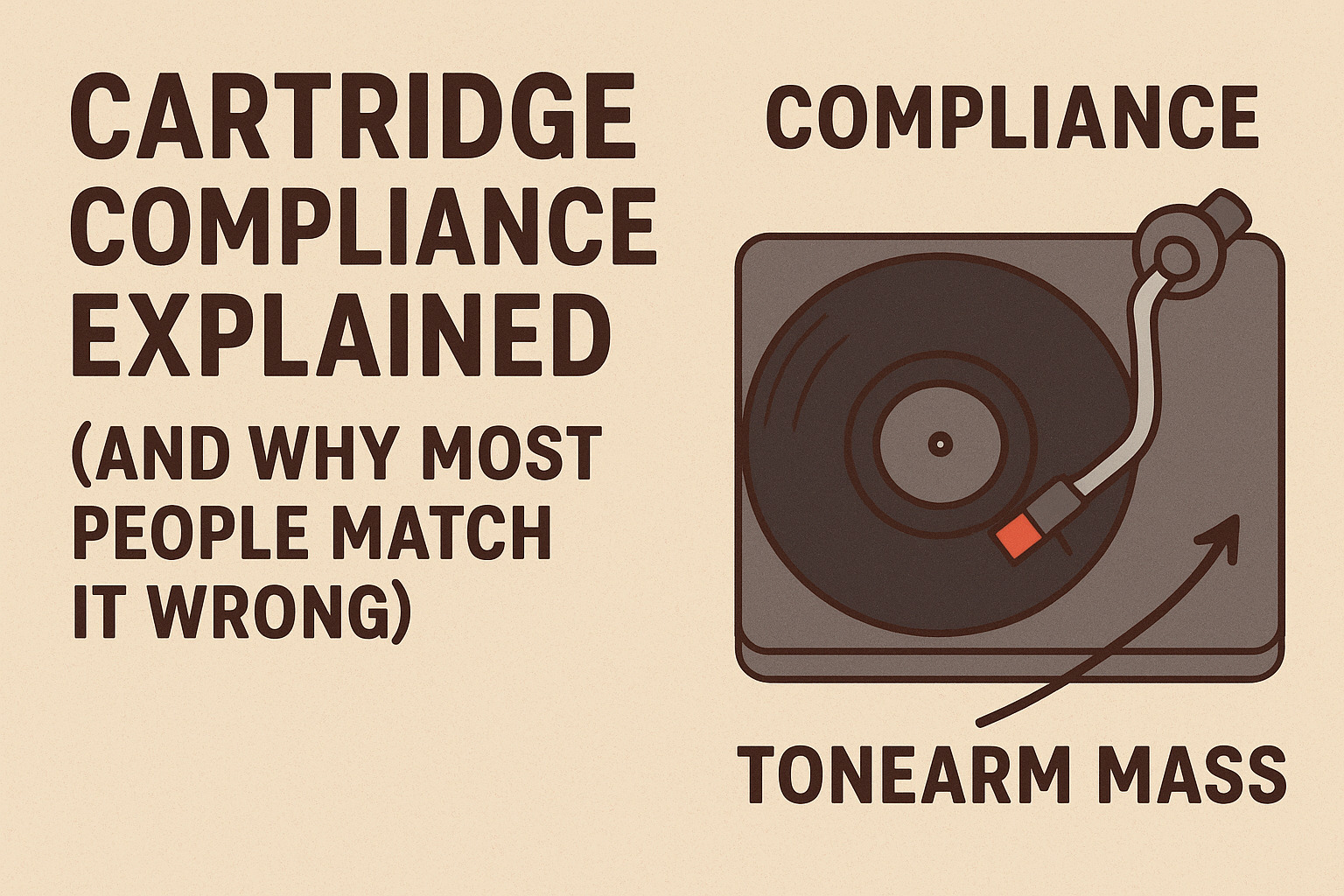
If you’ve spent any time in vinyl forums, you’ve probably seen the term cartridge compliance thrown around—usually followed by confusion, conflicting advice, or someone insisting that a particular cartridge “won’t match your tonearm.”
And the truth is:
Most people match compliance incorrectly — or don’t understand it at all.
Yet cartridge compliance is one of the most important factors in achieving clean, distortion-free playback and protecting your records from unnecessary wear. Once you understand how it works, choosing the right cartridge becomes much easier.
This guide breaks it all down in simple terms:
- What compliance really means
- How it interacts with tonearm mass
- Why matching it wrong causes problems
- And how to get it right every time
What Is Cartridge Compliance? (The Simple Answer)
Cartridge compliance is a measurement of how stiff or flexible the stylus suspension is.
Think of compliance as “springiness”:
- High-compliance = soft, flexible suspension
- Low-compliance = stiff, firm suspension
This springiness affects how the stylus reacts to bumps, grooves, and resonance when the record plays.
Tonearm Mass vs. Cartridge Compliance: The Real Relationship
A tonearm works like a seesaw:
The heavier the arm, the more force it applies to the cartridge during movement.
So the rule is simple:
🔸 Heavy tonearm = works better with low-compliance (stiff) cartridges
🔸 Light tonearm = works better with high-compliance (soft) cartridges
If you mismatch these, the system becomes unstable — either too wobbly or too stiff — causing tracking issues.
Why Getting It Wrong Causes Problems
When compliance and tonearm mass are mismatched, it creates a bad resonance frequency.
The ideal resonance frequency is:
#️⃣ 8 to 12 Hz
When matched incorrectly, you get:
Too Low (Below 8 Hz)
Happens when stiff/low-compliance cartridges are used on lightweight tonearms.
Problems:
- Bass distortion
- Rumble amplified
- The stylus may skip on warped records
Too High (Above 12 Hz)
Happens when flexible/high-compliance cartridges are used on heavy tonearms.
Problems:
- Harsh treble
- Inner groove distortion
- Loss of detail
- Stylus overreacts to small groove changes
Most turntable owners unintentionally fall into one of these traps.
Why Most People Match Compliance Wrong
1. They don’t know their tonearm’s effective mass
Many manufacturers don’t list it clearly. Without that number, matching is almost impossible.
2. They confuse dynamic vs static compliance
Japan often measures at 100 Hz; Western brands measure at 10 Hz.
These numbers cannot be compared directly without conversion.
3. They assume “any cartridge works on any turntable”
Not true — the tonearm and cartridge are one system.
4. They buy cartridges based on hype, not compatibility
A great cartridge can sound terrible if mismatched.
How to Match Your Cartridge Correctly
Here’s the quick formula most audiophiles use:
1. Find your tonearm’s effective mass
(Light: under 10g | Medium: 10–20g | Heavy: 20g+)
2. Get the compliance rating for the cartridge
Preferably at 10 Hz.
If the manufacturer uses 100 Hz, multiply by 1.5–2 to approximate.
3. Use a resonance calculator
Enter:
- Tonearm mass
- Cartridge weight
- Compliance
You want a result between 8–12 Hz.
If you want, I can calculate this for your exact turntable & cartridge — just tell me the model.
Typical Real-World Matches (Easy Reference)
Light Tonearms (modern Pro-Ject, Rega, U-Turn)
Best with high-compliance cartridges, such as:
- Ortofon OM series
- Audio-Technica VM95 (medium compliance sweet spot)
- Goldring 1000 series
Medium Tonearms (Technics SL-1200 series, vintage Japanese)
Best with medium-compliance cartridges:
- AT VM95 / VM540
- Nagaoka MP-110, MP-150
- Ortofon 2M series
Heavy Tonearms (older broadcast arms, DJ arms)
Best with low-compliance cartridges:
- Denon DL-103
- Ortofon SPU
- Some MC cartridges
How to Tell If Your Resonance Is Wrong (Without Measuring)
You’ll notice symptoms:
❌ If too low:
- Cartridge “pumps” visibly
- Bass sounds muddy
- Skips on footfalls or warped records
❌ If too high:
- Harsh, bright treble
- Sibilance
- Inner groove distortion
If you’ve had these problems, compliance mismatch may be the cause.
Final Thoughts: Compliance Isn’t Complicated — It’s Just Misunderstood
Once you understand how cartridge compliance and tonearm mass work together, matching becomes easy — and suddenly your system sounds better, cleaner, and smoother.
The best part?
You don’t need to buy new gear.
Just choosing a properly matched cartridge can transform your sound.