
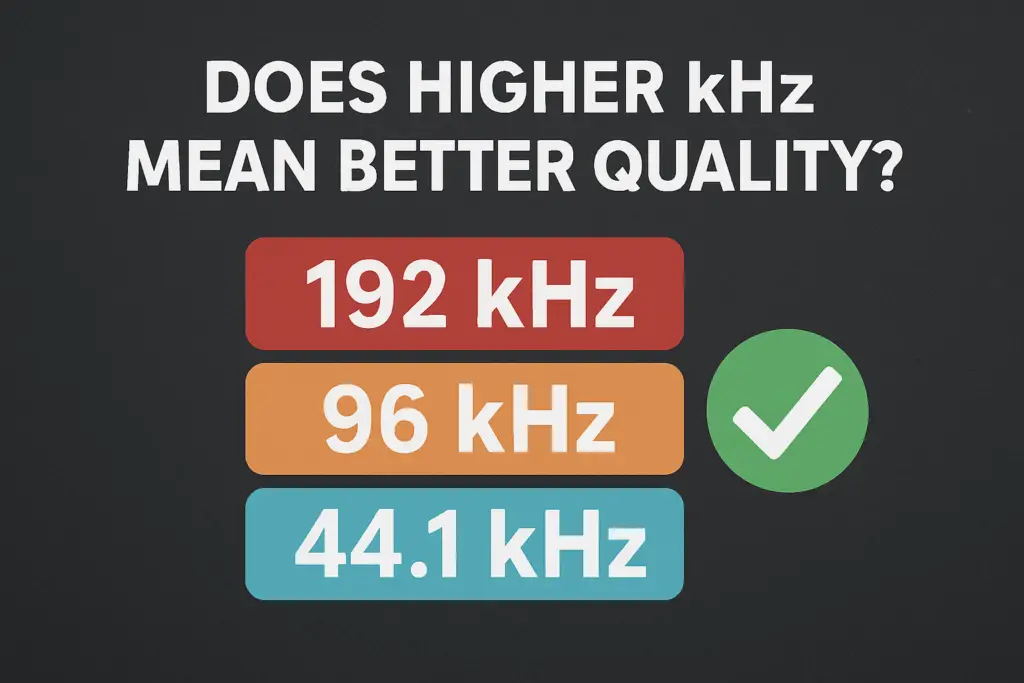
In the world of digital audio, you’ll often see sample rates measured in kilohertz (kHz). Numbers like 44.1 kHz, 48 kHz, 96 kHz, and 192 kHz are commonly used in streaming platforms, DAC specifications, and high-resolution downloads.
But there’s a question nearly every audiophile eventually asks:
Does higher kHz actually mean better sound quality?
The short answer is: Not always.
The long answer is far more interesting—and crucial for understanding what truly affects audio fidelity.
What Does kHz Mean in Audio?
The kHz value refers to the sample rate, or how many “snapshots” of an audio waveform are taken every second.
- 44.1 kHz = 44,100 samples per second
- 96 kHz = 96,000 samples per second
According to the Nyquist theorem, the highest frequency that can be accurately captured is half the sample rate.
So, a 44.1 kHz recording can reproduce up to 22.05 kHz—slightly above human hearing.
This means that anything above 44.1 kHz captures information we cannot hear directly.
Does Increasing kHz Improve Audio Quality?
1. For Human Hearing: No
Humans typically hear from 20 Hz to 20 kHz at most—often less as we age.
So increasing sample rate above 44.1 kHz does not add audible frequencies you can perceive.
2. For Digital Processing: Sometimes
Higher sample rates can improve:
- Transient accuracy
- DSP performance (EQ, crossovers, room correction)
- Plugin behavior in production software
- Anti-aliasing and filtering in DACs
A DAC, for example, may apply gentler digital filters at 96 kHz or 192 kHz, potentially reducing distortion.
3. For File Size and Efficiency: Higher kHz Is Worse
Going from 44.1 kHz to 96 kHz or 192 kHz:
- Increases file size massively
- Uses more CPU/RAM
- Doesn’t guarantee audible improvements
High kHz isn’t automatically “better”—it’s simply different.
When Higher kHz Can Sound Better
Higher sample rates may provide benefits when:
- You apply EQ or advanced DSP
- Your DAC is optimized for 48k/96k/192k
- You use upsampling software like HQPlayer or Roon
- You’re recording or mixing music professionally
In these cases, 96 kHz often produces cleaner, more transparent results because it reduces aliasing and gives digital filters more room to work.
When Higher kHz Makes No Difference
You will not hear an improvement if:
- You’re listening to music originally recorded at 44.1 kHz
- You are not using DSP
- Your headphones and speakers can’t resolve tiny micro-details
- You’re using typical consumer playback gear
A poorly mastered 192 kHz track will always sound worse than a beautifully mastered 44.1 kHz album.
The Most Important Factor Isn’t kHz—It’s Mastering
Higher sample rates don’t guarantee better quality.
The far more influential factors are:
- The mixing and mastering quality
- The original recording
- Your DAC and amp performance
- Your speakers, headphones, and room
- Noise floor and distortion characteristics
Great mastering at 44.1 kHz beats bad mastering at 192 kHz every time.
So… Does Higher kHz Mean Better Quality?
For audible frequency range:
❌ No. The human ear can’t hear the extra ultrasonic information.
For DSP, filters, and production tools:
✔️ Yes, sometimes. Higher kHz improves digital processing accuracy.
For everyday music listening:
❌ Not necessarily. 44.1 kHz is already transparent for human hearing.
For high-end audiophile chains with DSP:
✔️ Often. 96 kHz can reduce distortion and improve clarity.
Final Verdict
| Purpose | Best Sample Rate |
|---|---|
| Music listening (no DSP) | 44.1 kHz |
| Movies / gaming | 48 kHz |
| DSP & sophisticated upsampling | 96 kHz |
| Audio mixing, production, archiving | 96–192 kHz |
Higher kHz doesn’t automatically mean better audio quality.
It only helps when your processing chain and equipment can take advantage of it.